Smörgåsbord in Stockholm: where to find a real one
Stockholm: Swedish food tasting tour in Old Town restaurants
Duration: 2.5–5 hours
Where can I eat a genuine smörgåsbord in Stockholm?
The Grand Hôtel Veranda (750 SEK per person, with a seasonal pause; the 2026–27 break ends on 30 April 2027) is the most celebrated version — extensive, beautifully presented, worth the price. Ulla Winbladh on Djurgården is a historic inn that serves classic Swedish food and a Christmas buffet. Stallmästaregården near Haga Park is another traditional Swedish setting; check its website for current offerings. Avoid smörgåsbord menus at tourist restaurants in Gamla Stan — they are typically truncated versions at inflated prices.
What a real smörgåsbord is
The word smörgåsbord has been so thoroughly absorbed into English as a generic term for any buffet that its original specific meaning is almost lost. A Swedish smörgåsbord is not a random selection of dishes available simultaneously. It is a structured ritual of Swedish food culture with a specific sequence, specific dishes, and specific behaviour expectations.
| Where | Grand Hôtel Veranda, Ulla Winbladh, Stallmästaregården |
| Cost | 750 SEK per person at the Grand Hôtel, excluding drinks; other venues set their own prices |
| Time needed | 2–3 hours for the full sequence |
| Booking | Online at each venue; book ahead, especially for the December julbord |
| Best time | Check the Grand Hôtel’s seasonal pause; julbord season Nov–Dec |
The structure, simplified:
First course: cold fish. Herring (sill) in multiple preparations — pickled in mustard sauce, in tomato sauce, with dill, with onion — is always the opening. Gravlax (salt-cured salmon) and cold-smoked salmon appear alongside. Crispbread with butter is served with everything. This is where you spend more time than you expect: Swedish pickled herring in its best versions is genuinely interesting food, not just preserved fish.
Second course: cold dishes. Hard-boiled eggs, Gubbröra (egg and anchovy salad), Jansson’s Temptation (anchovy-potato gratin, served warm despite its cold course position), cold meats, Swedish cheeses, cucumber salad, beetroot preparations.
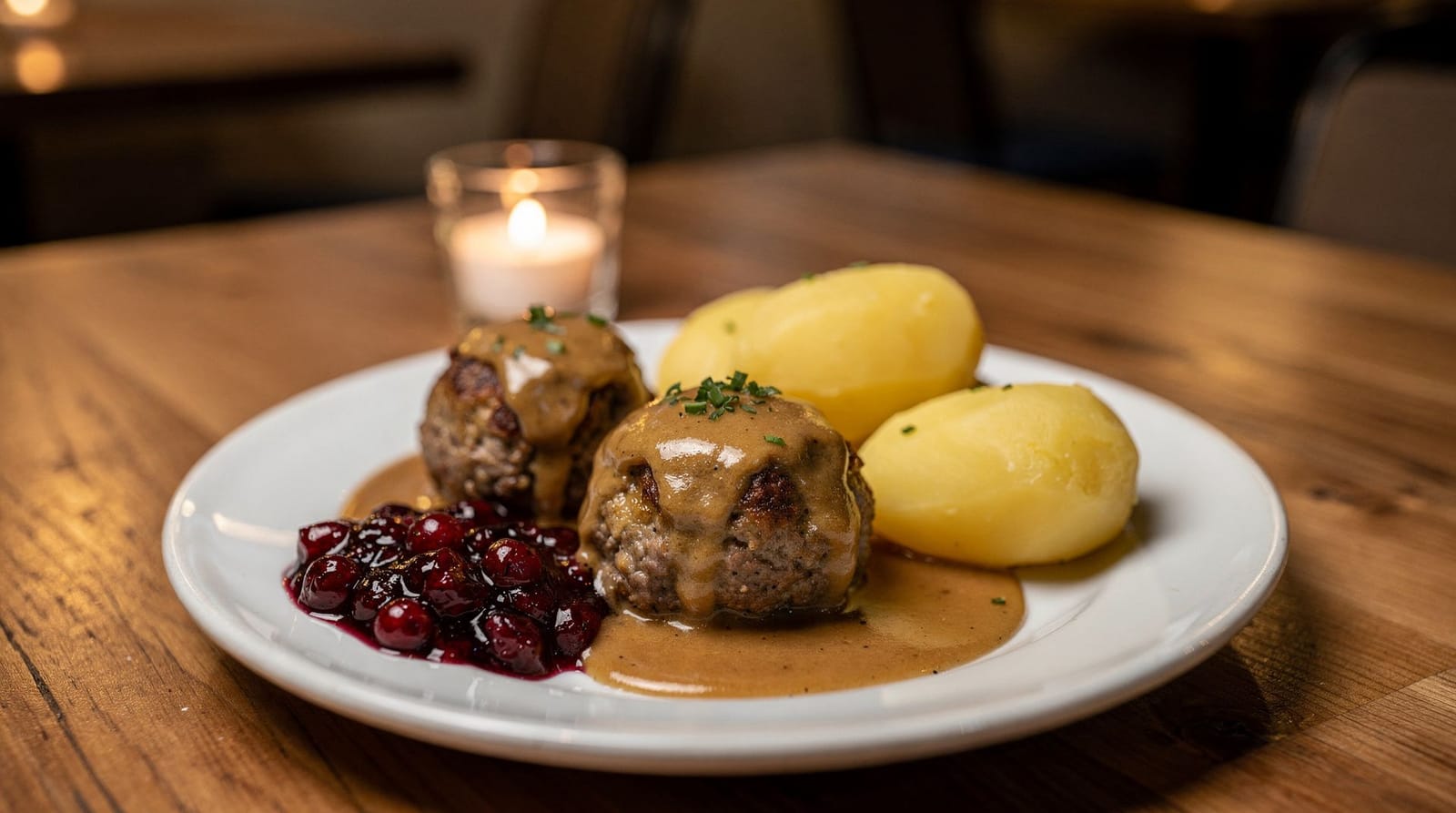
Third course: warm dishes. Köttbullar (meatballs), prinskorvar (small sausages), warm salmon, kassler (smoked pork), brown beans, braised red cabbage.
Fourth: dessert. Rice pudding (risgrynsgröt) with lingonberry jam, fruit preparations, traditional Swedish pastries.
The total duration for a proper smörgåsbord is two to three hours. Aquavit accompanies the herring course; beer follows; wine is increasingly common alongside.
Where to eat smörgåsbord in Stockholm
Grand Hôtel Veranda — the benchmark
Södra Blasieholmshamnen 8, Blasieholmen. The smörgåsbord pauses seasonally and returns on 30 April 2027; the Veranda’s website does not list the serving days, so check it or call before you plan.
The Grand Hôtel’s smörgåsbord is Stockholm’s finest version. The Veranda restaurant overlooks Strömmen with the Royal Palace visible across the water. The buffet is extensive — more herring preparations than most visitors have ever encountered in one place, gravlax cured in-house, warm dishes made with the same attention as the hotel’s regular restaurant, a dessert selection that includes both traditional Swedish options and contemporary pastry.
Price: 750 SEK per person (children aged 4–11: 375 SEK), according to the Veranda’s website. Book online in advance.
This is not everyday eating. It is a special occasion meal in one of Stockholm’s most beautiful dining rooms. Worth doing once for the combination of quality and setting.
Ulla Winbladh — Djurgården
Rosendalsvägen 8, Djurgården. Open daily: Monday 11:30–22:00, Tuesday to Friday 11:30–23:00, Saturday 12:00–23:00, Sunday 12:00–22:30 (the kitchen closes an hour before the restaurant).
Named after a figure from Carl Michael Bellman’s 18th-century Swedish songs (Bellman wrote frequently about Stockholm’s outdoor life and pleasure gardens on Djurgården), Ulla Winbladh is a historic inn that dates from 1897 and serves classic Swedish cooking on the Royal Djurgården.
The setting is charming and the food is honest Swedish cooking. The restaurant advertises a Christmas buffet in the weeks before Christmas (in 2026, 19 November to 23 December) and serves Swedish à la carte the rest of the time; check its website for any smörgåsbord dates. For other honest, non-touristy Djurgården-area food options, see the Södermalm food scene guide for the cross-water comparison, and Swedish fine dining if you want a formal alternative to the buffet format entirely.
Stallmästaregården — Haga
Norrtull, next to Haga Park (113 47 Stockholm, on the Solna side).
Stallmästaregården is a boutique hotel and restaurant near Haga Park, part of the Nobis Hospitality group, with an award-winning restaurant that emphasises organic and local ingredients. It is less central than Ulla Winbladh or the Grand Hôtel, so it suits a detour combined with a walk through Haga Park. The venue is building new spaces through 2026, and its website does not list smörgåsbord or julbord details, so check stallmastaregarden.se or call before you plan a meal around it.
Choosing between the three
The three places answer different needs. The Grand Hôtel is the formal, once-per-trip occasion, and it pauses seasonally, so it has to be planned around the restaurant’s calendar rather than the other way round. Ulla Winbladh is the easy choice if you are already spending the day on Djurgården: pair it with the Djurgården walking route or a morning at Skansen and let the meal be the long, slow centre of the day. Stallmästaregården suits travellers who want a quieter, more traditional room and don’t mind leaving the central core of the city.
If you are building a wider itinerary, a long seated lunch works best on a day with little else scheduled. The three-day first-timer itinerary and the Stockholm in 3 days overview both leave room for one unhurried meal, and a smörgåsbord is the right candidate. Treat it as the main event of the day, not as a quick stop between museums.
Aquavit and the herring ritual
Any smörgåsbord discussion requires addressing the schnapps component. Swedish pickled herring is traditionally eaten with aquavit (snaps in Swedish) rather than wine or beer. The ritual involves a toast — “Helan går” is the most famous toast song, or simply “Skål” — before downing the schnapps.
This is not obligatory. Many people eat smörgåsbord herring with just beer or mineral water. But if you are at a smörgåsbord with Swedish guests and they begin singing toast songs, participation is the appropriate response.
The Christmas version: julbord
The julbord is the most important version of the smörgåsbord in Swedish culture. It runs from late November (approximately the week after Sweden’s pre-Christmas period begins) through Christmas Eve, and Stockholm’s restaurants compete on the quality and extent of their Christmas tables.
Specific julbord dishes beyond the standard smörgåsbord:
Julskinka: Christmas ham, served in thick slices cold. The ham is cooked slowly and coated in a mustard-breadcrumb crust. This is the centrepiece of the Swedish Christmas table — large families coordinate who brings the ham to Christmas Eve dinner.
Dopp i grytan: Literally “dip in the pot” — bread dipped in the broth left from cooking the julskinka. A traditional first act of Christmas Eve dinner in some Swedish families.
Jansson’s frestelse (Jansson’s Temptation): The anchovy-potato gratin appears year-round but is central to the julbord, where it occupies its traditional warm-dish position.
Risgrynsgröt: Rice pudding with a hidden almond — the person who finds it is supposed to marry within the year. Served with cinnamon and sugar, or lingonberry jam.
Köttbullar med bruna bönor: Christmas meatballs with brown beans rather than the standard potato accompaniment.
Julbord reservations fill up in October and November. If you plan to eat at the Grand Hôtel (whose julbord runs from 27 November to 23 December in 2026) or elsewhere for the Christmas version, book early. If your December visit also takes in the Skansen Christmas market or the Gamla Stan Christmas market, a julbord makes a natural anchor for the evening — see the Stockholm Christmas markets complete guide for how to build a full festive day around it.
If you would rather learn the julbord dishes with a guide before sitting down to a full table, a walk through Stockholm’s Christmas traditions and seasonal treats introduces many of the flavours above in a lighter format. For comparing the markets themselves, the ranked Christmas markets blog post gives a candid view, and the Lucia day guide explains the other great December tradition that falls in the same weeks.
Planning your smörgåsbord day
A seated buffet of this length changes how you plan the rest of the day. Eat a light breakfast, because the point is to arrive hungry enough to enjoy the herring course properly, and avoid scheduling a demanding activity straight afterwards. A gentle walk is the natural way to finish: after the Grand Hôtel, the waterfront and the nearby Norrmalm streets are easy on a full stomach, and after Ulla Winbladh the paths of Djurgården do the same job.
Think about drinks before you book. Aquavit, beer and wine are all charged separately, so the final bill can be noticeably higher than the headline price per person. The Stockholm budget per day guide helps you decide where a splurge like this fits, and the Swish and payments guide is worth a read so you know how card payment works when the bill arrives.
Mention any dietary needs when you reserve. A traditional smörgåsbord leans heavily on fish, pork and dairy, and restaurants cope far better with allergies or restrictions when they know in advance rather than at the buffet. Vegetarian travellers should ask what is offered beyond the cold fish course before committing.
Finally, think about who is coming. The format suits groups well, because everyone can graze at their own pace and share impressions of the more unusual dishes. Children usually gravitate to the meatballs and the rice pudding, which makes the warm and dessert courses easy for families, even if the herring course is a harder sell.
How smörgåsbord compares to a food tour
If the two-to-three-hour, 750 SEK commitment of a full smörgåsbord doesn’t fit your schedule or budget, a guided Stockholm food tour covers many of the same core dishes — herring, meatballs, gravlax — in a shorter, cheaper format spread across several stops rather than one seated sitting. It won’t replicate the ritual and setting of the Grand Hôtel, but it’s a legitimate way to sample the flavours without the full commitment. For a broader sense of where locals actually eat meatballs day-to-day rather than at a formal buffet, see the Swedish meatballs guide.
Smörgåsbord etiquette
A few points that matter in the Swedish context:
Do not put everything on one plate. Multiple small plates are protocol. The buffet structure assumes you will make several trips.
Start with herring. Jumping to the warm dishes first is not wrong but it misses the point — the cold fish opening is where the traditional Swedish flavours are concentrated.
Do not rush the schnapps. If aquavit is being poured, the toast happens before drinking. Drinking schnapps without the toast is a minor social error in a Swedish setting.
The dessert is part of the meal. Swedish risgrynsgröt and the traditional pastries at a good smörgåsbord are not afterthoughts. Save room.
For Swedish food context without the full commitment
A proper smörgåsbord is a significant investment of time and money. For a more accessible introduction to Swedish food traditions:
Join a Swedish food and walking tourFood walking tours cover the Swedish food essentials — herring, meatballs, gravlax, kanelbulle — in a more compressed format with cultural context provided by a guide.
If you are already exploring the medieval streets, a Swedish food tasting in the Old Town is a useful way to sample the dishes without the risk of landing in an overpriced tourist menu. Pair it with the Gamla Stan neighbourhood deep dive and the honest Gamla Stan restaurants guide to see which streets to trust.
Once the tasting is done, the cinnamon bun guide and the fika culture guide cover the sweet side of Swedish eating, which a smörgåsbord only touches in its dessert course.
For the crayfish party tradition (the summer seasonal equivalent of the Christmas julbord), see the kräftskiva guide.
Frequently asked questions about smörgåsbord in Stockholm
What is a smörgåsbord exactly?
Smörgåsbord is a structured Scandinavian buffet tradition featuring cold fish first (herring, gravlax), then cold meats and salads, then warm dishes (meatballs, Jansson’s Temptation), then desserts. The structure is important — it is not a random buffet but a ritualized sequence.
What is the difference between smörgåsbord and julbord?
The julbord is the Christmas version, available November–December, featuring Christmas ham, Christmas herring preparations, and traditional holiday dishes not available at a regular smörgåsbord.
How do you eat a smörgåsbord properly?
Start with cold herring on crispbread, then cold fish, then cold meats, then warm dishes. Take multiple small plates rather than one large plate. Eat slowly — a proper smörgåsbord is a two-hour meal.
When is smörgåsbord typically eaten in Sweden?
Primarily at holidays (Midsummer, Christmas) and special occasions. The Grand Hôtel’s version runs for most of the year with a seasonal pause, so check its website.
Is the Grand Hôtel smörgåsbord worth 750 SEK?
For a special-occasion meal in Stockholm, yes. The quality of the herring preparations, gravlax, warm dishes, and setting (views over Strömmen toward the Royal Palace) combine into one of Stockholm’s finest dining experiences.
Top experiences
Bookable activities with verified prices and instant confirmation on GetYourGuide.