Uppsala: cathedral, university, and Viking burial mounds
Uppsala day trip: 38-min train from Stockholm, tallest Nordic cathedral, oldest Swedish university, Viking burial mounds at Gamla Uppsala, Linnaeus garden.
Stockholm: full-day small-group Viking culture tour to Uppsala
Duration: 8–9 hours
Quick facts
- Train from Stockholm Central
- 38 minutes by train
- Days needed
- 1 day
- Uppsala Cathedral
- Tallest church in the Nordic countries
- Uppsala University
- Founded 1477 — oldest university in Sweden
Thirty-eight minutes to Sweden’s intellectual capital
Uppsala is Stockholm’s closest substantial city — 70 kilometres north, 38 minutes by direct commuter train from Stockholm Central. It is also culturally distinct in a way that justifies the trip: a university city of 170,000 people built around a medieval cathedral and the oldest university in Sweden, with a Viking royal burial ground sitting in the flat farmland 3 kilometres north of the centre.
The city feels nothing like Stockholm. Where Stockholm sprawls across islands and water, Uppsala concentrates around the Fyrisån river on flat ground. The cathedral tower dominates the skyline for kilometres. The central streets have the compact, walkable quality of a university town — students cycling, bookshops, cafés that have been in the same building since the 18th century. The atmosphere is noticeably quieter and more domestic than Stockholm, which is part of its appeal as a day trip.
A full day in Uppsala covers the cathedral, the university quarter, the Linnaeus garden, a walk to Gamla Uppsala for the burial mounds, and dinner before the train back. This requires planning but is entirely feasible as a single day.
| Where | 70 km north of Stockholm |
| Getting there | Commuter train from Stockholm Central, 38 min |
| Time needed | 1 day |
| Cost | Cathedral free; Gustavianum and Gamla Uppsala Museum 150 SEK each |
| Best for | Cathedral, oldest Swedish university, Viking burial mounds |
Getting to Uppsala from Stockholm
The commuter train (pendeltåg) from Stockholm Central to Uppsala Central takes 38 minutes on direct trains, which run frequently throughout the day (typically every 15–30 minutes). Check SJ, Mälartåg or SL for the current fare and the tickets that are valid on this route. The journey is direct and comfortable — no changes required.
The arrival at Uppsala Central puts you within a few minutes’ walk of the river, the cathedral, and the start of the main sightseeing areas.
An alternative is the regional train (SJ or Upplands Lokaltrafik), which is comparable in journey time. The SL pass is specifically valid on the pendeltåg; check your pass coverage before boarding a different operator’s train.
If you have not yet worked out how the commuter train fits into your wider transport plan, the SL pass guide and the explanation of Stockholm public transport cover how the zones and tickets work. Uppsala is also one of the easier excursions in the day trips by train roundup, since there is nothing to book and no timetable puzzle to solve.
Uppsala Cathedral (Uppsala Domkyrka)
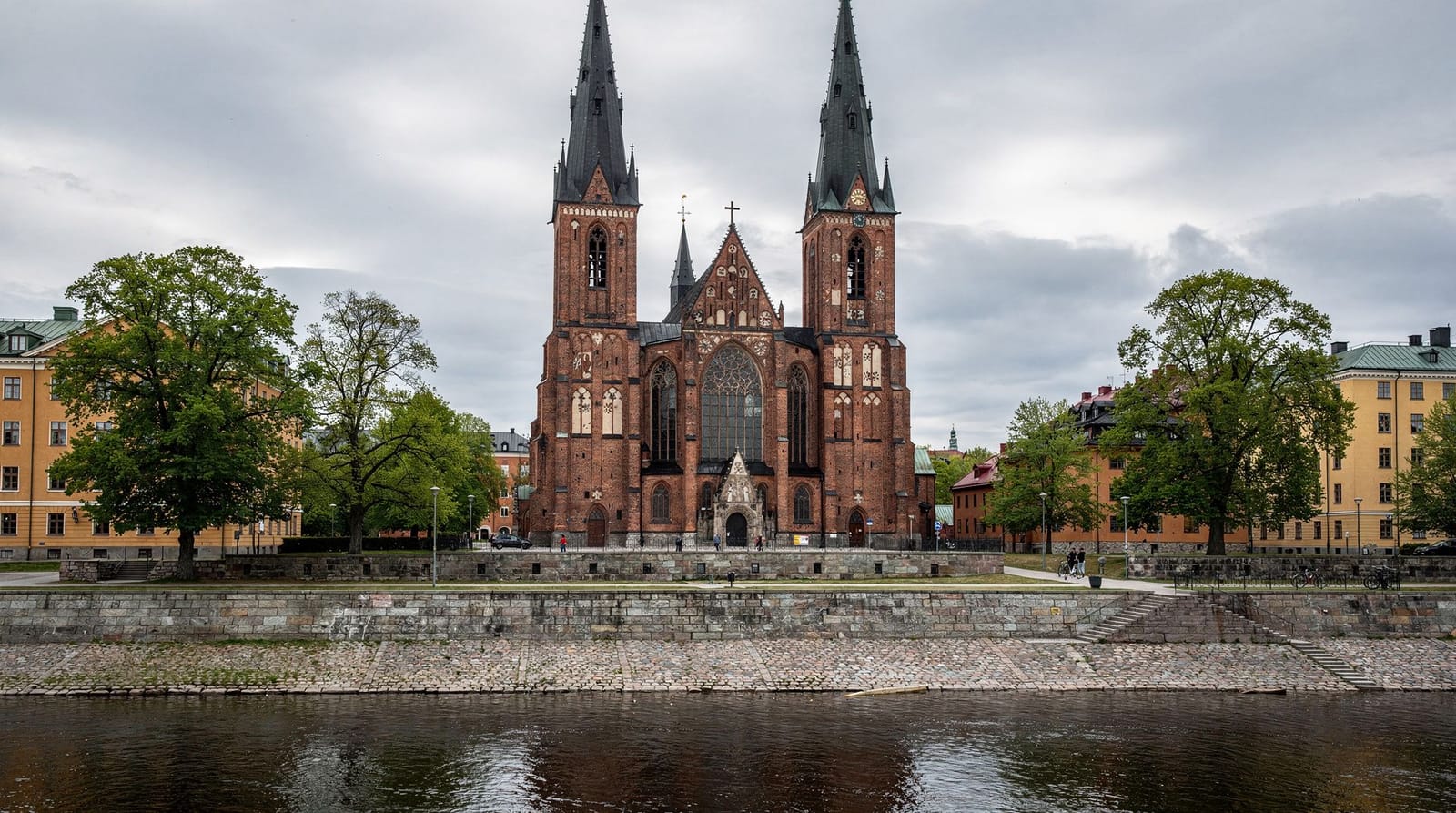
Uppsala Domkyrka is the tallest church in the Nordic countries — 118.7 metres at the spire — and the seat of the Archbishop of the Church of Sweden, the country’s highest ecclesiastical authority. Construction began in 1287 (the same year as Stockholm was receiving its town charter) and the cathedral took 150 years to complete in its original form, with the current distinctive twin spires added in the 19th century after a fire.
The interior is monumental. The nave runs 119 metres from west to east, giving Uppsala Domkyrka a physical scale that announces itself immediately on entering. The light in the nave in the afternoon, with the high Gothic windows giving a pale northern illumination, is among the best architectural experiences in Sweden.
The cathedral is also a royal mausoleum. Gustav Vasa — the founder of modern Sweden, who broke with Rome in 1527 and established the Swedish Reformation — is buried here in an elaborate Renaissance tomb. Saint Erik, the patron saint of Sweden, has his reliquary in the cathedral. Carl Linnaeus (see below) is also buried here, as is the Swedish theologian and archbishop Nathan Söderblom. The collection of historical figures makes Uppsala Domkyrka one of the most significant burial churches in Scandinavia.
Entry is free. The cathedral treasury, containing medieval religious objects and vestments, has a separate admission fee. Allow 45–60 minutes for the interior.
Uppsala University (Uppsala Universitet)
Uppsala University was founded in 1477, making it the oldest university in Sweden and one of the oldest in northern Europe. It was re-established in 1593 after a period of closure, and has been continuously active since. Today it has approximately 45,000 students and a significant research output in medicine, science, and the humanities.
The university campus is woven into the centre of Uppsala rather than being a separate enclosed precinct. The Main Building (Universitetshusets), a grand neo-Renaissance structure on a hill behind the cathedral completed in 1887, is the most visible expression of academic authority. The Gustavianum — the original 17th-century university building, with its distinctive anatomical theatre rotunda on the roof — now houses a museum with exhibits on Viking Age Uppsala, Egyptian antiquities, and the anatomical theatre itself, one of the oldest surviving in Europe.
Carolina Rediviva, the university library, holds Sweden’s most significant collection of medieval manuscripts and early printed books. Among its holdings is the Codex Argenteus — the Silver Bible — a 6th-century Gothic manuscript of the New Testament written in silver ink on purple vellum, one of the most beautiful books surviving from late antiquity. The Silver Bible is Uppsala’s single most extraordinary object; the library reading room is open to visitors.
The student nation system — in which students belong to regional nations (nations) with their own clubhouses, dining rooms, and social life — is a distinctive Uppsala institution with medieval origins. Walking past the nation buildings, particularly around Övre Slottsgatan, gives a sense of a university culture that has remarkable historical continuity.
Gamla Uppsala and the Viking royal burial mounds
Gamla Uppsala (Old Uppsala) sits 3 kilometres north of the city centre and is reached by bus (route 2 from the centre, approximately 10 minutes). It was the religious and political centre of the pre-Christian Swedish kingdom and the site of the most important royal burial mounds in Sweden.
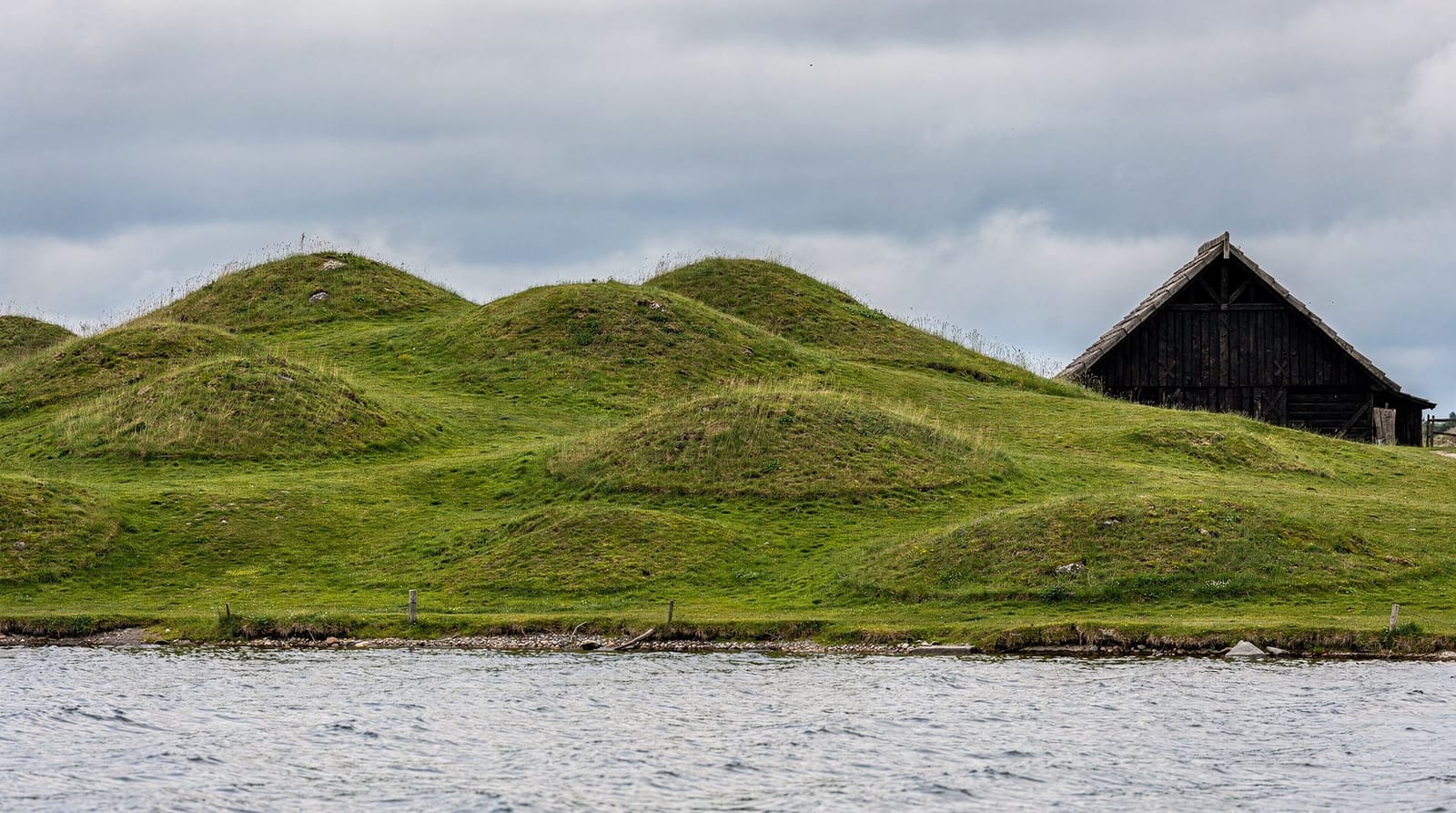
The three great royal burial mounds (kungshögarna) at Gamla Uppsala date from the 5th–6th century AD. Archaeological excavations in the 19th century found cremation burials of prominent individuals — almost certainly members of the Yngling royal dynasty — with grave goods including weapons, horses, and objects that indicate contacts across the early medieval trading networks. The mounds are not reconstructions — they are the actual tumuli, 9–10 metres high, standing in an open landscape that has changed relatively little since they were raised.
Walking around the mounds and climbing to the top of the largest (access is permitted) gives a direct encounter with the physical scale of Viking royal power: these are large earthworks that required significant labour to construct and were meant to be visible from a distance as statements of dynastic authority. The flatness of the surrounding agricultural landscape makes this very clear.
The Gamla Uppsala Museum (Gamla Uppsala museum) at the site covers the archaeology and mythology of the Uppsala area in detail, including the pre-Christian sacred site (Uppsala was the location of Sweden’s most important pagan temple before conversion to Christianity). The adjacent church — Gamla Uppsala kyrka — is a medieval stone church built partly over the original pagan temple site, with runic carvings and a peculiar quality of accumulated significance that is hard to articulate but easy to feel.
Carl Linnaeus heritage in Uppsala
Carl Linnaeus (Carl von Linné, 1707–1778) — the Swedish botanist who invented the binomial nomenclature system still used to name every species on Earth — spent most of his academic career at Uppsala University, where he created the system of scientific classification that transformed biology. Uppsala takes his legacy seriously.
Linnéträdgården (The Linnaean Garden) at Svartbäcksgatan is the botanical garden that Linnaeus designed and managed at the university. It has been maintained largely in its 18th-century form, with plant beds arranged according to his classification system. The garden is one of the oldest continuously maintained botanical gardens in Sweden and has a quiet, scholarly atmosphere that suits its history.
Linnémuseet (The Linnaean Museum) in the adjacent house where Linnaeus actually lived and worked from 1743 onwards contains his original herbarium, his scientific instruments, and correspondence — a remarkably direct connection to the man who named the species of every living thing you have ever heard of.
Linnaeus is buried in Uppsala Domkyrka, which closes the biographical circle if you have visited the cathedral earlier in the day.
Uppsala’s Viking-Age story is easier to place once you see it next to the other sites around Mälaren. The Viking heritage guide connects Gamla Uppsala with Birka and Sigtuna, and works well as reading the evening before you go.
Where to eat in Uppsala
Ofvandahls Hofkonditori on Sysslomansgatan is Uppsala’s most historically significant café — in operation since 1878 and associated with the academic and intellectual life of the city through generations. It is not a nostalgic reconstruction of an old café; it is an old café that has continued operating. Coffee and cakes served under painted ceilings with the particular atmosphere of a place that has been doing this specific thing for nearly 150 years. Essential for fika.
The streets around the cathedral and the Fyrisån river have multiple options for lunch — Swedish husmanskost (home cooking), pizza, and café food at various price points. The student population keeps prices more reasonable in Uppsala than in Stockholm for casual meals.
For dinner before the return train, the streets east of the river (Dragarbrunnsgatan, Sysslomansgatan) have a denser concentration of restaurants including options for Swedish, international, and contemporary cooking.
Uppsala’s student culture
Uppsala University’s 45,000 students make Uppsala a genuinely university-dominated town in a way that Oxford or Cambridge once were and Stockholm’s universities, dispersed across the city, never quite achieve. The presence of the student nations (student associations organised by geographic origin, a system dating to the 17th century) gives Uppsala a social layer that visitors can observe even if they cannot access it directly.
The thirteen nations each maintain a clubhouse, dining hall, and bar in the city centre — some of the older clubhouse buildings are architecturally notable. The nations host their own events, concerts, and ceremonies including the famous Valborg (Walpurgis Night) celebration on 30 April, when Uppsala’s entire student population gathers on the slope below the castle to watch a ceremony involving the traditional donning of white student caps and, historically, the rolling of a large snowball into the river (a practice that has been modified over time as spring arrives earlier).
Valborg is one of Sweden’s great public celebrations and Uppsala is its epicentre. If you are in Stockholm in late April and can travel to Uppsala on the 30th, the sight of 30,000+ students in white caps filling the city’s central spaces is one of the most distinctive Swedish cultural experiences available.
Uppsala for families
Uppsala works well as a family day trip, though it requires slightly different pacing than an adult-focused itinerary. The Gustavianum’s anatomical theatre and Egyptian antiquities tend to hold children’s attention better than the cathedral’s more solemn atmosphere, and Gamla Uppsala’s open burial mounds are genuinely exciting for children old enough to run up and down a grass hill that happens to be 1,500 years old. The Fyrisån riverside is pleasant for a picnic break between sights, and the flat, compact city centre is easier for a stroller than Stockholm’s cobbled, hilly districts. Budget slightly more transition time between stops than an adult itinerary would need, and consider prioritising Gamla Uppsala and the Gustavianum over the university library’s manuscript room, which appeals more to older children and adults.
Eating and drinking in Uppsala beyond Ofvandahls
Uppsala has a full spectrum of restaurants and cafés beyond the historic Ofvandahls fika institution. The area east of the Fyrisån river — Dragarbrunnsgatan, Sysslomansgatan, and the adjacent streets — concentrates the most varied options.
Nation dining: Most of the student nations operate restaurants and cafés with very reasonable prices, open to the public (with varying degrees of formality depending on the time of day and the event). The nation dining rooms often serve excellent Swedish home cooking — the kind of straightforward husmanskost that expensive Stockholm restaurants serve as heritage cuisine but which in Uppsala is simply what students eat for lunch. Check which nations are open to the public (most are during day service).
Akademihotellet (the Academic Hotel), a classic Uppsala hotel with a good restaurant, is convenient for visitors who want reliable quality near the cathedral area.
The concentration of younger residents in Uppsala (students plus academic staff) supports a café culture that is lively and relatively independent — fewer chain cafés and more individual operations than in suburban Stockholm.
Uppsala vs Sigtuna: which day trip fits your schedule
Uppsala and Sigtuna are the two most commonly compared Stockholm day trips, both connecting to Sweden’s early history but offering different depth and requiring different amounts of time.
| Uppsala | Sigtuna | |
|---|---|---|
| Travel time from Stockholm | 38 min (direct train) | ~45 min (train + bus) |
| Time needed | Full day | Half a day |
| Main draw | Cathedral, university, Gamla Uppsala mounds | Medieval streetscape, runestones, church ruins |
| Best for | A dedicated day, stronger Viking-history interest | A relaxed half-day or Arlanda stopover |
For visitors with a full free day, Uppsala offers more depth and the singular Gamla Uppsala burial mounds. For a lighter half-day, especially one built around an Arlanda flight, Sigtuna is the better fit. The Uppsala day trip guide and the Sigtuna day trip guide both go deeper into planning each independently.
Private guided walking tour of Uppsala — cathedral, university quarter and Gamla Uppsala with a local guideCombining Uppsala with Sigtuna
The two towns are connected by the same historical narrative — both were centres of Swedish power before Stockholm superseded them — and can be combined in a single long day. Bus connections run between them. The 8-hour Uppsala and Sigtuna tour from Stockholm handles the logistics and provides historical context at both sites. The full-day Viking culture tour to Uppsala focuses specifically on the Viking heritage of the Uppsala region including Gamla Uppsala.
For visitors with one day for a day trip and an interest in Viking history, Uppsala with Gamla Uppsala is a stronger choice than Sigtuna alone — the burial mounds are singular objects that Sigtuna cannot match. For medieval townscape and a shorter trip, Sigtuna has the advantage. The Sigtuna guide covers the alternative.
Uppsala’s museum circuit beyond Gustavianum
Beyond the Gustavianum, Uppsala has a small cluster of specialised museums worth knowing about for a second visit or a specific interest. The Uppsala Art Museum, in the same building complex as the train station, has a changing programme of Swedish and international contemporary art. The Evolution Museum (Evolutionsmuseet), part of the university’s natural history collections, covers zoology, botany and comparative anatomy in a format that pairs well with a Linnaeus-focused day. None of these matches the scale of Gustavianum or the cathedral, but as rain-day fallbacks or additions to a second Uppsala visit, they extend what the city offers beyond its headline sights.
Fitting Uppsala into a longer Stockholm stay
Uppsala is best treated as one full day inside a longer visit rather than the whole trip. The Stockholm and Uppsala in 3 days itinerary shows one way to balance it against the capital, while the 3-day first-timer itinerary and the complete day trips overview help you decide which other excursions compete for the same day. If your plans lean towards the water instead, Drottningholm and the archipelago are the natural alternatives, and the blog’s three day trips better than Drottningholm is a candid take on how the options compare. Back in the city, Gamla Stan makes a good contrast with Uppsala’s flat, academic streets on the days either side.
Guided day trips from Stockholm
For visitors who prefer guided context to independent navigation, the day trip to Uppsala from Stockholm provides guided access to the main sites. The Uppsala must-sees in 2.5 hours with a local guide is a more compressed option for visitors who want professional context without filling the entire day.
Frequently asked questions about Uppsala
How much time do I need in Uppsala?
A full day is ideal. The cathedral, university quarter (Gustavianum and Carolina Rediviva), Gamla Uppsala mounds, and Linnaeus garden across a day leaves time for a proper lunch and fika without rushing. If you only have a half-day, choose between the city centre (cathedral + university) or Gamla Uppsala — both are excellent but on opposite sides of the day.
How much does the Uppsala day trip cost?
Check SJ, Mälartåg or SL for the current train fare. Cathedral entry is free (the treasury charges 80 SEK for adults). Gustavianum costs 150 SEK and Gamla Uppsala Museum 150 SEK (free for visitors under 19). The Linnaean Garden and Museum are modestly priced or free depending on season.
Is Gamla Uppsala worth the extra bus trip?
Yes, strongly. The burial mounds are one of the most powerful Viking Age sites accessible from Stockholm — large, atmospheric, and located in a landscape that has not been overwhelmed by modern development. The 10-minute bus ride from the city centre is not a significant additional effort for what is arguably the most impressive single object in the Uppsala day trip.
What is the Silver Bible and can I see it?
The Codex Argenteus — the Silver Bible — is a 6th-century Gothic New Testament written in silver and gold ink on purple-dyed vellum, held at Carolina Rediviva library. It is on permanent display in the library’s reading room, which is open to visitors. The object is physically extraordinary — the silver ink has not faded, the purple vellum is vivid — and seeing it in person is significantly more impressive than photographs suggest.
Is Uppsala suitable as a day trip in winter?
Yes. The cathedral and university buildings are year-round destinations and the indoor museums are excellent in poor weather. Gamla Uppsala is more atmospheric in good light but the mounds can be visited in any weather. The main winter limitation is that the days are short (8–10 hours of usable light in December) which reduces the effective visiting day.
How is Uppsala different from Stockholm as a travel experience?
Uppsala is quieter, smaller, more focused on a single historical narrative (ecclesiastical, academic, Viking), and has a different aesthetic from Stockholm’s island city. It feels like a place with a specific gravity rather than a collection of attractions. The concentration of historical significance — the cathedral, the oldest university, the Viking burial mounds, the world’s most important royal botanical collection — in a walkable area makes it unusually rewarding for its physical size.
Should I choose Uppsala or Sigtuna if I can only do one?
Choose Uppsala if you have a full free day and a stronger interest in Viking-Age archaeology — the Gamla Uppsala burial mounds have no equivalent elsewhere near Stockholm. Choose Sigtuna if your time is limited to a half-day, especially if it fits around an Arlanda flight, since Sigtuna sits only 15 km from the airport. Both can be combined in a single guided 8-hour day if you want both without choosing.
Top experiences
Bookable activities with verified prices and instant confirmation on GetYourGuide.