Gamla Stan neighborhood deep dive: Stockholm's medieval island
Stockholm: secrets of Gamla Stan guided tour with fika option
Duration: ~2 hours
How much time should I spend in Gamla Stan?
2–3 hours is enough to walk the main streets and see the key sights: Stortorget, Mårten Trotzigs Gränd, the Royal Palace exterior, Storkyrkan cathedral, and the Iron Boy statue. Allow a full half-day if you want to explore at a relaxed pace and visit the Nobel Museum or Royal Palace interior.
Gamla Stan: the island that started it all
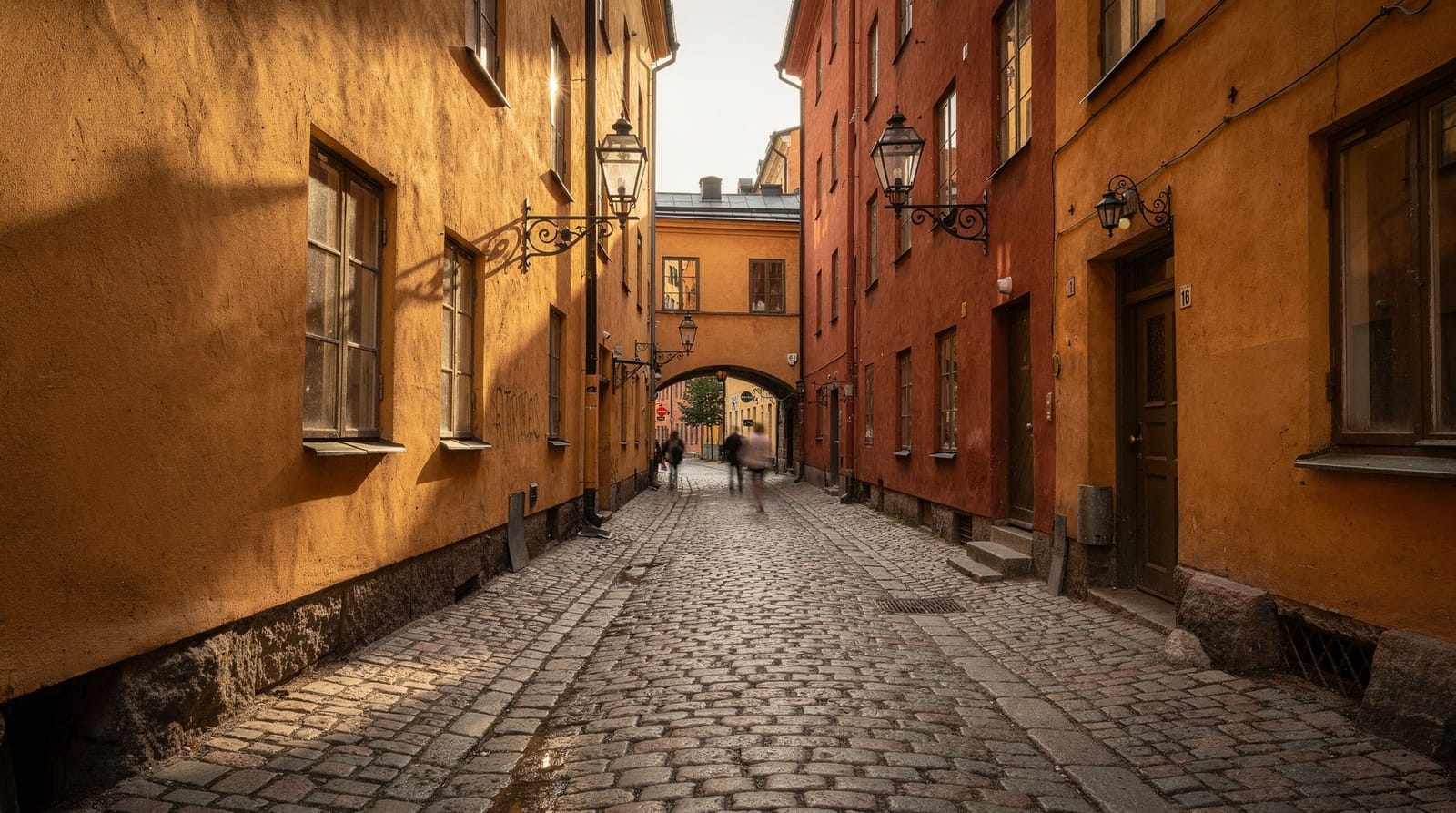
Gamla Stan — literally “Old Town” in Swedish, though locals and most visitors use the Swedish name — is the medieval island at the centre of Stockholm. It is where the city was founded in the 13th century, and it remains the most complete medieval urban fabric in Scandinavia: 300-odd buildings on a 0.7-square-kilometre island, crammed together as they were when space within the city walls was the most valuable commodity in the kingdom.
The island is connected to the mainland (Norrmalm and Södermalm) by bridges, and to the royal island of Riddarholmen by a short footbridge. Everything within its bounds is essentially a UNESCO-level heritage zone in practice, even if not formally designated as such.
The tourist pressure is real — Gamla Stan is Stockholm’s single most visited area and the main drag (Västerlånggatan) shows it in the form of overpriced restaurants, souvenir shops, and walking tour groups. The honest approach is to understand which parts of Gamla Stan are genuinely rewarding and which to pass through quickly.
| Where | Central island, between Norrmalm and Södermalm, linked by bridges |
| Time needed | 2–3 hours for the highlights, half a day at a relaxed pace |
| Cost | Free to walk; Storkyrkan 120 SEK; Royal Palace interior extra |
| Getting there | T-bana Gamla Stan (red/green) or a 10–15 min walk from Norrmalm |
| Best time | Early morning (7–9am) or weekday late afternoon for fewer crowds |
Riddarholmen: the quiet neighbor
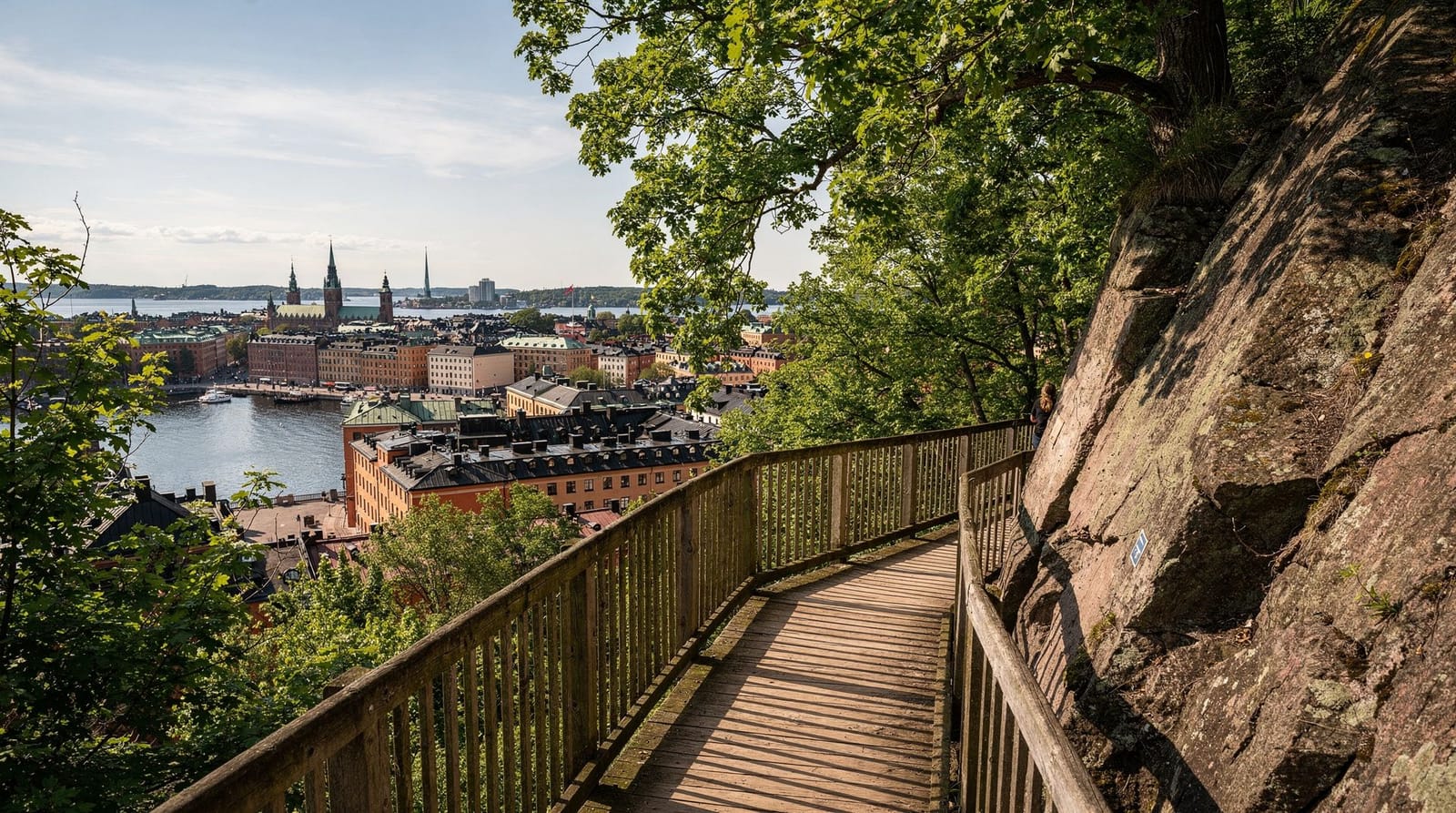
Most visitors never cross the small footbridge from Gamla Stan onto Riddarholmen, which is exactly why it rewards the effort. This tiny island holds Riddarholmen Church, the burial church of Swedish monarchs since the 16th century, its cast-iron spire visible from much of central Stockholm. There are no souvenir shops, no restaurant touts, and often no other tourists at all — just cobbled quiet and views back across the water to Södermalm and the Riddarfjärden bay. Fifteen minutes here is a useful reset after the crowds of Stortorget, and it costs nothing beyond the short walk.
If the medieval layers fascinate you, the Gamla Stan medieval secrets guide goes further into the details that most visitors walk straight past, and the Gamla Stan destination page gives the wider overview of the island.
Practical logistics: restrooms, luggage, and access
Public restrooms inside Gamla Stan are limited; the most reliable options are inside cafés (for paying customers) and the public facilities near Slussen. There is no dedicated luggage storage on the island itself — the nearest lockers are at Stockholm Central Station, a 10–15-minute walk or one T-bana stop away, which matters if you are exploring Gamla Stan on an arrival or departure day. Mobility access is genuinely difficult: cobblestones are uneven throughout, several lanes involve steps, and pavements narrow to single file in places. Wheelchair users and anyone with limited mobility should plan a route along the wider streets (Västerlånggatan, Österlånggatan, and the palace forecourt) rather than attempting the atmospheric-but-narrow side lanes.
Brief history
Founded 1252: Stockholm’s first documented mention is a letter from Birger Jarl, effectively the Swedish regent, in 1252. The island of Stadsholmen (the core of what is now Gamla Stan) was already fortified as a strategic point controlling traffic between Lake Mälaren and the Baltic.
Medieval growth: By the 14th century, the island was densely built up with craftspeople’s quarters, merchant houses, churches, and the growing apparatus of the Swedish state. The narrow lane pattern — Mårten Trotzigs Gränd, Prästgatan, Köpmangatan — reflects the medieval street plan preserved almost intact.
The Stockholm Bloodbath, 1520: The defining trauma in Gamla Stan’s history. Danish King Christian II, having conquered Sweden, invited the Swedish nobility to Stockholm for a coronation feast, then arrested and executed approximately 90 people — nobles, clergy, and burghers — in Stortorget over three days. The event ended Danish control of Sweden and led directly to Gustav Vasa’s revolt and the founding of modern Sweden. The red house on the north side of Stortorget was said to be stained with blood; whether this is literally true or symbolic is disputed, but the association is permanent. The full account of the bloodbath covers the political background in more depth.
Preservation: Unlike many European medieval cities, Gamla Stan was never bombed, never cleared for modernisation, and was gradually protected by heritage legislation from the late 19th century onwards. What you see is largely authentic fabric from the 15th to 18th centuries, with some 19th-century additions.
What to actually see
Stortorget
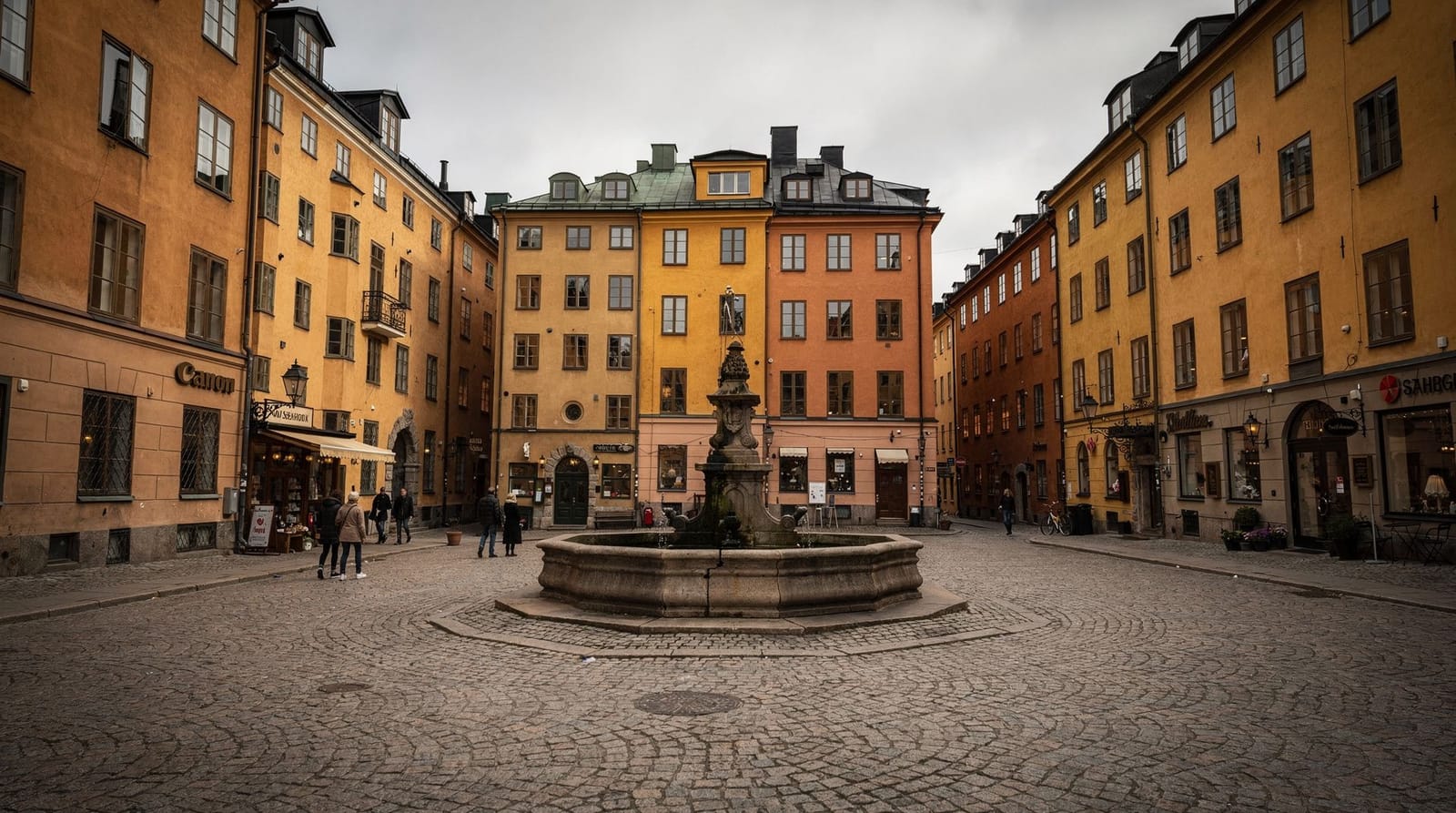
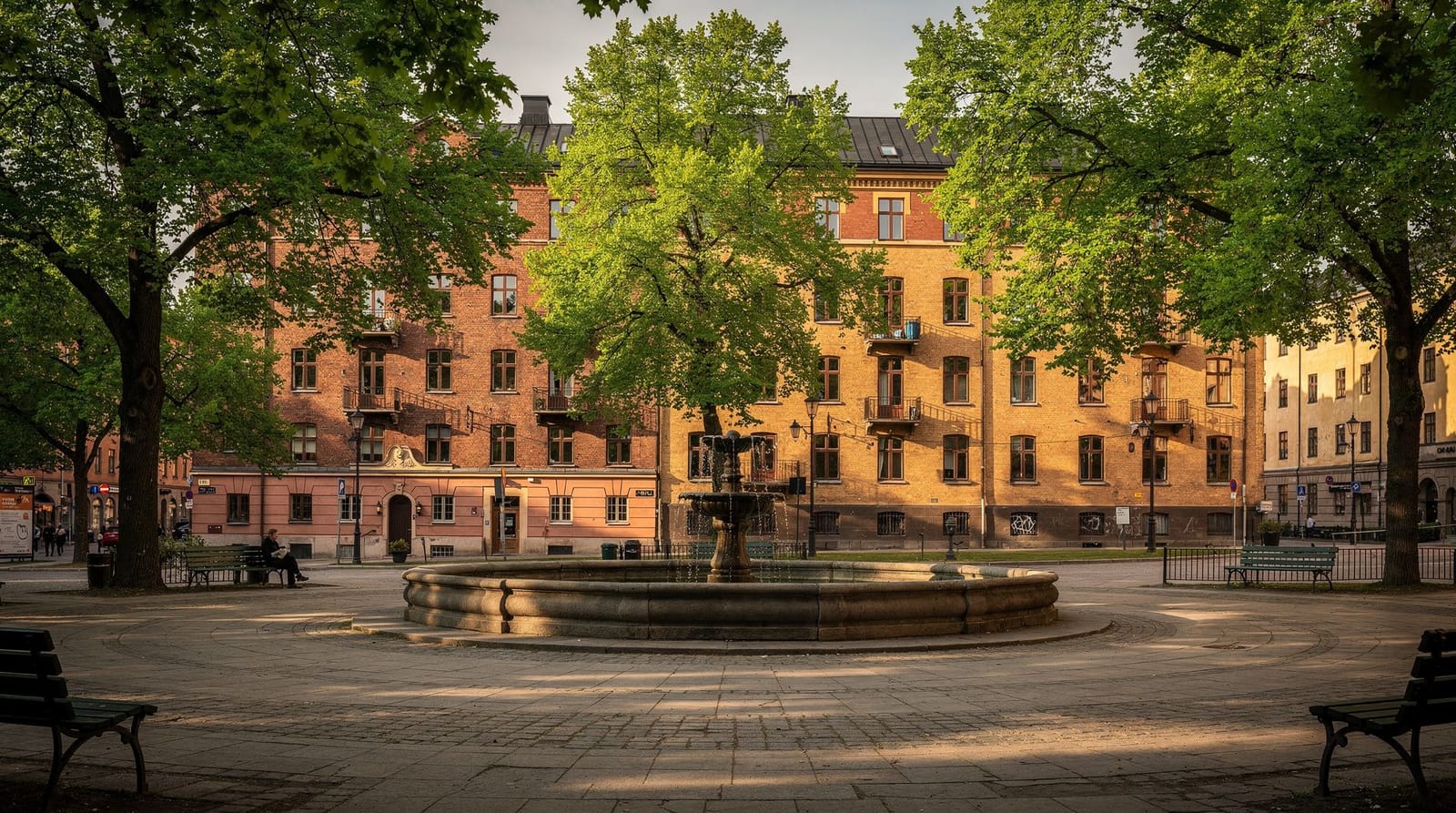
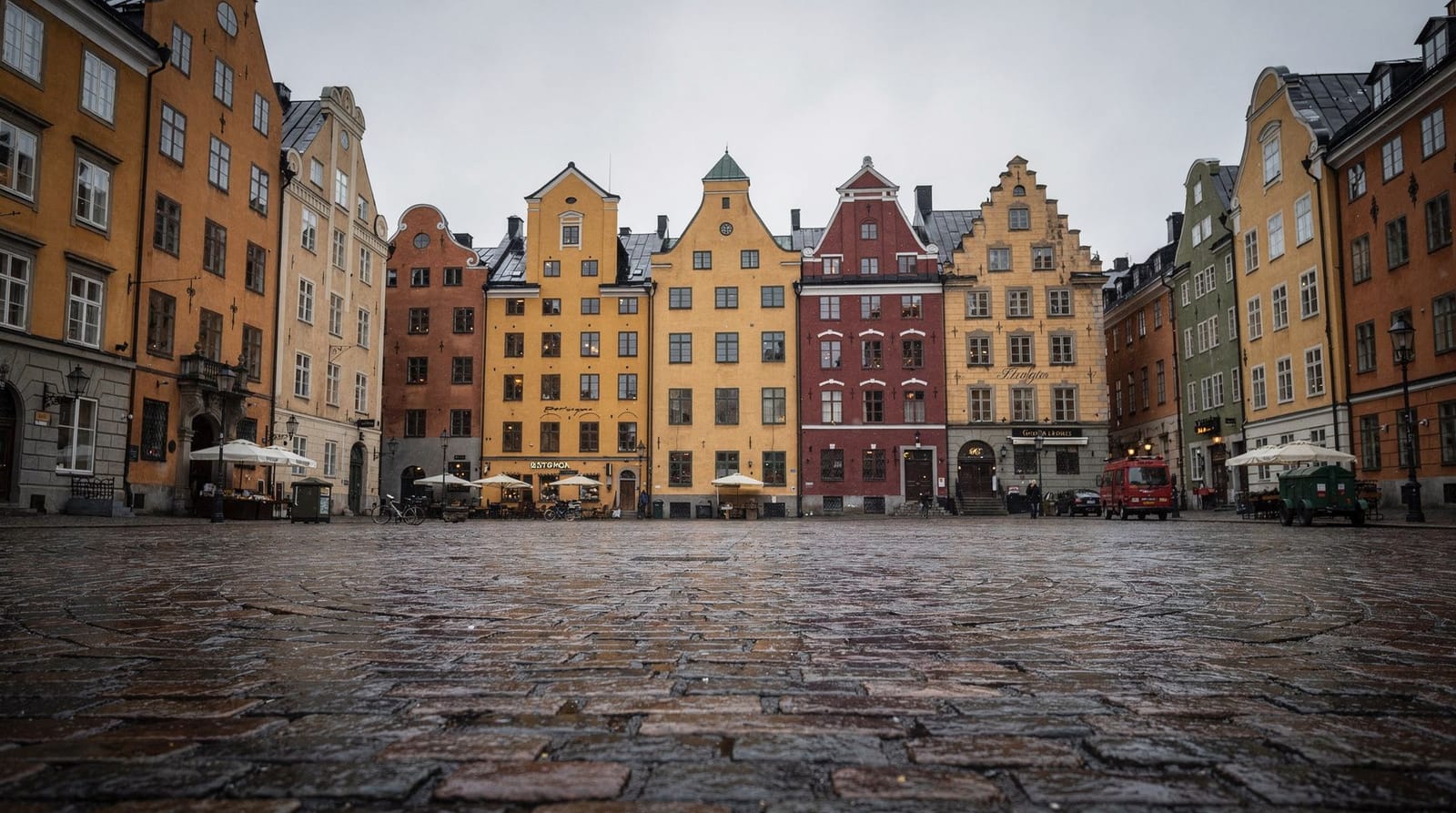
The main square of Gamla Stan and the site of the Stockholm Bloodbath. It is ringed by tall merchant houses in ochre, terracotta, and dark red — the colours typical of 17th and 18th-century Scandinavian merchant architecture. The central fountain is a later addition (18th century); the square’s original function was as a market and the execution ground used in 1520.
The square is busy with tourists at most times of day but worth entering properly. Stand in the centre and look up at the roofline — the variation in building heights and styles across the square tells the story of different construction eras. The tallest building on the north side (No. 20, painted deep red) is the one most commonly associated with the bloodbath.
Coffee on Stortorget: Several cafés ring the square. The prices reflect the tourist footfall — expect to pay a premium. If you want coffee, the quieter streets behind the square (Köpmantorget, Österlånggatan) have better value options.
Mårten Trotzigs Gränd
Sweden’s narrowest street, at 90 centimetres at its narrowest point. The entrance is off Västerlånggatan — easy to miss the first time. The lane descends in stairs from Prästgatan down to Västerlånggatan, and the walls close in to the width of an adult with arms half-extended.
The reason for its narrowness is straightforward medieval property logic: the lane marks a property boundary between two buildings that were built as close together as their owners could manage. It was named after a German merchant, Wilhelm Trotzigs, who owned adjacent buildings here in the early 17th century.
Photographically, it is one of the most-photographed spots in Stockholm. Morning, before the tour groups arrive (before 9am), is the best time for a clear shot.
Storkyrkan — the Cathedral
Storkyrkan (Great Church), adjacent to the Royal Palace, is Stockholm’s oldest church — founded in the 13th century and in its current form largely from the 14th and 15th centuries. Entry costs 120 SEK for adults (audio guide included; under 18 free).
The interior has several notable features, but the most famous is the St George and the Dragon sculpture from 1489, by German sculptor Bernt Notke. It is one of the finest Gothic wooden sculptures in northern Europe — a towering ensemble of oak (St George, the dragon, the princess Sabina) originally commissioned to commemorate the Swedish victory over the Danes at the Battle of Brunkeberg in 1471. The religious subject is also a political statement: the dragon represents Denmark; Sweden is the Saint.
The church also contains the Stockholm Sun Dog painting from 1535 — the oldest known painting of a Stockholm cityscape, which also happens to depict an atmospheric optical phenomenon (sun dogs, parhelia) observed over the city that year.
Book a guided tour of Gamla Stan’s secrets with fika optionThe Iron Boy (Järnpojken)
Bollhustäppan — a tiny courtyard off Köpmantorget, between the back of Storkyrkan and the Royal Palace — contains the Iron Boy: a 15-centimetre bronze sculpture of a seated child, staring at the sky. It was created by sculptor Liss Eriksson in 1967 and is the smallest public sculpture in Stockholm.
The Iron Boy is a genuine piece of Stockholm folklore. The superstition holds that you should give him a coin or leave him a hat (people knit miniature hats for him throughout the year) and make a wish. During cold weather, Stockholmers leave scarves and hats for him without irony; in the coldest winters, someone always ensures he has winter clothing.
Finding the Iron Boy without a guide requires a bit of searching — the courtyard is deliberately unobvious. This is part of what makes it satisfying when you do find it.
The Royal Palace (Kungliga Slottet)
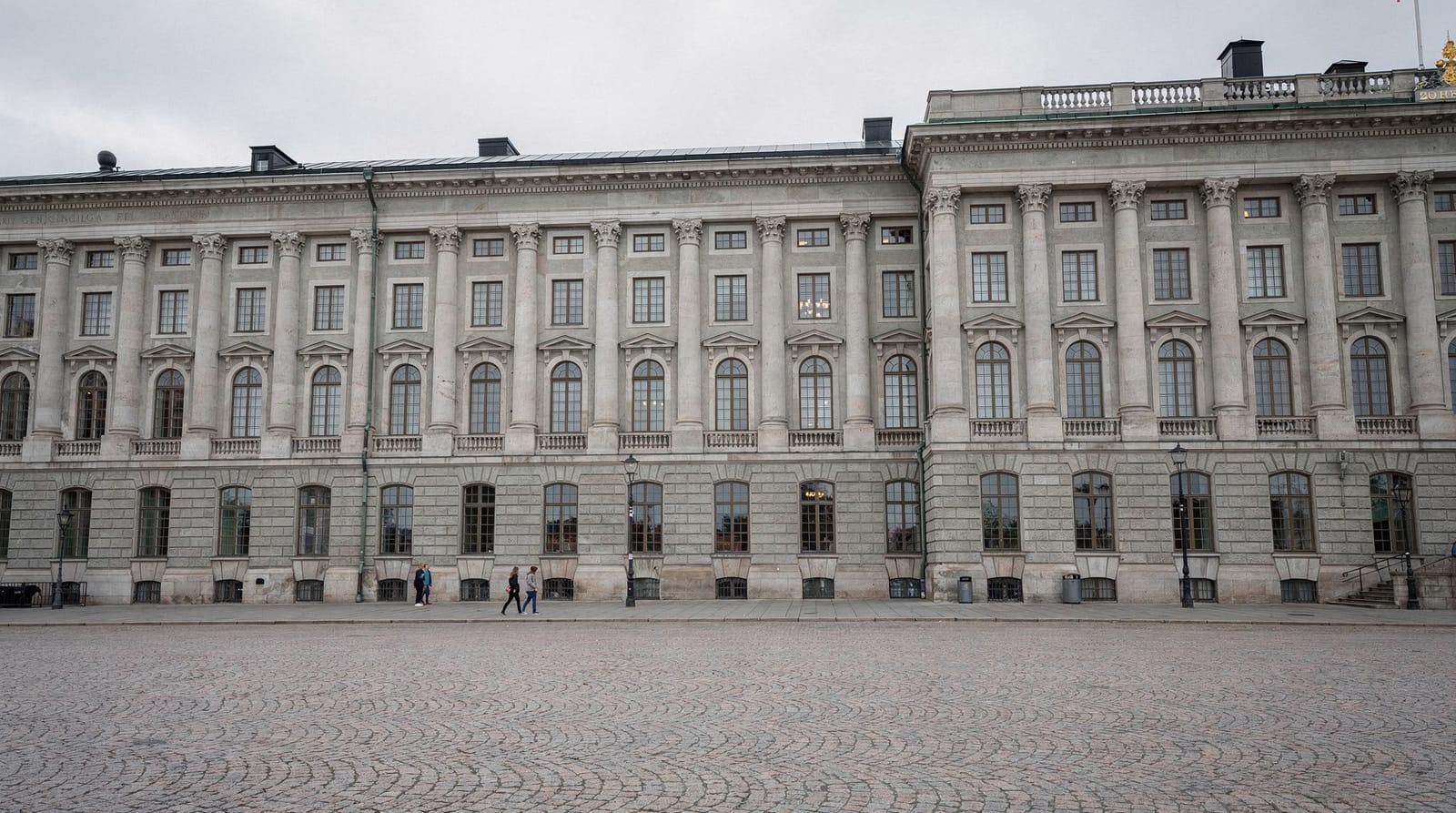
The Royal Palace in Gamla Stan is one of the largest functioning royal palaces in the world — 1,430 rooms, housing multiple museums and state apartments. The Swedish royal family does not live here (they reside at Drottningholm), but official state functions take place in the palace, and several wings are open to the public.
What’s worth seeing inside: The Royal Treasury (Skattkammaren) for the crown jewels; the Apartments of State for the ceremonial rooms; the Royal Armoury (Livrustkammaren) for the best collection of royal regalia, armour, and historical costumes in Sweden. The Museum of Antiquities is smaller but has interesting Greek and Roman holdings. A short walk away, the Nobel Prize Museum on Stortorget is worth combining with a palace visit.
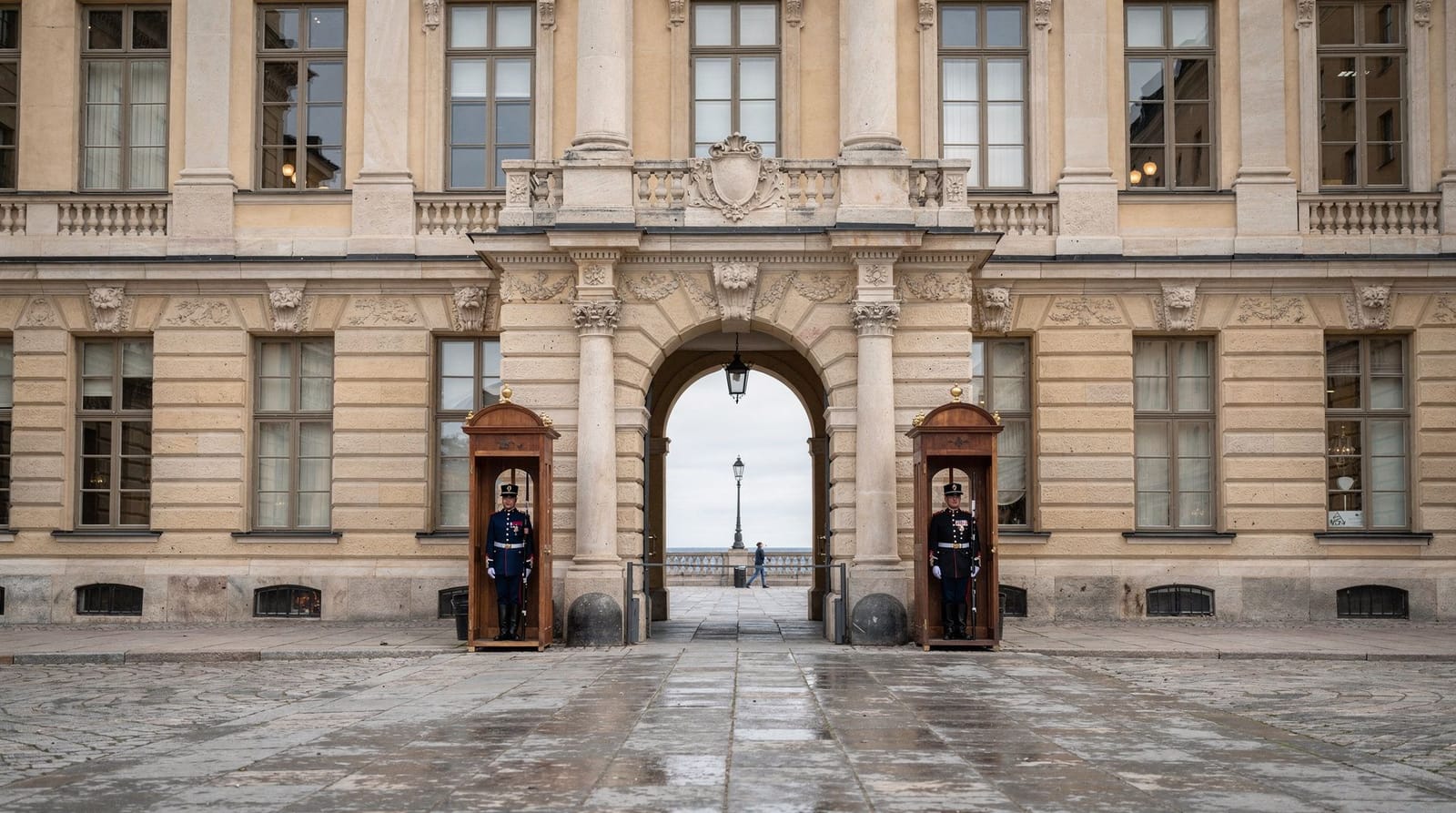
The Changing of the Guard: Takes place all year at 12:15 Monday–Saturday and 13:15 on Sundays and public holidays in the courtyard. The marching band and ceremony last about 40 minutes. It is free to watch from the courtyard or the surrounding streets.
See the dedicated Royal Palace guide for entry costs and opening hours.
What to skip or approach carefully
Västerlånggatan restaurants: This is the main tourist drag and one of Stockholm’s most consistent tourist traps. Menus outside rarely show full prices; supplements appear at payment; some venues target tourists who do not check their bill. If you want to eat in Gamla Stan, use Österlånggatan (the parallel street one block east) or the small lanes off the main drag — better food, lower pressure, similar architecture. Our honest Gamla Stan restaurants guide names the specific places worth the walk.
Viking souvenir shops: Gamla Stan has a high concentration of shops selling Viking helmets, fake runes, and Norse mythology merchandise. None of it is authentic Swedish culture; most is manufactured generically (our guide to overpriced souvenir shops explains what to look for instead). If you want genuinely Swedish design, Iris Hantverk (on Lästmakaregatan, 5 minutes from Gamla Stan) is worth the slightly longer walk.
“Free” walking tours: Gamla Stan is the starting point for Stockholm’s most aggressively marketed free walking tours. These are not free — the tip expectation at the end is 100–200 SEK per person. See the free walking tours guide for an honest assessment.
Where to go after Gamla Stan
Gamla Stan works best as one chapter of a longer Stockholm day rather than the whole of it. A natural pairing is a walk across the bridge to Södermalm, where the mood is local rather than historic; the Södermalm neighborhood deep dive picks up from there. In the other direction, the Norrmalm neighborhood deep dive covers the commercial heart of the city, and the Djurgården neighborhood deep dive suits a slower, greener afternoon with the big museums.
If you are still planning the shape of your trip, the Stockholm in 3 days overview shows where the old town fits among the other sights, and the first-timer 3-day itinerary turns that into a day-by-day plan. For the food side of the visit, the fika culture guide explains the coffee-break habit that makes the quieter cafés on the side streets so appealing.
Getting in and getting around
Gamla Stan is 2 kilometres end-to-end at its longest. Walking from the Royal Palace at the northern end to the Stortorget at the centre takes about 10 minutes. Walking the full island perimeter takes 45–60 minutes.
T-bana: Gamla Stan station (red and green lines) exits directly into the island’s northern section, near the Royal Palace. Slussen station (red and green) exits to the bridge connecting Gamla Stan with Södermalm.
Foot: From Norrmalm (the main city hotel district), Gamla Stan is a 10–15-minute walk south across Strömbron bridge. From Södermalm, a 5-minute walk north across Slussplan.
Gamla Stan by time of day
Early morning (7–9am): The best time. The lanes are largely empty; the early light is excellent; the bakeries open at 7am (Fabrique Stortorget is worth visiting for the first coffee of the day). The sense of the medieval city, when you are not threading through tourist groups, is accessible and genuine.
Midday: Busy. The Royal Palace guard change happens at 12:15 (Monday–Saturday), which concentrates crowds around the palace courtyard. Stortorget is at its most crowded.
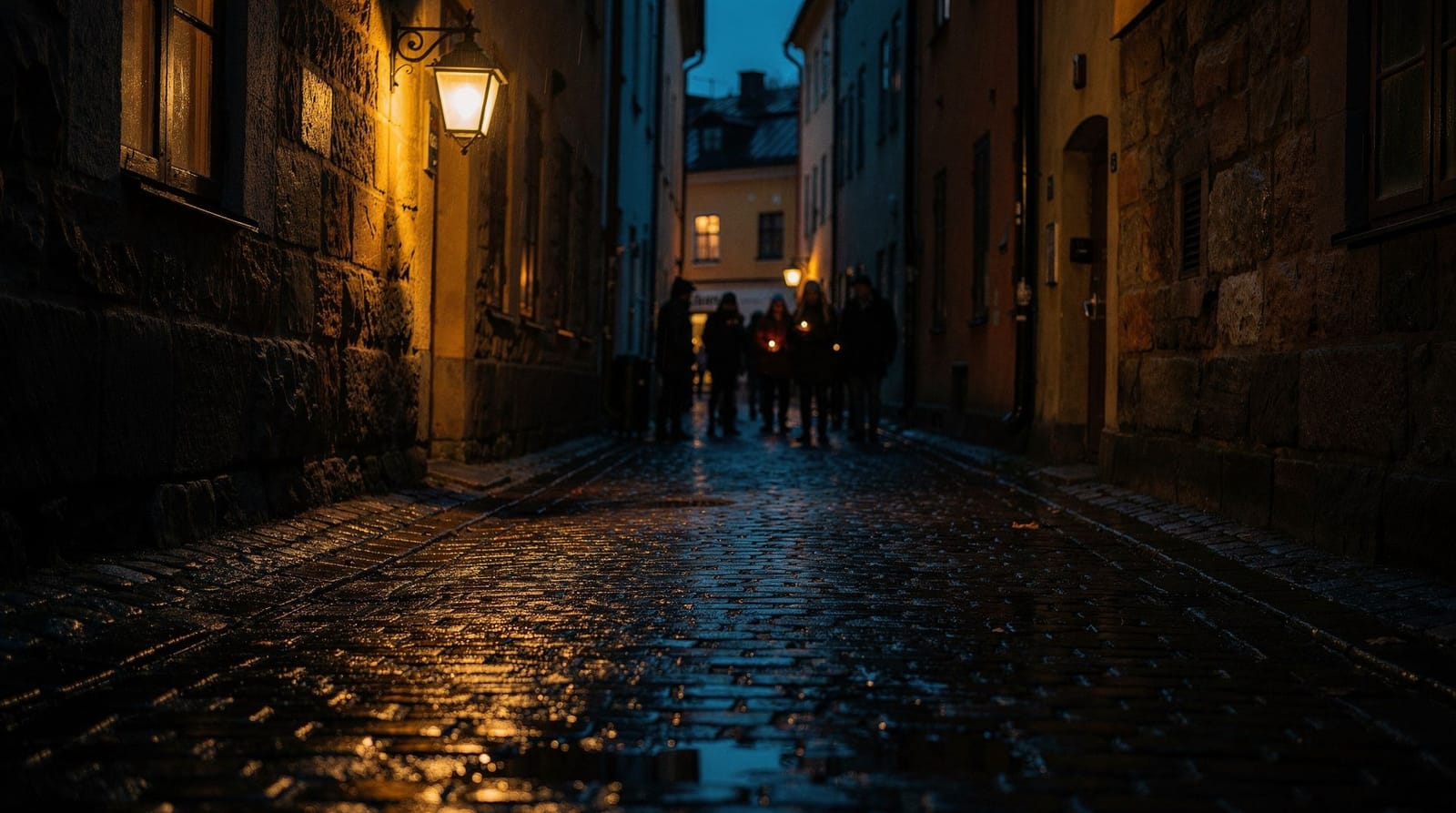
Evening (after 6pm): The souvenir shops close and the character changes. The restaurants (including the problematic Västerlånggatan ones) are still open; the quieter streets become pleasant for a slow walk. The summer evening light on the ochre facades is excellent for photography. Evening is also when the Gamla Stan ghost walking tour sets off, leaning into the medieval alleys’ genuinely atmospheric dark side.
Book an Old Town walking tour — stories and secretsFrequently asked questions about Gamla Stan
What is the Stortorget bloodbath?
In November 1520, Danish King Christian II orchestrated the arrest and execution of approximately 90 Swedish nobles, clergy, and burghers in Stortorget over three days. The executions broke a promise of amnesty given to secure their attendance at the coronation festivities. The event — known as the Stockholm Bloodbath (Stockholms blodbad) — triggered Gustav Vasa’s rebellion, the expulsion of the Danes, and the founding of modern Sweden in 1523.
How narrow is Mårten Trotzigs Gränd?
The narrowest point is exactly 90 centimetres — just wide enough for an adult to pass, with arms held at the sides. Two adults cannot pass each other at the narrowest section. The lane is approximately 36 metres long and descends via steps from Prästgatan to Västerlånggatan.
Is the Iron Boy hard to find?
It requires some searching. From Stortorget, walk towards the Royal Palace, then turn into Köpmantorget (the small square with the St George statue copy). At the far end, look for the narrow entrance to Bollhustäppan courtyard. The Iron Boy sits against the wall, barely visible until you are standing in the courtyard. It is approximately 15 centimetres tall.
When is the best time to visit Gamla Stan to avoid crowds?
Early morning (7–9am) any day of the week; or late afternoon on weekdays after the tour groups have finished. July and August are consistently the most crowded. September is significantly quieter with equally good (often better) weather.
Is Gamla Stan suitable for a stroller?
The main streets (Västerlånggatan, Österlånggatan) are manageable but the cobblestones are bumpy. Many of the narrower lanes are paved with uneven stone that makes stroller navigation difficult. Mårten Trotzigs Gränd, with its steps, is not navigable with a stroller. The island’s perimeter roads are smoother. A baby carrier is easier than a stroller in Gamla Stan.
Where can I store luggage near Gamla Stan?
There is no locker facility on the island itself. The closest reliable option is Stockholm Central Station, roughly a 10–15-minute walk or one T-bana stop away, which has staffed and automated luggage storage. Plan for this if you’re exploring Gamla Stan on the day you arrive or leave Stockholm.
Is Riddarholmen worth visiting alongside Gamla Stan?
Yes, if you have an extra 15–20 minutes. Riddarholmen sits just across a small footbridge from Gamla Stan’s western edge and holds Riddarholmen Church, the royal burial church, along with quiet cobbled streets and open water views back towards Södermalm. It sees a fraction of Gamla Stan’s foot traffic, making it a useful contrast after the busier squares.
Top experiences
Bookable activities with verified prices and instant confirmation on GetYourGuide.