Royal Palace Stockholm guide: Europe's largest working palace
Stockholm: Royal Palace museums & Gamla Stan skip-the-line tour
Duration: ~4 hours
Is the Stockholm Royal Palace worth visiting?
Yes, particularly for the State Apartments, the Treasury (crown jewels), and the free changing of the guard ceremony (12:15 Monday–Saturday, 13:15 on Sundays and public holidays). The palace is the largest still-functioning royal palace in Europe with 600 rooms — allow at least 2 hours for the main sections.
Europe’s largest working royal palace
The Stockholm Royal Palace — Kungliga Slottet — occupies the highest point of Gamla Stan’s island and has defined the Stockholm skyline since the 18th century. With approximately 600 rooms, it is the largest palace still used as an official royal residence in Europe. The Swedish Royal Family uses it for state ceremonies, official audiences, and diplomatic receptions; it also functions as a fully open public museum with five distinct collections accessible to visitors.
This is not Versailles — the palace lacks the grandeur-for-grandeur’s-sake excess of French royal architecture — but it is genuinely impressive in a specifically Swedish way: serious, well-proportioned, and full of objects accumulated by a monarchy that has been continuously active in this location for over a thousand years.
Practical essentials
| Detail | Information |
|---|---|
| Address | Slottsbacken 1, Gamla Stan |
| Opening hours | Daily; 10:00–17:00 May–September, 10:00–16:00 October–April (closed on some dates for state events) |
| Admission (Royal Apartments, Treasury, Museum Three Crowns) | 220 SEK adult (240 SEK May–Sep); children 7–17: 110 SEK (120 SEK May–Sep); under 7 free |
| Children under 18 | Free |
| Changing of the guard | 12:15 Monday–Saturday, 13:15 Sundays and public holidays, all year |
| Recommended time | 2–3 hours |
| T-bana | Gamla Stan (Red and Green lines), 5 min walk |
The outer courtyard and the changing of the guard ceremony are free. A ticket is required for the museums inside.
Book the Royal Palace skip-the-line tour including Gamla StanWhich sections to prioritise if time is short
Not every visitor has 2–3 hours to spend on all five collections. If you need to prioritise:
| Priority | Section | Time | Why |
|---|---|---|---|
| 1 | The Treasury | 30–40 min | Crown jewels — the single most spectacular room |
| 2 | State Apartments | 45–60 min | The working ceremonial rooms, most photogenic |
| 3 | Tre Kronor Museum | 20–30 min | Medieval foundations, good for history-minded visitors |
| 4 | Gustav III’s Antiquities | 20–30 min | Classical sculpture, specialist interest |
| 5 | Orders of Chivalry | 10–15 min | Smallest collection, skip if pressed for time |
What to see inside
The State Apartments (Representationsvåningarna)
The most impressive section of the palace interior. The State Apartments are the official working rooms used for state banquets, foreign heads of state audiences, and royal ceremonies. The Hall of State (Rikssalen) is the centrepiece — a baroque hall with a silver throne under a canopy of crimson silk, where the annual opening of parliament was held until 1975. The rooms are furnished with the original 18th-century pieces; the silver, gilding, and tapestries are in remarkable condition.
The Karl XI Gallery, modelled loosely on Versailles’s Hall of Mirrors, runs the full length of one wing and is hung with portraits of Swedish kings from the 17th century. The Guest Apartments, used by visiting heads of state, are shown as they appeared in recent decades — more 20th-century functional than baroque.
The Treasury (Skattkammaren)
The underground treasury holds the Swedish royal regalia: crowns, sceptres, orbs, and swords used in coronations and state ceremonies since the 16th century. The centrepiece is the crown of King Erik XIV (1561), the oldest of the Swedish crowns and one of the finest examples of Renaissance goldsmithing in northern Europe. The collection also includes the royal insignia currently used for the baptism and funeral ceremonies of the ruling house.
Unlike many crown jewel collections, this one is displayed in a context that explains the political and ceremonial function of each object. The explanatory material is genuinely illuminating.
The Tre Kronor Museum
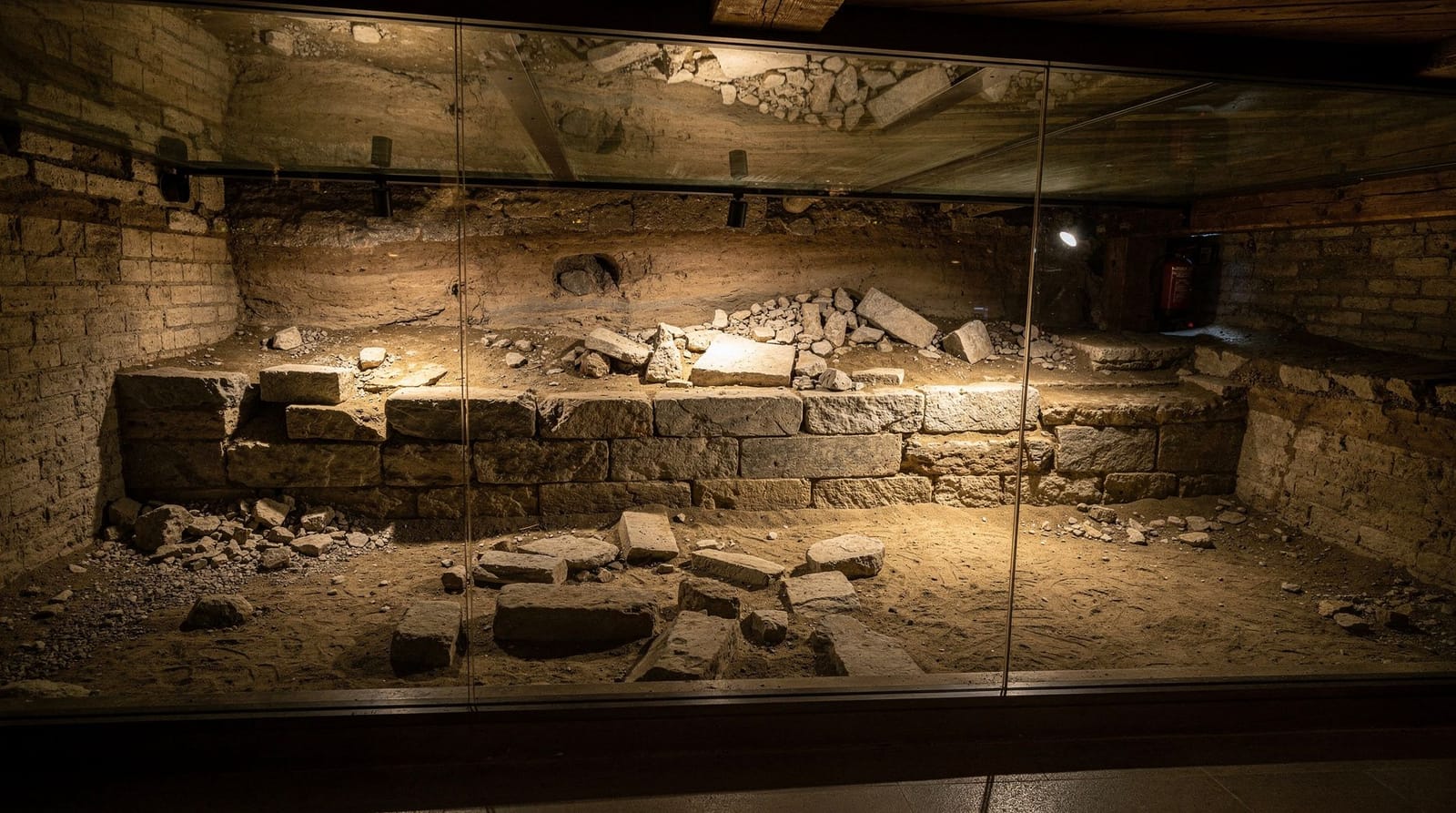
Below the palace, in the medieval foundations, the Tre Kronor Museum occupies the remains of the earlier castle — the Tre Kronor (Three Crowns) castle that burned in 1697, making way for the current baroque palace. Archaeological excavations during the palace’s construction revealed medieval masonry that has been incorporated into the museum display. The section covering the 1697 fire is particularly interesting: the fire burned for three days and destroyed most of the royal collection accumulated over centuries.
Gustav III’s Museum of Antiquities
Gustav III (reigned 1771–1792) was an enthusiastic collector of classical antiquities, bringing a large collection back from his Italian journey in 1783–1784. The museum displays his collection of Greek and Roman sculpture, displayed in the same neoclassical gallery where Gustav installed it — one of the few royal art collections in Europe still shown in its original arrangement. The most important piece is a group of ancient Roman sculptures including a well-preserved statue of Endymion and a fine bust of Livia, wife of Augustus.
The Orders of Chivalry (Riddarholmskyrkan collection)
A smaller collection covering the Swedish royal orders of chivalry and their insignia, housed in a section of the palace with direct access to the palace chapel. Specialist interest mainly.
The changing of the guard
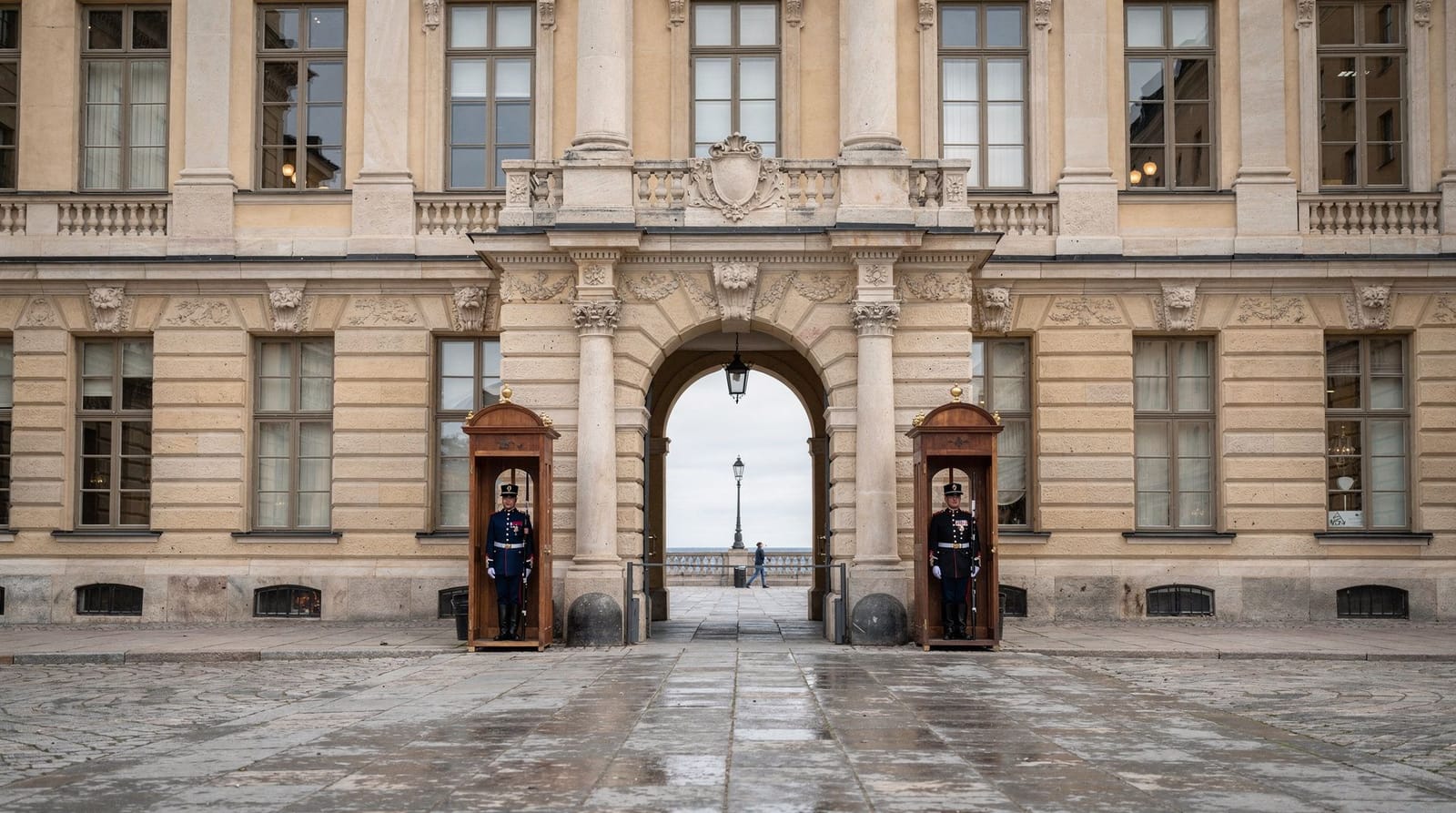
The changing of the guard at the Stockholm Royal Palace is one of the best free spectacles in the city. The ceremony begins at 12:15 Monday–Saturday (13:15 on Sundays and public holidays) and lasts approximately 40 minutes. The Royal Guard (Högvakten) marches from their barracks on Riddarholmen accompanied by the Life Guards Band; the ceremony involves elaborate formal exchanges between the outgoing and incoming guards in the outer courtyard.
In summer (May–August) the ceremony takes place daily. Off-season it occurs on Wednesdays, Saturdays, Sundays, and Swedish public holidays. The ceremony is free — simply enter the outer courtyard before 12:00 to get a good position. The best viewing spots are along the walls on either side of the central courtyard.
Tourist trap warning: Vendors selling “ceremony programmes” sometimes approach tourists near the courtyard. These are unnecessary — the ceremony is the same every day and no programme is needed to appreciate it.
History of the Royal Palace
A royal fortress has occupied this site since at least the 13th century. The Tre Kronor castle — named for the three crowns that featured on its towers and in the Swedish coat of arms — was expanded and rebuilt repeatedly over four centuries. The castle that burned in 1697 had been the centre of Swedish royal power during the Stormaktstiden (Age of Greatness), when Sweden was a Baltic empire.
The fire was caused by negligence in a room adjacent to the royal apartments. It burned for three days, destroying most of the medieval castle and the accumulated royal art collection. King Karl XII, fighting wars in eastern Europe, never returned to Stockholm to see the reconstruction. His successor ordered the design of a new baroque palace from architect Nicodemus Tessin the Younger, following Italian models.
Construction took from 1697 to 1760. The result is the present building: a baroque palace in the manner of Bernini’s Palazzo Montecitorio rather than Versailles, with facades in Roman palace style rather than French formal classicism. The Swedish royal family has occupied it continuously since the 1750s, though the principal private residence has shifted to Drottningholm in the modern era.
For a fuller comparison of how the Royal Palace relates to the family’s other residences and Sweden’s other historic castles, see the royal palaces comparison guide, which sets Gamla Stan’s palace alongside Drottningholm and Gripsholm side by side.
Understanding the Vasa dynasty’s imprint on the palace
Much of what makes the Royal Palace’s collections legible is the underlying story of the Swedish monarchy across four centuries, and the palace itself is arguably the best single place to absorb that story. The fortress that preceded the current baroque building was already centuries old when the Vasa dynasty took power in the 16th century — the same dynasty that built Gripsholm Castle in Mariefred as a secondary residence and defensive stronghold. Seeing the Royal Palace’s Treasury alongside a visit to Gripsholm, for visitors with the time, gives a genuinely fuller picture of how Swedish royal power expressed itself differently in an urban ceremonial palace versus a rural fortress.
The Tre Kronor Museum specifically addresses the transition point: the medieval castle that stood here before 1697 was itself a Vasa-era stronghold, rebuilt and expanded across generations before the catastrophic fire cleared the way for Tessin’s baroque design. Walking from the Tre Kronor Museum’s medieval foundations up into the 18th-century State Apartments above makes that three-century leap physically legible in a way that reading about it cannot replicate.
Tickets and passes
Admission: 220 SEK adult (240 SEK May–September), 200 SEK students (220 SEK May–September), 110 SEK for ages 7–17 (120 SEK May–September), free up to age 6 with an adult. One ticket covers the Royal Apartments, the Treasury and the Museum Three Crowns. Prices can change, so check kungligaslotten.se.
Individual sections: The State Apartments and Treasury can be purchased separately at slightly lower prices than the full combination. For most visitors the combination makes more sense.
Skip-the-line guided tour: The Royal Palace skip-the-line tour with Gamla Stan includes a guided walk through the palace museums and a tour of the surrounding old town streets — a good option for first-time visitors who want orientation as well as access.
Stockholm Pass: Included. Verify coverage at time of purchase.
Self-guided mystery tour: The self-guided mystery tour at the Royal Palace uses an app-based format with puzzles and storytelling — a good option for families with older children.
Accessibility
Lifts serve the main museum sections. The Treasury is underground and has lift access. Some areas of the older Tre Kronor museum have limited accessibility. Contact the palace in advance for detailed accessibility information. The outer courtyard is fully accessible.
Getting there
T-bana: Gamla Stan station (Red line 13/14, Green line 17/18/19). Walk north through the island — the palace is at the northern tip of Gamla Stan, approximately 7 minutes’ walk from the station.
On foot from Central Station: Cross Centralbron bridge and walk south into Gamla Stan; allow 15–20 minutes.
From Slussen (Södermalm): The Gamla Stan T-bana station is at Slussen; the palace is an 8-minute walk north through the old town.
Where to eat nearby
Den Gyldene Freden (Österlånggatan 51): One of Stockholm’s oldest restaurants (1722), a few minutes’ walk from the palace. Traditional Swedish husmanskost in a genuinely historic interior. Moderate-expensive; reserve ahead.
Pelikan (Blekingegatan 40, Södermalm): A tram ride away on Södermalm, this beer hall serves some of the best traditional Swedish food in the city. Worth the detour for a proper Swedish lunch after the palace visit.
Café Kaffekoppen (Stortorget 20): On the main square of Gamla Stan, immediately south of the palace. Hot chocolate in ceramic cups, served in a candlelit basement. Tourist pricing, but the hot chocolate is legitimately excellent on a cold day.
Combine with
Nobel Prize Museum: Five minutes’ walk south on Stortorget (the main square of Gamla Stan), the Nobel Museum is a natural pairing. See the Nobel Prize Museum guide.
Gamla Stan walking tour: The palace anchors the northern end of Gamla Stan — a walk south through the island to Stortorget and along the main lanes covers the key historic district in 1–2 hours. See the Gamla Stan walking tour guide for a structured route.
Medieval Museum: The Medieval Museum under Norrbro, a short walk from the palace, has been closed since November 2023, with a new museum planned at Börshuset and no opening date. Our Medieval Museum guide explains the current situation and the Medieval Hub pop-up.
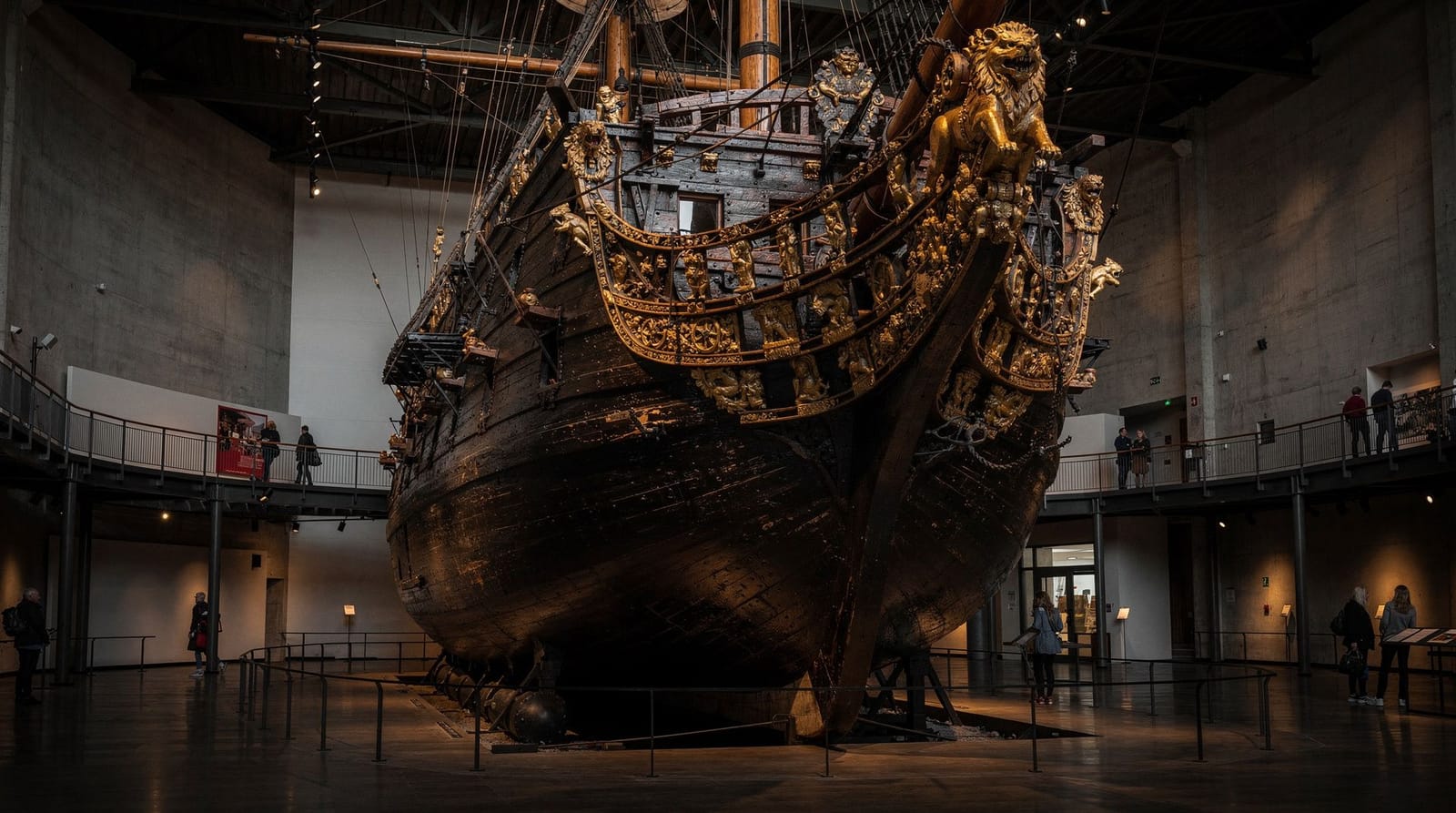
Vasa Museum: A short T-bana or ferry ride away on Djurgården, the preserved 17th-century warship makes a strong afternoon pairing with a Royal Palace morning — both cover roughly the same century of Swedish state ambition from different angles. See the Vasa Museum guide.
Changing of the guard + morning in Gamla Stan: The ideal sequence is: arrive in Gamla Stan by 10:30, walk the lanes, be in the palace courtyard by 12:00 for the ceremony, then visit the interior museums in the afternoon.
On a rainy day or with a museum pass: If poor weather is forecast, the palace’s five indoor sections make it one of the more reliable rainy-day options in Gamla Stan — see the rainy-day museum guide. If you are visiting several paid museums, check whether the Stockholm museum pass covers the palace before buying tickets separately.
Frequently asked questions about the Stockholm Royal Palace
Is the Royal Palace in Stockholm open every day?
The palace museums are open daily with seasonal hours (generally 10:00–17:00; longer in summer). The outer courtyard and chapel exterior can be accessed outside museum hours. Check for closure during specific state ceremonies — the palace occasionally closes sections for official functions.
What is the difference between the Royal Palace and Drottningholm?
The Royal Palace in Gamla Stan is the official state palace, used for ceremonies and open to the public as a museum. Drottningholm Palace is the family’s primary private residence, located outside the city on Lake Mälaren, and is also a UNESCO World Heritage Site. Both are worth visiting; Drottningholm requires a half-day trip but includes extensive grounds and a baroque theatre.
Can I see the crown jewels at the Royal Palace?
Yes. The Treasury (Skattkammaren), one of the five museum sections inside the palace, displays the Swedish royal regalia including coronation crowns, sceptres, and orbs dating from the 16th century onward.
When is the best time to visit the Royal Palace to avoid crowds?
Weekday mornings between 10:00 and 11:30 are quietest. Arrival before the changing of the guard ceremony (before 11:30) allows you to see the interior before the courtyard fills for the 12:15 event. July weekends are busiest.
Is the changing of the guard at the Royal Palace free?
Yes. The ceremony in the outer courtyard is free of charge. You do not need a museum ticket to watch the changing of the guard — simply enter the outer courtyard before the ceremony begins at 12:15.
How does the Stockholm Royal Palace compare to Buckingham Palace?
The Stockholm Royal Palace is significantly larger (600 rooms vs approximately 775 rooms at Buckingham, though the comparison is complicated by different definitions) and offers more extensive public access to the interior. The Swedish palace is more open about allowing visitors into the working state rooms. Buckingham Palace is more limited in what it shows. For the quality of what is visible, Stockholm compares very favourably.
Top experiences
Bookable activities with verified prices and instant confirmation on GetYourGuide.