Stockholm in December vs January — the honest tradeoff
Both months are dark. At 59° north, December and January offer roughly six to seven hours of daylight and temperatures in the -2°C to +3°C range. Dressing for both is the same: thermal layers, a serious coat, waterproof shoes.
The experiences, despite these shared parameters, are quite different.
| December wins on | Christmas markets, Lucia (Dec 13), Nobel Week, decorative atmosphere |
| January wins on | Lowest hotel prices, no booking pressure, best ice conditions |
| Shared | 6–7 daylight hours, -2°C to +3°C, same packing list |
| Price gap | Roughly 2,800–3,500 SEK/night (Dec) vs 800–1,200 SEK/night (Jan), mid-range Norrmalm |
| Neither: best overall | September — best weather-to-crowd ratio of the year |
December: what it actually gives you
December in Stockholm has several things in its favour that no other month offers:
Christmas markets. Stortorget in Gamla Stan, Skansen, Kungsträdgården — all operating from late November through December 22nd. The markets are genuinely atmospheric and not interchangeable with generic European Christmas market culture. Stockholm’s versions have a specific Swedish character.
Lucia, December 13th. The candlelit procession is one of the genuinely distinctive Swedish cultural events that has no equivalent elsewhere. If you’re in Stockholm on December 13th, being present for a Lucia ceremony — even the public version in Storkyrkan or a broadcast in your hotel restaurant — is worth structuring your trip around.
Nobel Week. The Nobel Prize awards are typically presented at Stockholm Concert Hall on December 10th, with the Nobel Banquet at Stadshuset that evening. The city has a specific energy during Nobel Week. Exhibits and events related to the prizes appear across the city.
Advent lighting. Stockholm’s Advent decoration is genuinely beautiful. The combination of dark streets, amber string lights, and the particular quality of northern winter light creates a visual atmosphere that photographs poorly and looks extraordinary in person.
The honest costs of December: It’s the most expensive winter month. Hotels cost 30-40% more in December than January. Restaurants are harder to book (office parties and Christmas events). The period December 22nd through January 2nd sees many businesses close or run on reduced hours — Swedes go home for Jul (Christmas).
January: what it actually gives you
January in Stockholm is the city stripped of its decoration and its tourists. It is, in many respects, the most honest version of the city.
The prices. Hotel rates in January drop to their annual low — a room that costs 200 USD/night in July can be 75-90 USD in January. The Arlanda Express discount applies more broadly. Restaurant walk-in availability improves dramatically.
The museums without crowds. The Vasa Museum in January can be visited without pre-booking. The ABBA Museum doesn’t require the weeks-in-advance timed entry that July demands. The Nordiska Museet and Fotografiska have room to breathe.
The possible Northern Lights. Stockholm is not a Northern Lights destination in the same way as Lapland (it sits too far south for reliable aurora viewing), but clear, dark nights in January occasionally produce faint displays visible from city outskirts and definitely from islands. The Vaxholm archipelago in January, on a clear night, has produced low auroras that Stockholm visitors very rarely experience.
The winter sports. Ice skating on natural ice at Djurgårdsbroen or Kungsträdgården (when temperatures cooperate). Winter kayaking with sauna. The long-distance ice skating on the frozen lake archipelago in January-February is a specific Swedish experience with no warm-weather equivalent.
The honest costs of January: It’s the darkest month. Six hours of daylight means your day — from a photography and outdoor-activities perspective — is compressed into a narrow window of useful light. If you’re prone to seasonal mood effects, this is real. The city can feel austere without the Christmas decoration.
The comparison table
| Factor | December | January |
|---|---|---|
| Hotel prices | +30-40% | Lowest of year |
| Christmas atmosphere | Yes, through Dec 22 | No |
| Lucia ceremony | Dec 13 specifically | No |
| Museum crowd levels | Low (off peak) | Very low |
| Nobel events | Dec 10 | No |
| Northern Lights possibility | Low | Moderate |
| Winter sports | Limited ice | Best ice conditions |
| Restaurant availability | Harder to book | Easy |
| Daylight hours | 6-7 hours | 6-7 hours |
Our recommendation
Choose December if: Christmas markets, Lucia, and the decorative atmosphere matter to you. Book accommodation and key restaurants well in advance. Budget for higher prices.
Choose January if: Budget, crowd avoidance, and unusual winter experiences are the priority. The city works for you — it simply works without spectacle.
The case for neither: September. Best weather, longest useful daylight, lowest crowd levels while all attractions are open, not yet at summer prices. September in Stockholm is objectively the best month if you have flexibility.
Stockholm Christmas markets and lights guided walking tour Stockholm ice skating with fire and chance of Northern LightsFull seasonal planning is in our Stockholm seasonal guide. The winter-specific Stockholm winter activities guide covers ice skating, winter kayaking and sauna options.
The specific beauty of December Stockholm
December in Stockholm produces an aesthetic that’s specific to the latitude. The combination of 6-7 hours of daylight and the full Advent decoration — strings of amber lights running between buildings, stars in windows, the blue-hour quality of the light at 3 PM — creates a visual environment that photographs inadequately. It needs to be seen at walking pace.
The key December window: 3 PM to 5 PM, when it’s dark enough for the lights to matter but the streets are still active. This is when Gamla Stan goes from pretty to extraordinary. The narrow streets between Prästgatan and Stortorget, with low winter light remaining in the west and the amber lanterns already lit, is the Stockholm aesthetic that the Christmas market visitors actually remember afterward.
Practical December timing: Arrive no later than December 10th if Lucia (13th) is a priority. The week before Lucia, the city builds toward it. By December 22nd, most markets are closing. The dead week (December 23rd-January 2nd) is a separate experience: the city is closed, the Swedes are with family, the streets are empty in a way that is either peaceful or eerie depending on your perspective.
The specific beauty of January Stockholm
January’s aesthetic is the opposite of December’s spectacle. The city stripped down: no decoration, fewer people, long horizontal winter light that hits the facades of buildings at angles that summer never reaches.
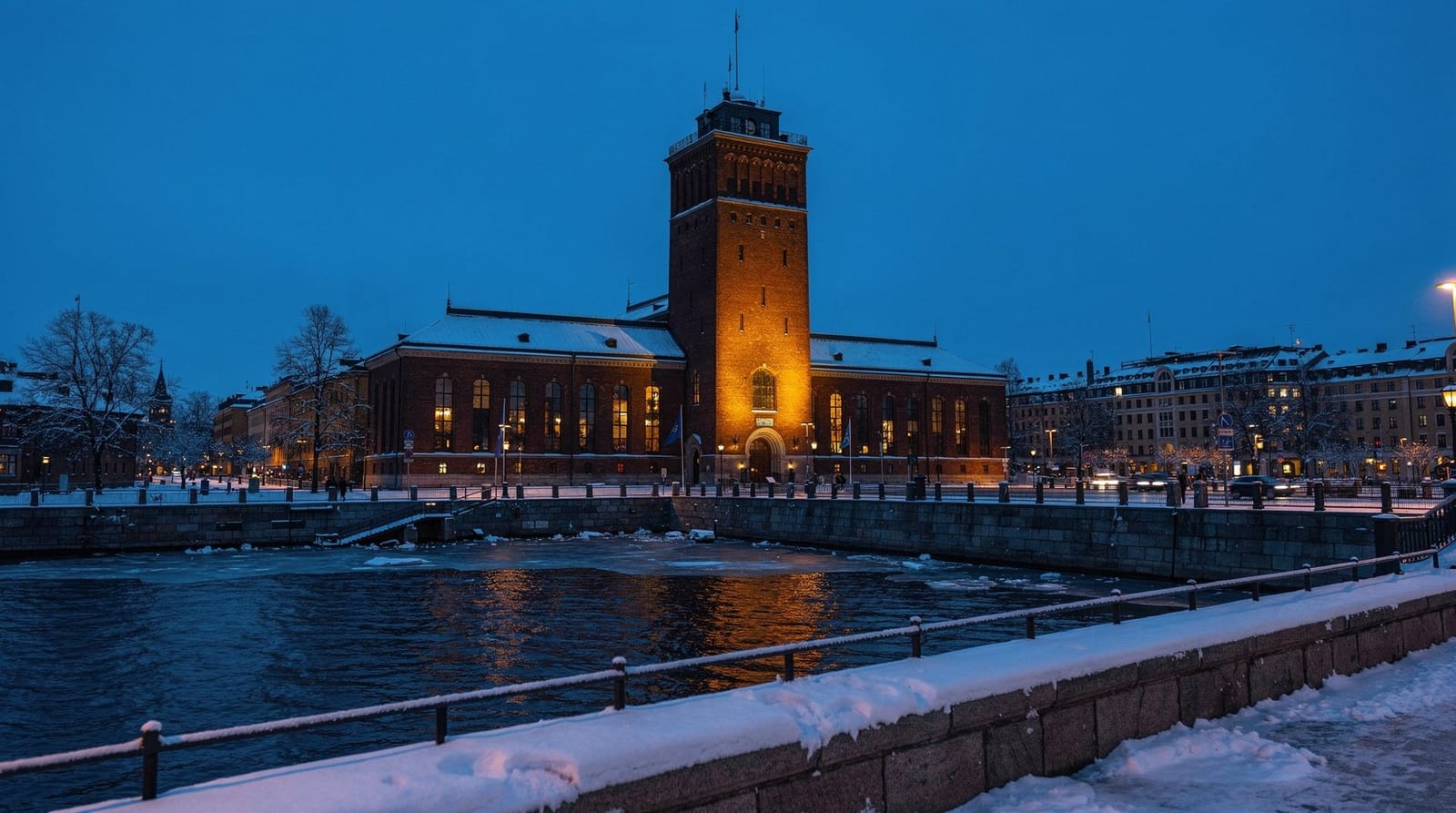
The specific January Stockholm view: from Södermalm’s heights (Monteliusvägen, the cliff walk above Mälaren) at noon, looking north toward the City Hall and Gamla Stan. The red brick of Stadshuset in the low winter sun, the water below it dark and flat, the sky the colour of hammered pewter. This view exists at every season but it is in January that it is most itself.
Budget difference made concrete
To illustrate the December vs January price gap in concrete terms:
A 3-night stay at a mid-range Norrmalm hotel:
- Early December: 2,800-3,500 SEK per night
- Mid-January: 800-1,200 SEK per night
For a couple on a 3-night trip, the difference is 6,000-6,900 SEK (roughly €550-620) — enough for additional activities, nicer restaurants, or simply a more comfortable budget.
The attractions themselves don’t change price with season, which means January effectively gives you the same city for substantially less accommodation cost.
The case for a combined visit
If you have flexibility, the optimal Stockholm winter visit is December 11-14 (capturing Lucia on the 13th) followed by a gap and a return visit in late January. This sounds like more travel than most people plan, but if you’re within a 3-hour flight of Stockholm, the logistics are manageable.
The alternative: pick one, go deep. Four nights in early December, focused on markets and Lucia and the Christmas atmosphere. Or four nights in late January, focused on museums, ice skating, low prices, and the quiet city.
Nobel Week and Lucia in more depth
December’s calendar events deserve their own planning notes since they’re date-fixed, not seasonal. The Nobel Prize Museum runs Nobel-related exhibits and events through the December 10th award ceremony, and the city’s energy noticeably shifts that week. Lucia, three days later, is worth structuring a trip around if you can — our Lucia Day guide covers where to catch a ceremony and what the day involves beyond the candlelit procession itself. Both events cluster in the same ten days, which is one reason a focused early-December visit (the 10th to the 14th, roughly) captures more of the city’s specific character than a longer, more diffuse stay.
What each month means for museums and markets
January’s crowd-free museums are a real practical advantage: the Vasa Museum needs no advance booking, unlike July’s queues. December instead delivers the Christmas markets — Stortorget, Skansen and Kungsträdgården all running through the 22nd — which January doesn’t have at all. If markets matter more than crowd-free museums, that alone should settle the choice between the two months. Gamla Stan is worth visiting in either month, but the character shifts completely: decorated and lively in December, quiet and stripped-back in January.
Packing and ice conditions
Both months share a packing list, but January’s better and more reliable ice makes cold-weather gear slightly more load-bearing if activities are on your itinerary. Our ice skating guide covers where natural ice forms most reliably, usually favouring January and February over December. If you’re arriving without proper winter kit, winter clothing rental works for either month and saves checked-baggage space. Clear January nights occasionally produce faint aurora from the outer archipelago — see our Northern Lights from Stockholm guide for realistic expectations, since Stockholm is not a reliable aurora destination the way Lapland is.
Stockholm Nordic ice skating for beginnersFrequently asked questions about Stockholm in winter
Do Stockholm hotels have good heating?
Yes. Swedish buildings are exceptionally well-insulated and heated for the climate. Indoor temperatures in hotels and restaurants are warm to the point that visitors occasionally find them too warm. Dress in layers you can remove indoors.
Should I fly to Stockholm in winter or take the train?
Flying is faster from most European cities. The train from Hamburg to Stockholm via Copenhagen is a realistic 10-12-hour journey for those who prefer overland travel. From London, the flight is roughly 2.5 hours. From within Scandinavia, the train is competitive.
Is there snow in Stockholm in December and January?
Not reliably. Stockholm gets snow but it doesn’t stay. December snow is possible but often melts within days. January is more likely to have sustained snow cover, particularly in years with consistent cold. A white Christmas in Stockholm is a wish rather than an expectation.
Which month has better ice skating?
January, generally. Natural ice on the archipelago lakes needs sustained cold to form safely, which December’s milder, more variable temperatures don’t always provide. See our ice skating guide for current conditions and where to check before heading out onto natural ice.
Is Nobel Week worth planning a December trip around?
If you’re interested in the ceremony’s atmosphere rather than attending the events themselves (which require invitations), yes — the city has a distinct energy in the days around December 10th, and the Nobel Prize Museum runs related exhibits that are open to the public.