Stockholm Viking Museum guide: the Djurgården experience reviewed honestly
Stockholm: Viking Museum exhibition and Viking Ride
Is the Stockholm Viking Museum worth visiting?
The Viking Museum (Vikingaliv) on Djurgården is worth visiting for families and those wanting an accessible introduction to the Viking Age. The Viking Ride (Ragnfrid saga) is a genuinely engaging motion-ride experience. The ticket includes both the ride and the full exhibition; check the current price on the museum's official site. For serious Viking Age history, the museum is supplementary rather than definitive — the Birka day trip and the Swedish History Museum's Gold Room cover the academic depth.
Vikingaliv: the Viking Museum that chose entertainment over academia
The Stockholm Viking Museum opened in 2017 on Djurgårdsstranden — the waterfront path that links the Vasa Museum to the Nordiska Museet. It was built with a clear philosophy: the Viking Age matters, but most people will not read academic panels. The solution was to build a motion-ride attraction (the Ragnfrid Viking Saga) as the museum’s core, and surround it with exhibition content that could be navigated casually or in depth depending on the visitor’s appetite.
This philosophy is worth understanding before visiting, because it shapes what the museum is and what it is not. It is not primarily an archaeology museum — the Swedish History Museum’s Gold Room holds that distinction. It is not the most rigorous guide to Viking Age history in Stockholm — that would be a guided visit to Birka. It is a produced cultural experience that takes the Viking Age seriously enough to base its content on scholarship, while presenting it in a way accessible to people who would not otherwise engage with Viking history at all.
For what it is, it is well executed. The question of whether it is the right choice for you depends on what you are looking for.
Book Viking Museum exhibition and Viking Ride ticketsThe Viking Ride: Ragnfrid’s journey
The centrepiece is the Ragnfrid Viking Saga — a motion experience. The premise: Ragnfrid is a female Norse merchant, a trader on the eastern routes. Visitors follow her story through a sequence of theatrical sets.
Scenes include:
- A Norse market town in summer — the buying and selling that was the economic reality of the Viking Age rather than the raiding that dominates popular imagination.
- A longship at sea — the vessel and the voyage, with scale models and sound design creating the sense of crossing open water.
- A storm — the most kinetically intense moment of the ride; significant sound and movement.
- Encounters with foreign cultures — Byzantine, Frankish, Arab — demonstrating the range of the trade networks.
The choice of Ragnfrid as the narrative figure is deliberate: the Viking Age produced female traders, landowners, and — as the 2017 Birka discovery demonstrated — possibly female military commanders. The museum makes this explicit rather than defaulting to the male-warrior stereotype.
Technical note: The ride runs on a timed schedule. Check the day’s schedule immediately on arrival and plan your visit around it — either seeing the exhibition first and catching a later ride, or going directly to the ride at the next available departure.
Age/accessibility: The ride is appropriate for children aged 5 and above. The storm sequence involves significant sound and movement that may frighten very young children (under 4). Height restrictions apply for safety; check on arrival.
The permanent exhibition
Longship technology
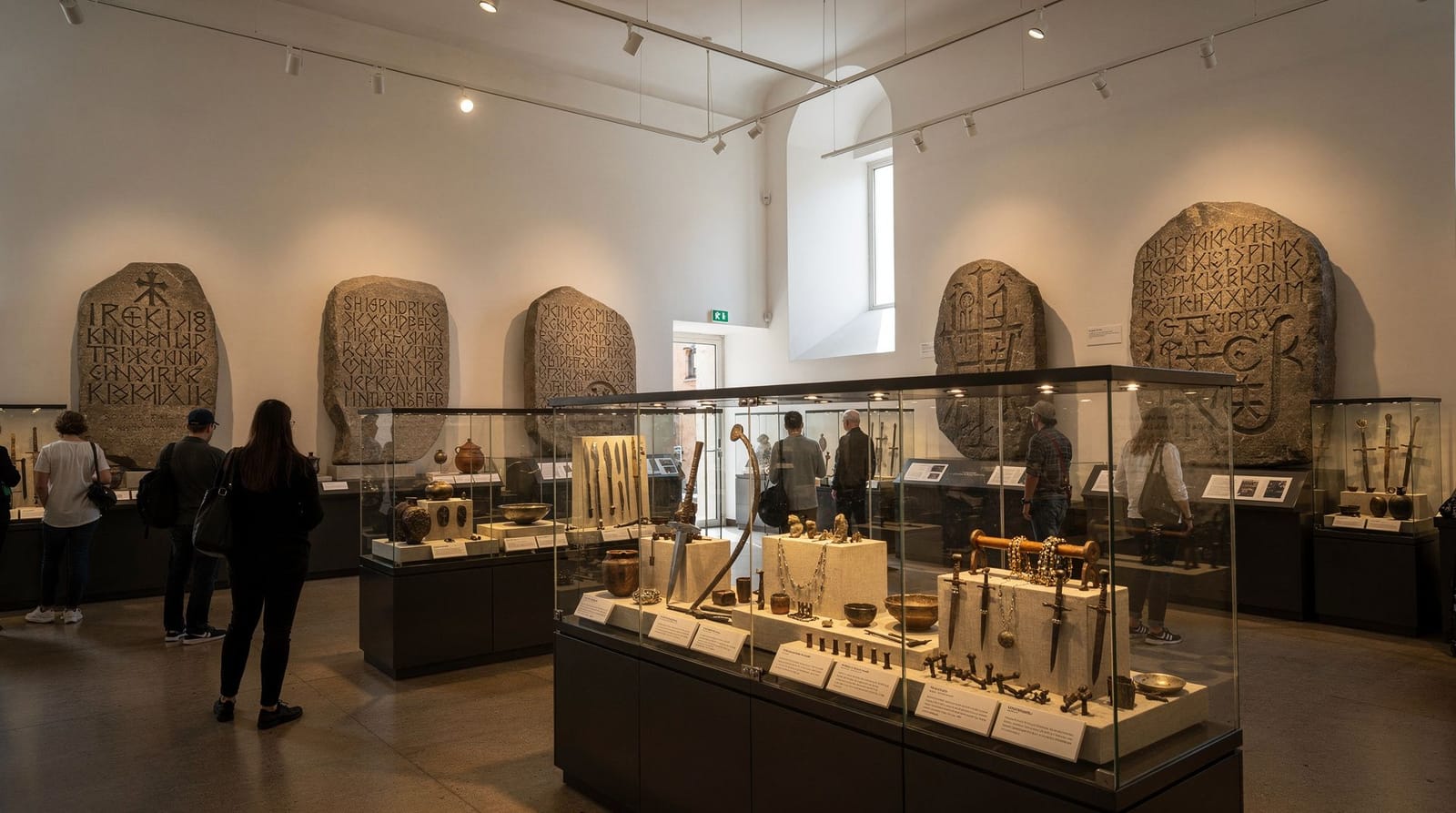
The exhibition’s technical section addresses Norse shipbuilding — specifically the clinker-built technique (strakes overlapping) that gave Viking ships their characteristic flexibility in heavy seas. Scale models and partial hull sections show the construction method and demonstrate why these vessels could cross the North Atlantic and navigate the shallow rivers of Eastern Europe.
The display distinguishes between the three main vessel types: the longship (langskip) used for warfare and raids, the knarr used for trading, and the faering (small rowing boat) used for fishing and local travel. Most popular imagery focuses exclusively on the longship; the museum corrects this.
Trade networks and material culture
The strongest academic content in the museum addresses the Vikings as traders and travellers rather than warriors. The trade-route maps show the extent of Norse commercial reach — from the British Isles west, down the Atlantic coast, across the Mediterranean, and via the Volga routes to Byzantium and the Arab world.
Objects (replicas and some originals) illustrate what was traded: furs, amber, ivory, silver, and slaves northward; luxury goods — silk, silver coins, glass, spices — southward. The Arabic dirhams found in Scandinavian graves (the original coins are in the Swedish History Museum and at Birka) are explained here with maps showing the dirhams’ origin in the Abbasid Caliphate and their journey north.
Women in the Viking Age
A dedicated section addresses the historical and archaeological evidence for women’s roles in Viking Age society — more varied and active than the male-warrior stereotype suggests. The Birka warrior woman (grave Bj 581) features prominently; the museum explains both the original 1878 excavation assumptions and the 2017 DNA analysis that upended them.
This section is among the most current and evidence-based in the museum. The guide panels cite specific academic sources and acknowledge scholarly debate rather than presenting a single interpretation.
Interactive elements
Hands-on stations allow visitors to handle replica tools, try aspects of period clothing, and attempt rope-making and other craft activities. These are primarily useful for children and younger visitors; adults with archaeological interest will move through them quickly.
Honest assessment: who benefits most
Best for:
- Families with children aged 5–14: the ride is the strongest family-museum experience in the Viking category in Stockholm.
- Visitors with a day in Stockholm who want to engage with the Viking Age without the full day required for Birka.
- Those who want an accessible, designed museum experience rather than an outdoor archaeological site.
- Non-English speakers: the audio guide and exhibition panels are available in multiple languages.
Less suited for:
- Visitors with deep archaeological interest (Swedish History Museum + Birka is the appropriate combination).
- Those seeking primary source material — most display objects are replicas or reproductions.
- Adults without children who prefer more academic presentation.
- Budget travellers: tickets are not cheap, so compare the current price with the other Djurgården museums.
Combining the Viking Museum with other Djurgården museums
The Viking Museum sits on Djurgårdsstranden between the Vasa Museum (5 minutes west) and the Nordiska Museet (8 minutes west). A logical Djurgården day:
- 11:00 (10:00 at weekends): Viking Museum (check ride schedule; arrive for 10:30 ride if possible).
- 12:00: Lunch at the Viking Museum café or Blå Porten Café (5 minutes east) — see the ABBA Museum guide for the fuller description of the café.
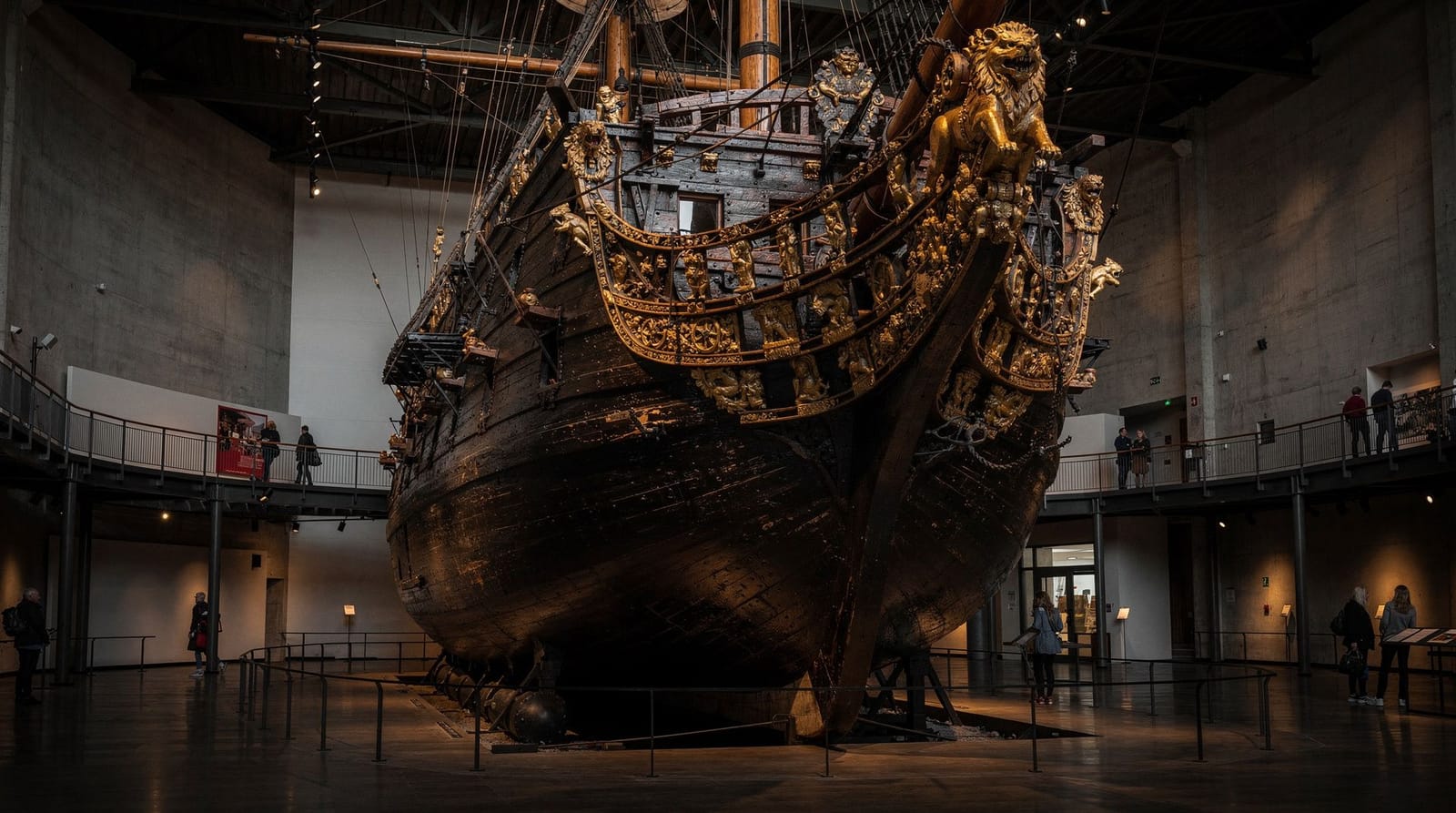
- 13:00: Vasa Museum (buy tickets online in advance — see the Vasa Museum guide).
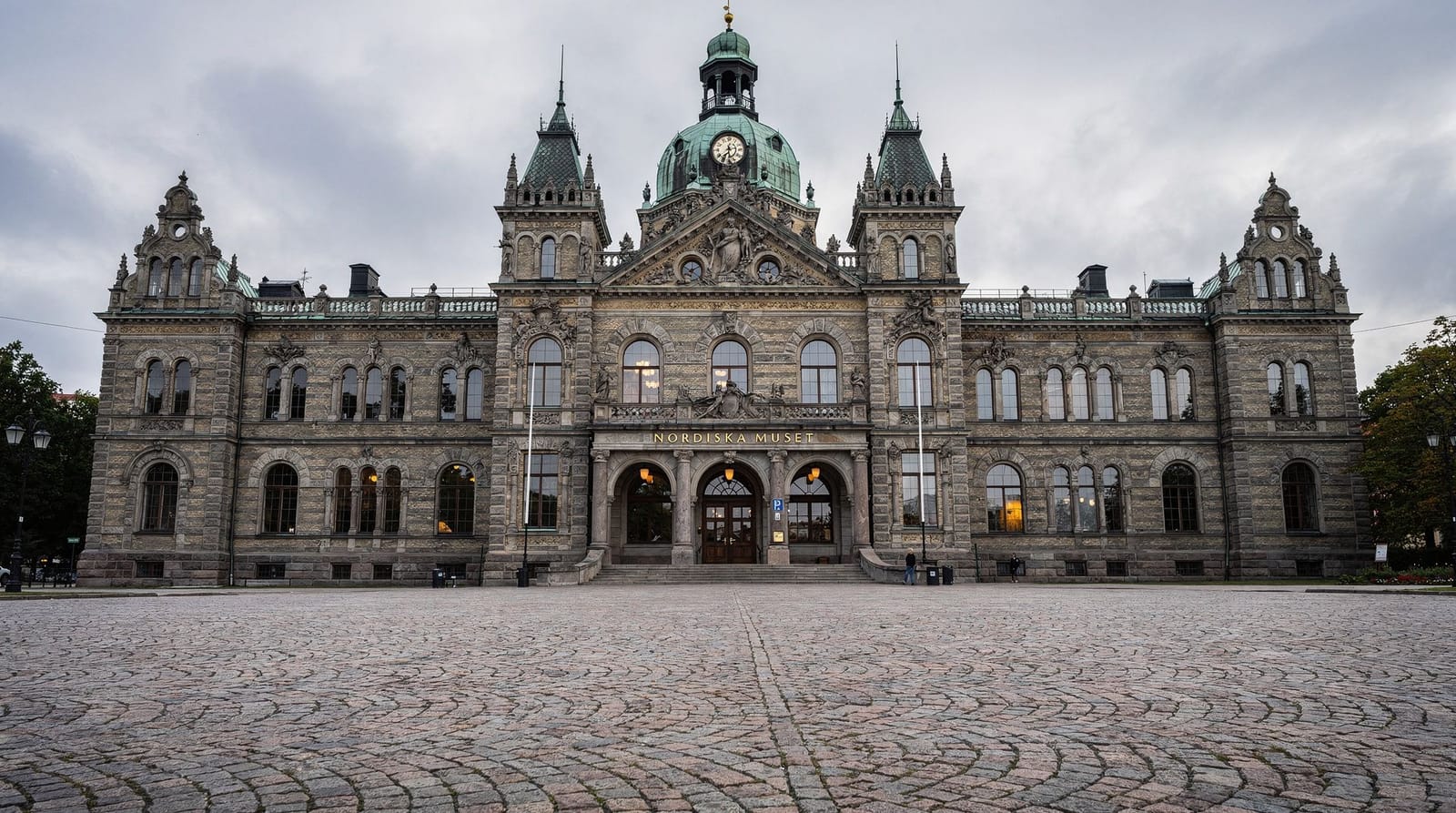
- 15:30: Nordiska Museet (Swedish cultural history, free entry with certain cards).
For visitors doing this in bad weather, see the museum rainy-day guide — all three museums above are indoor, making this route as good a wet-weather plan as a sunny one. If you’re weighing whether a multi-museum pass makes sense for your trip, the Stockholm museum pass guide breaks down current coverage and value.
This combination covers three major Djurgården museums in a single day — feasible if moving efficiently between them.
How the Viking Museum compares to Birka
| Viking Museum (Djurgården) | Birka (Björkö island) | |
|---|---|---|
| Distance from centre | 20 min by tram/bus | 2 hours by boat |
| Price | See official site | ~395 SEK (includes boat) |
| Time needed | 1.5–2 hours | 7 hours total |
| Primary approach | Entertainment/interactive | Archaeological site |
| Objects | Mostly replicas | Museum with excavation finds |
| Best for | Families, casual interest | Archaeological interest, serious history |
| Year-round | Yes | May–September only |
The two are complementary, not competitive. Visitors in Stockholm for 4+ days can reasonably do both. For shorter visits: the Viking Museum is the in-city option; Birka is the full-day commitment that delivers more archaeological substance.
If the museum leaves you curious about the real sites, a boat trip out to the Viking trading town of Birka is the natural next step. The Birka destination page and the Birka Viking village guide explain what you will find on the island, and Sigtuna and Uppsala offer further Viking Age layers if you have more days to spend. Visitors planning a longer stay can slot all of this into a 4-day itinerary with the archipelago, and those thinking about how to compare the museum with Stockholm’s other headline attraction can read Vasa versus ABBA for a similar family-oriented decision.
The Viking Age in popular culture vs reality: what the museum gets right
The Viking Museum is unusually honest for a popular cultural institution. It does not reproduce the horned-helmet mythology (Viking Age helmets did not have horns — this is a 19th-century romantic invention); it presents the trade network as primary rather than the raiding; it addresses women’s roles with current archaeological evidence rather than default male-warrior assumptions.
These corrections are not minor. The horned helmet is a powerful enough image that it appears in souvenir shops throughout Gamla Stan; the Viking-as-berserker stereotype still dominates most popular media portrayals. The museum’s willingness to contradict these comfortable clichés is worth acknowledging, even if the medium (a motion ride) inevitably introduces its own dramatisations.
What the museum gets right specifically:
- The primacy of trade in the Norse world economy
- The diversity of Norse society (farmers, craftspeople, traders vastly outnumbered warriors)
- The remarkable geographical reach of Norse travel (not just western raids but eastern river routes)
- The ongoing scholarly reassessment of gender in the Viking Age
- The historical accuracy of the Ragnfrid narrative (female merchants are historically attested)
What the museum necessarily simplifies:
- The scale of Norse slavery (an economically central practice that the museum addresses but cannot dwell on)
- The internal political complexity of the Viking Age Norse world
- The religious transition from paganism to Christianity (briefly mentioned but not examined)
- Regional variation within Scandinavia (the museum conflates Norwegian, Danish, and Swedish Norse practices for narrative simplicity)
None of these simplifications are dishonest — they are inevitable given the entertainment format. Knowing them allows you to use the museum as an introduction rather than a conclusion.
Getting to the Viking Museum
Djurgårdslinjen tram (seasonal): From Norrmalmstorg (Norrmalm), the historic tram runs along Strandvägen and across Djurgårdsbroen to the museum strip. The tram is a pleasant and appropriate way to arrive on Djurgården — wooden carriages from the early 20th century, moving at a comfortable pace through the park.
Bus 69: From Nybroplan or Sergels Torg, direct to Djurgårdsstranden stop.
On foot from Nordiska Museet: A 5-minute walk east along the waterfront path (Djurgårdsstranden). The walk between Nordiska Museet, the Viking Museum, and the ABBA Museum covers the full museum strip.
By boat: Some hop-on hop-off boat services stop at Allmänna Gränd on Djurgården, within walking distance of the museum strip.
The Viking Museum in relation to Stockholm’s broader Viking story
The Viking Museum on Djurgården is part of a larger network of Viking Age heritage in the Stockholm region. Visiting only the Djurgården museum gives an entertainment-focused but incomplete picture. To understand what the museum is communicating, it helps to know where the material evidence actually lives.
The museum’s exhibition is based on scholarship drawn primarily from:
- The Birka excavations (Björkö island, Lake Mälaren): the actual archaeological site with the actual burial goods, accessible by boat May–September
- The Swedish History Museum’s collection (Historiska museet, Östermalm): genuine Viking Age artefacts including the extraordinary Gold Room
- The runestone corpus in the greater Stockholm region: over 1,000 runestones within day-trip distance, including the Sigtuna cluster
The Viking Museum uses reconstructions, replicas, and theatrical presentation to communicate what these sources reveal. The distinction between “this is a replica of an object in the Swedish History Museum” and “this is an actual 9th-century trading vessel component” matters for visitors who want to calibrate their experience.
For the casual visitor or family: the museum is entirely sufficient — you do not need to visit the other sites to have a worthwhile museum experience. For the visitor who wants to connect the entertainment-presentation to actual archaeological evidence: the Swedish History Museum and Birka are the necessary complements. For a full map of every Viking Age site accessible from Stockholm — including Gamla Uppsala and Sigtuna as well as Birka — see the Viking heritage in the Stockholm region guide.
What to buy at the museum shop
The Viking Museum shop is one of the better museum shops in Stockholm for genuinely interesting objects.
Books: The museum carries Neil Price’s “Children of Ash and Elm” (the best current popular account of the Viking Age), Judith Jesch’s work on women in the Viking Age, and several Swedish-language archaeology titles. If you read Swedish, the Swedish titles offer deeper access to the scholarship behind the exhibition.
Replicas: High-quality jewellery reproductions based on actual Viking Age pieces from Swedish museum collections — brooches, pendants, and arm rings modelled on originals. These are the appropriate Viking souvenir for visitors who want an accurate reference rather than a cartoon shield magnet.
Children’s items: Vikings for children is well-served here — illustrated books, small replica objects, and educational games that avoid the horned-helmet mythology while still engaging with the material.
Practical essentials
| Detail | Information |
|---|---|
| Address | Djurgårdsstranden 15, Djurgården |
| Opening hours | Mon–Fri 11:00–17:00, Sat–Sun 10:00–17:00 |
| Adult ticket | See official site |
| Children 5–15 | See official site |
| Under 5 | Free |
| Duration | 1.5–2 hours |
| Access | Bus 69, Djurgårdslinjen tram |
Frequently asked questions about the Stockholm Viking Museum
Is the Viking Museum worth it as a solo traveller without children?
Yes, if you approach it as a designed cultural experience rather than an academic museum. The Viking Ride is more engaging than most solo adults expect; the exhibition panels are well written. The ticket price is defensible for 1.5–2 hours of quality content. If archaeology is your primary interest, combine it with the Swedish History Museum’s Gold Room.
Can you skip the Viking Ride and just visit the exhibition?
The ride is included in the standard ticket. Some visitors with motion sensitivity cannot do the ride and can request an alternative at the ticket desk. A reduced ticket for exhibition-only may be available — confirm on arrival.
What should you read or watch before visiting the Viking Museum?
The museum’s own content is self-contained. For context: Neil Price’s “Children of Ash and Elm” is the most current and comprehensive popular academic account of the Viking Age. The museum’s narrative aligns with the current scholarly consensus Price represents — it will add depth to what you see, not contradict it.
How does the Viking Museum fit into a Djurgården day with children?
For families with children aged 5–12, a Djurgården day that includes the Viking Museum works best in the following sequence: Viking Museum first (opens 11:00 on weekdays, 10:00 at weekends; book the first Viking Ride slot), Vasa Museum in the afternoon (book online for timed entry around 13:00 to avoid midday queues). The two museums share the same Djurgårdsvägen location (5 minutes apart on foot), and the combination — immersive Viking experience plus the 17th-century warship — covers a large span of Swedish maritime and historical culture in a single day.
The Viking Museum’s interactive elements (the Viking Ride, the hands-on stations) tend to engage children who may find the Vasa Museum’s more static presentation less immediately gripping. Starting with the Viking Museum’s energy and concluding with the Vasa Museum’s sheer scale works well developmentally.
What is the Viking Museum’s approach to the violent aspects of the Viking Age?
The museum addresses raiding and violence without dwelling on them in a way that would be inappropriate for children. The Ragnfrid narrative focuses on trading and travel; weapons are shown in combat context in the exhibition but not in graphic detail. The museum’s approach is honest — it does not pretend the Viking Age was peaceable — while maintaining appropriate content for family audiences. Parents with children under 8 who are particularly sensitive to violent historical content may want to preview the weapons section before bringing young children through it.
Is the Viking Museum the same as the Swedish History Museum?
No — they are separate institutions in different locations. The Viking Museum (Vikingaliv) is on Djurgårdsstranden and is an entertainment-focused private museum focused on the Viking Age specifically. The Swedish History Museum (Historiska museet) is on Narvavägen in Östermalm, is a state museum covering all of Swedish prehistory and history, and holds the most important archaeological Viking Age collection in Sweden including the Gold Room. Both are worth visiting; they are not interchangeable. The Viking Museum is more engaging for casual visitors and families; the History Museum is more substantive for those interested in the actual archaeological material.
Ticket value at a glance
| Ticket | Price | Best for |
|---|---|---|
| Standard adult (GYG) | See official site | Guaranteed ride slot, skip the ticket-desk queue |
| Child 5–15 | See official site | Same inclusions as adult |
| Under 5 | Free | Exhibition access (ride subject to height limits) |
| Combined with Vasa | Purchased separately | No official discount, but a 5-minute walk apart |
Top experiences
Bookable activities with verified prices and instant confirmation on GetYourGuide.