ABBA Museum guide: Stockholm's pop pilgrimage
Stockholm: ABBA The Museum entrance ticket
Duration: ~2 hours
Is the ABBA Museum worth visiting?
For ABBA fans it is absolutely worth it — the museum is genuinely well-designed, interactive, and emotionally resonant. For casual visitors curious about the cultural phenomenon, it still delivers. Allow 1.5 to 2 hours. Book in advance; timed entry is mandatory and summer slots sell out weeks ahead.
ABBA in the place that made them
ABBA won the Eurovision Song Contest in Brighton in 1974 with Waterloo. The four members — Agnetha Fältskog, Björn Ulvaeus, Benny Andersson, and Anni-Frid Lyngstad — became the most commercially successful Swedish musical act in history, selling an estimated 400 million records worldwide. They stopped performing together in 1982. For thirty years they declined every reunion offer.
ABBA The Museum opened on Djurgården in Stockholm in 2013, built with the direct involvement of Björn and Benny. It is housed in a striking building at the eastern end of Djurgårdsvägen, next to the Grona Lund amusement park. The Pop House, as the complex is called, also includes a hotel, restaurant, and the Swedish Music Hall of Fame. The museum itself spans two floors and covers the band’s entire career, personal histories, and cultural legacy in considerable depth.
This is not a casual detour. The museum was designed by people who care about it, and it shows.
Practical essentials
| Detail | Information |
|---|---|
| Address | Djurgårdsvägen 68, Djurgården |
| Opening hours | Daily: 10:00–18:00 (Sep–Apr), 10:00–20:00 (May), 09:00–20:00 (June to mid-Aug), 10:00–20:00 (late Aug); Christmas Eve and Day 10:00–15:00 |
| Adult ticket | 269–349 SEK depending on the date (~26–33 USD) |
| Children 7–15 | Half price |
| Under 7 | Free |
| Recommended time | 1.5–2 hours |
| T-bana/tram | Bus 69 or Djurgårdslinjen tram from Norrmalmstorg |
| Walk from Vasa Museum | 10 minutes east on Djurgårdsvägen |
Timed entry is mandatory. Book your slot before you travel — do not rely on same-day availability in summer.
Book your ABBA Museum timed entry ticketWhat to see inside
The holographic stage: ABBA Mega Mix
The most famous element is the virtual holographic stage where visitors can perform alongside ABBA. You choose your costume (options span the entire 1970s sequin-and-platform spectrum), step up, and the technology places a life-size holographic ABBA band around you. The result is recorded and can be purchased. It is one of those experiences that works better than it sounds — people who describe themselves as not particularly ABBA fans frequently report it as one of the highlights.
The costumes
The exhibition includes the full original stage and video costumes, presented in meticulous condition. The 1974 Eurovision silver platform boots, the various Voulez-Vous-era jumpsuits, and the white outfits from the iconic videos are all here. The costumes are more striking in person than in photographs — the scale of the platform shoes in particular, which look theatrical even by 1970s standards, is remarkable up close.
The recording studio replica
A faithful reconstruction of Polar Music Studio in Stockholm, where ABBA recorded most of their hits, occupies a significant section of the second floor. The equipment is period-accurate. Visitors can sit at the mixing desk and interact with isolated vocal and instrument tracks from ABBA recordings. Hearing the individual components of Waterloo or The Winner Takes It All separated out — just Agnetha’s vocals, just the piano — gives the production quality a startling clarity.
Benny’s piano
This is not a replica. Benny Andersson donated his actual piano to the museum, and it is connected directly to his home. If Benny sits down at his own piano while you are visiting — which happens — both instruments play simultaneously and an indicator light illuminates in the museum. This happens less often than the marketing implies, but it does happen, and the conceit is delightful.
The Swedish Music Hall of Fame
Adjacent to the ABBA Museum but accessible with the same ticket, the Hall of Fame covers the full sweep of Swedish popular music. Sweden is disproportionately successful in global pop — the country of four million inhabitants in ABBA’s heyday has produced Roxette, Ace of Base, The Cardigans, Robyn, Avicii, and a significant proportion of the songwriters behind American pop hits (Max Martin, Denniz Pop). The context for why this happened is interesting even if the specific artists are not all familiar to you.
Personal artefacts and photographs
The exhibition draws on genuinely private material — personal letters, home photographs, handwritten lyrics, and audio recordings of the band before they were famous. The section covering the band members’ personal lives and the two romantic relationships at its heart (Björn and Agnetha, Benny and Frida, both of which ended in divorce during the band’s peak commercial period) is handled with care and adds considerably to understanding why the music has such emotional register.
Insider tips
Book months in advance for July. July is the busiest month in Stockholm and ABBA Museum slots sell out weeks ahead. If you are visiting in July, book the moment your travel plans are confirmed.
Morning slots are quieter. The first entry slots (09:00 in June to mid-August, otherwise 10:00) are significantly less crowded than midday. The interactive elements are more enjoyable without queues.
The Pop House restaurant is decent. The restaurant at ground level serves good Swedish food and is a more pleasant lunch option than many Djurgården alternatives at a similar price point.
Fast-track tour option. If you want guided context rather than self-guided exploration, the ABBA Museum fast-track and pop culture tour combines entry with a guide who covers the broader Swedish music scene.
ABBA The Movie. The museum often screens archive footage and the ABBA The Movie (1977) film in its cinema space. Check the schedule when booking.
Stockholm Pass coverage. The Stockholm Pass / Go City does not always include the ABBA Museum — verify at the time of booking as coverage has changed. Do not assume.
The story of ABBA: from Eurovision to global phenomenon
Björn Ulvaeus and Benny Andersson had been successful Swedish pop songwriters before ABBA — Björn with the Hootenanny Singers, Benny with the Hep Stars. They met in 1966 and began writing together almost immediately. Their partners, Agnetha Fältskog and Anni-Frid (Frida) Lyngstad, were both solo artists with Swedish chart careers. The four had been performing together informally before their Eurovision entry was formally registered under the name ABBA (an acronym of their initials, already being used as a sardine brand, which required and received permission from the food company).
The Eurovision win in Brighton transformed the group’s scale overnight. The global tours that followed through the mid-1970s made them one of the highest-grossing acts in the world, particularly in the UK, Australia, and Germany. By 1979, only Volvo was earning more foreign exchange for Sweden. The ABBA gold album, released after the group’s dissolution in 1982, has been released in new editions continuously ever since and is among the best-selling compilation albums ever made.
The reunion came in 2021 with the Voyage album — the first new ABBA material in 40 years — and the Abba Voyage concert in London, where holographic avatars of the band perform to live audiences. The museum added a section on Voyage to its permanent collection.
Tickets and passes
Standard timed entry: 269–349 SEK adult depending on the date, 129–169 SEK for children aged 7–15, free under 7. Book online with a specific entry time for the best price and a guaranteed slot.
Fast-track pop culture tour: Includes a guided introduction to Swedish music history alongside museum entry. More expensive but contextually richer.
Book the ABBA Museum fast-track and pop culture tourStockholm Pass: Check current coverage as inclusion varies.
Combination tickets: The Djurgården area is compact enough to combine the ABBA Museum with the Vasa Museum on the same day. No combined discount exists unless bundled through a tour or pass.
Accessibility
The ABBA Museum is fully accessible. Lifts serve both floors. Wheelchair-accessible toilets are available. The interactive elements, including the Mega Mix stage, have accessibility adaptations. Contact the museum in advance if specific arrangements are needed.
Getting there
Bus 69: From Nybroplan or Sergels Torg, direction Djurgården. Alight at Grona Lund — the museum is immediately opposite.
Tram (Djurgårdslinjen, line 7): Seasonal service from Norrmalmstorg. Stops directly at Djurgårdsvägen.
On foot from Vasa Museum: A flat 10-minute walk east along Djurgårdsvägen.
Boat: The hop-on hop-off boat stops at Djurgården; from the landing stage it is a 10-minute walk.
Where to eat nearby
Pop House Restaurant: On-site, ground floor of the same building. Swedish modern cuisine, good lunch menu, open daily.
Blå Porten Café (Djurgårdsvägen 64): An institution on Djurgården, this café occupies a former stables building with a large garden terrace. Excellent cinnamon buns and open sandwiches.
Spritmuseum restaurant (Djurgårdsvägen 38): A 10-minute walk west, the Spritmuseum’s café and restaurant is one of the better lunch options on the island. See the Spritmuseum guide.
Combine with
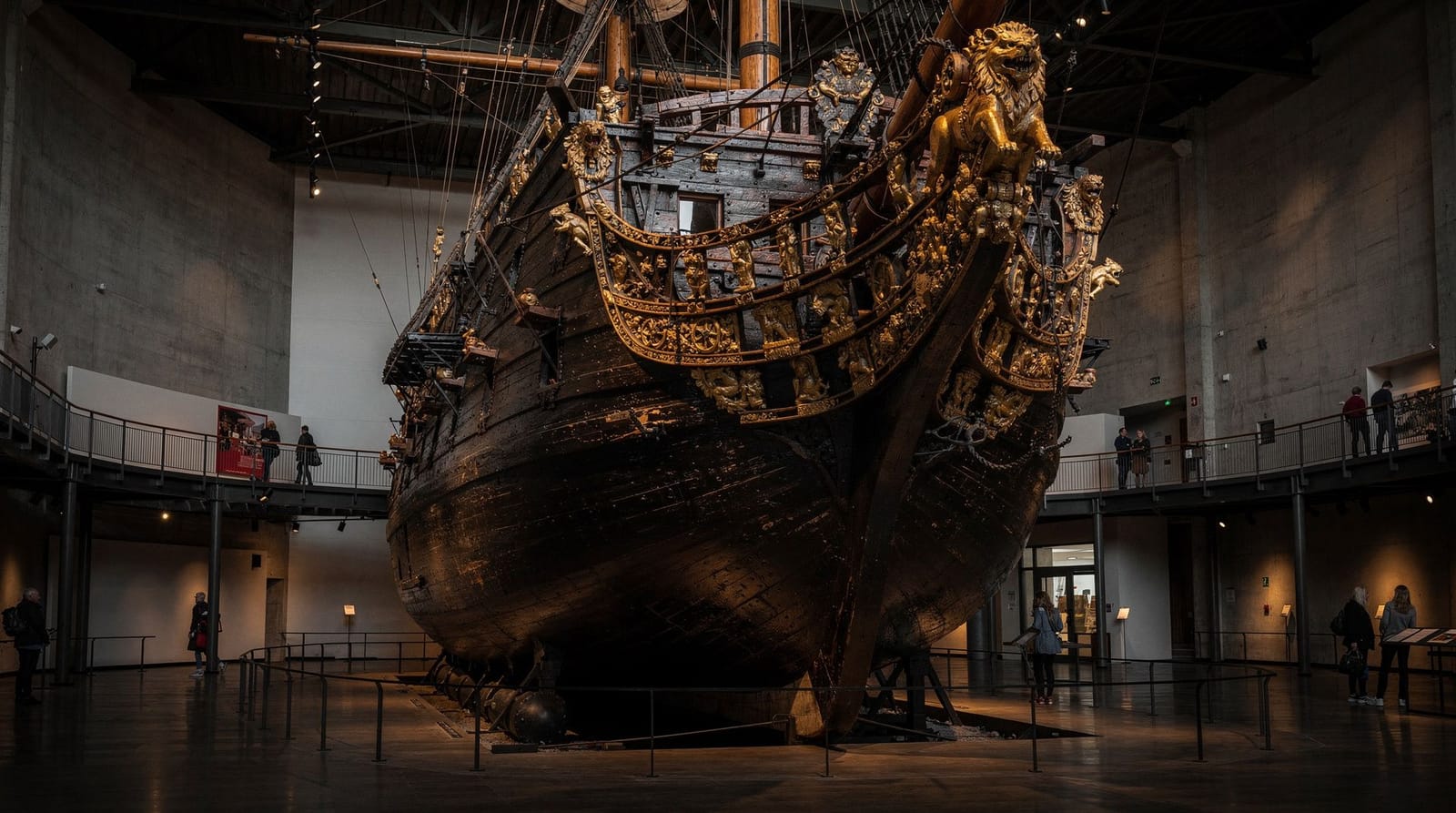
Vasa Museum: Ten minutes west along Djurgårdsvägen, Sweden’s most-visited museum. The contrast between 17th-century maritime history and 1970s pop is surprisingly satisfying as a day’s combination. See the Vasa Museum guide.
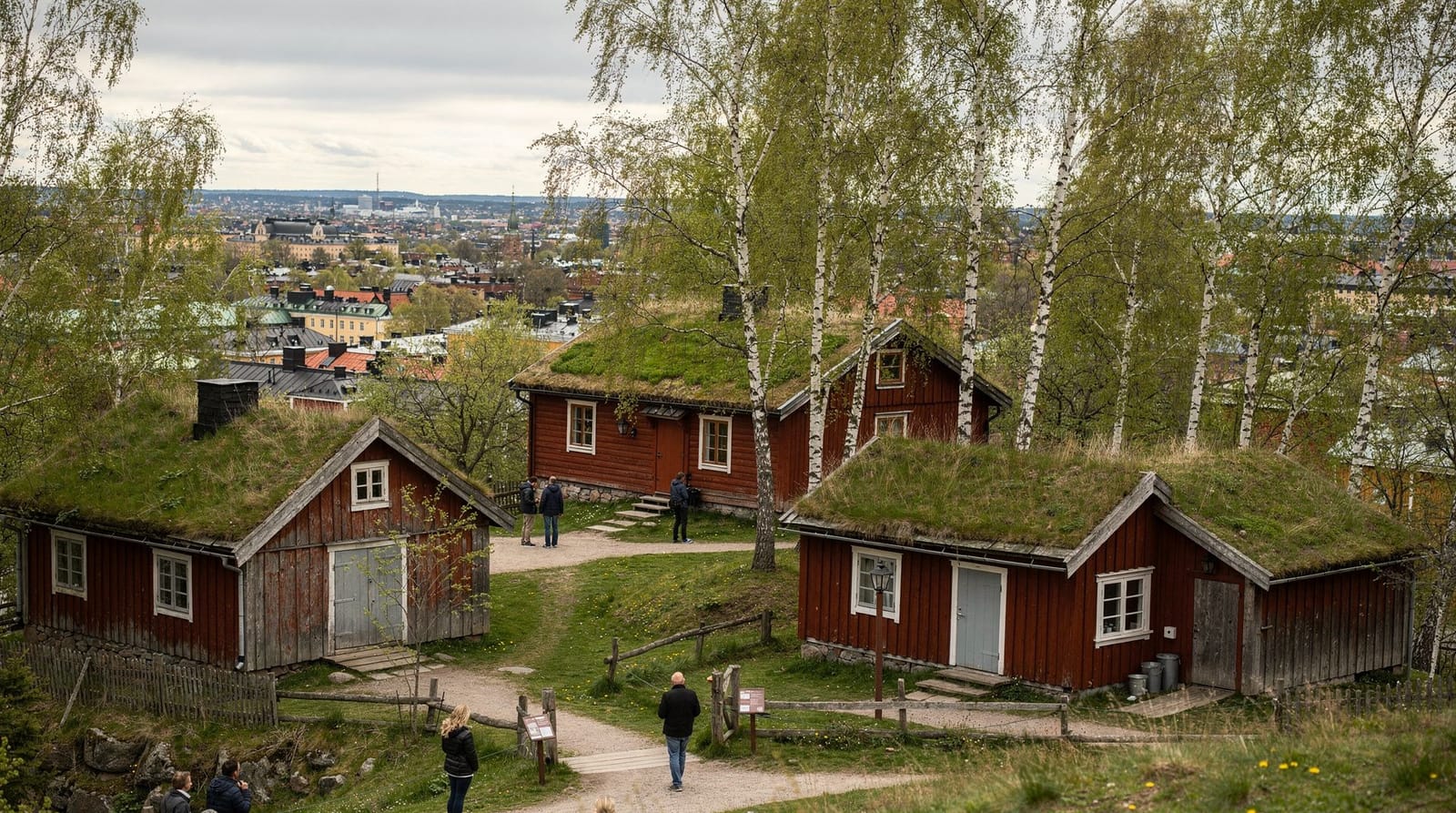
Skansen: Fifteen minutes’ walk from the ABBA Museum, the world’s oldest open-air museum makes a logical afternoon continuation on the same Djurgården day. See the Skansen guide.
Nordiska Museet: Across from the Vasa Museum, Sweden’s largest museum of cultural history covers folk costumes, design, and everyday Swedish life from the 16th century. See the Nordiska Museet guide.
Photography and recordings inside the museum
Photography is generally permitted throughout the museum, including at the costume displays and the recording studio replica, though flash is discouraged near the more delicate archival materials. The Mega Mix holographic performance is recorded automatically and offered for purchase afterwards — you do not need to bring your own camera for that particular experience, though many visitors film short clips on their phones as well for personal memory. Staff occasionally ask visitors to pause filming near the personal artefacts section out of respect for the private nature of the material on display; follow any posted signage.
Best time of year to visit
Winter (November–February): The quietest season and the easiest time to get a same-week timed-entry slot. Combine with a walk along Djurgårdsvägen when the island is frosted and near-empty — a very different atmosphere from the summer crowds. Museum interiors are unaffected by weather, so a rainy or snowy day is a good excuse to spend two hours indoors.
Shoulder season (March–May, September–October): A strong middle ground — moderate crowds, reasonably easy booking, and pleasant weather for the walk between Djurgården attractions. September in particular pairs well with a Skansen visit while the park is still in full swing but past its July peak.
Summer (June–August): The busiest period and the one requiring the most advance booking. July especially sells out weeks ahead. If summer is your only option, book the moment your Stockholm dates are fixed and take a morning slot to avoid the worst of the midday queues described above.
Solo visitors, couples, and groups
The ABBA Museum works well for solo travellers — the audio guide and interactive stations are designed for individual pacing, and the Mega Mix stage is genuinely more fun without needing to coordinate a group’s enthusiasm. Couples tend to linger longest in the costume and personal-artefacts sections, where the two central relationships in the band’s history (Björn and Agnetha, Benny and Frida) resonate. Groups of friends get the most out of the Mega Mix holographic stage, which is built for a small group performing together rather than a single visitor. Whichever configuration you are visiting in, budget the full 1.5–2 hours — the museum rewards unhurried exploration far more than a rushed pass-through.
Frequently asked questions about the ABBA Museum
Do I need to like ABBA to enjoy the museum?
Not unconditionally. The museum works on several levels: as a music fan pilgrimage, as a window into Swedish cultural production, and as an unusually well-designed interactive experience. Visitors who know nothing about ABBA beyond Mamma Mia the musical often report enjoying it more than expected. Visitors who actively dislike the music will find two hours a stretch.
Can you do the ABBA Museum without booking?
In theory yes, but in practice summer walk-ins are nearly impossible. The museum operates on timed entry and popular time slots sell out. For any visit between June and August, booking weeks in advance is essential. Off-season, same-week booking is usually sufficient.
Is the ABBA Museum part of the Stockholm Pass?
Coverage varies and has changed over time. Do not assume — verify the current terms on the Go City / Stockholm Pass website at the time of purchase.
Where is the ABBA Museum in relation to the Vasa Museum?
Both are on Djurgården island. The Vasa Museum is at the western end of Djurgårdsvägen; the ABBA Museum is 10 minutes’ walk east on the same road. They are very easy to combine in a single day.
Is the ABBA Mega Mix (virtual stage) good?
Consistently rated as the highlight by visitors regardless of pre-visit enthusiasm levels. The technology is better than expected, the costume selection is generous, and the recording can be purchased as a memento. It takes about 10 minutes per group and is worth the queue.
Are there guided tours of the ABBA Museum?
The standard ticket is self-guided with an included audio guide. Guided tours are available through GetYourGuide and include additional context about Stockholm’s music scene. For most visitors the self-guided audio format is sufficient.
How does the ABBA Museum compare to Avicii Experience?
Very different experiences. The ABBA Museum is larger, covers a much longer career, and has more interactive depth. The Avicii Experience is smaller, more technically focused on music production, and more emotionally intense given Avicii’s story. Both are worth visiting for music fans; budget considerations may require choosing one.
Top experiences
Bookable activities with verified prices and instant confirmation on GetYourGuide.