Birka Viking day trip from Stockholm: the UNESCO island guide
Stockholm: Viking island tour — Birka from Stockholm by boat
Duration: 7 hours
How do I visit Birka from Stockholm?
The only practical way to reach Birka is by tour boat from Stadshusbron (near Stockholm City Hall). The boat runs May to September, takes approximately 2 hours each way, and the round trip with entry and guided tour costs around 495 SEK. The boats leave at specific times — book in advance in summer as capacity is limited. There is no ferry or public transport alternative.
What makes Birka different
Birka is the most demanding day trip from Stockholm in terms of commitment — a full day, largely consumed by the boat journey — and the most irreplaceable. Uppsala can be approximated by reading about medieval cathedrals; Sigtuna’s runestones can be seen in Stockholm’s museums. Birka cannot be substituted.
| Where | Björkö island, Lake Mälaren, ~30 km west of Stockholm |
| Departure | Stadshusbron, next to City Hall |
| Cost | Around 495 SEK incl. boat, entry, guided tour |
| Time needed | Full day, around 9–10 hours door to door |
| Season | May–September only |
For other options that don’t need a full day, compare against the day trips from Stockholm overview or the faster Sigtuna day trip.
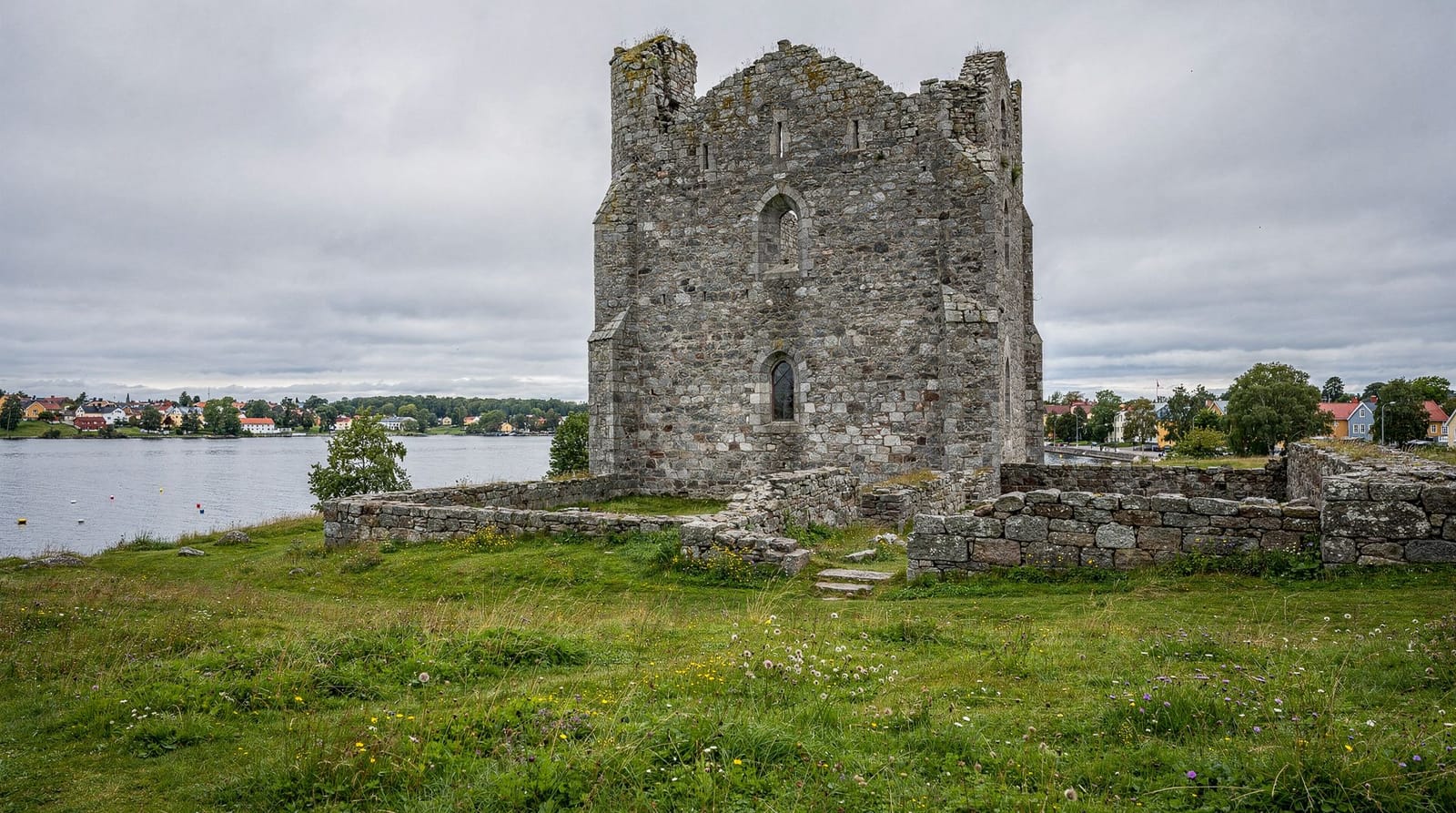
The island of Björkö, a 30 km boat journey west of Stockholm across Lake Mälaren, was Sweden’s first town. For two centuries beginning around 750 AD, it was one of the most important trading hubs in the northern world — connecting the Frankish empire to the south, Byzantine traders to the east (via the great Russian river routes), and the scattered Norse settlements to the west and north. Islamic silver dirhams, Byzantine silk, and Frankish wine arrived here; furs, amber, and slaves left. The population at its peak may have been a thousand people.
Then it stopped, suddenly, around 975 AD. The town was abandoned; a new trading post (Sigtuna) was founded 45 km to the north. The island returned to meadow and forest. The abandonment is one of Swedish archaeology’s persistent mysteries.
What remains is one of the most archaeologically significant sites in Scandinavia: over 3,000 burial mounds, the outline of the former town area, and objects that have transformed understanding of the Viking world.
Getting to Birka
The only practical route is by tour boat from Stadshusbron (the pier next to Stockholm City Hall, in the Kungsholmen area).
Book the Birka Viking island boat trip from StockholmSeason: May to September only. The boats do not run in winter.
Journey time: Approximately 2 hours each way.
Departure: Typically in the morning (check the current Strömma timetable for the departure time). Return in the late afternoon.
Price: Approximately 495 SEK per adult, including the boat journey, museum entry, and guided tour.
Booking: Essential in summer — the boats have limited capacity (typically 300–400 passengers maximum) and summer days sell out 1–2 weeks ahead.
There is no ferry, bus, or train alternative to Birka. A private boat hire can reach the island but is expensive and requires navigation knowledge. The organised boat tour is the standard access.
On the island: what to expect
The tour arrives at the small pier on the eastern shore and proceeds as follows:
The Birka Museum
The on-site museum at the landing area is well-designed and substantial. The permanent collection includes:
- Original objects excavated from the burial mounds and the Black Earth town area: weapons, jewellery, tools, clothing fragments, and trade goods
- Maps and diagrams explaining the archaeological context
- Interpretive displays on Viking Age trade networks and Birka’s role within them
- A scale model of the town at its peak
Allow 45–60 minutes in the museum before the guided tour begins.
The guided walking tour
The guided tour (included in the boat ticket) covers:
The Black Earth (Svarta Jordens): The area of the former town, now agricultural fields. The dark soil (caused by 200 years of dense human occupation) is visible in photographs and satellite imagery; in person it requires some imagination. The guide’s commentary transforms this from an empty field into a comprehensible historical landscape.
The burial mound cemetery (Fornborg): The concentration of mounds on the southern and western slopes of the island is striking in person. 3,000+ individual burials, ranging from simple earthen mounds to larger chamber graves. The largest mounds are several metres high. The guide explains excavation findings and burial customs.
Hovgården: The adjacent island of Adelsö (visible from Björkö) was the site of Hovgården, the royal estate associated with Birka. Together Birka and Hovgården form the UNESCO World Heritage designation.
The hill fort (Borg): A 9th-century fortification on the island’s high ground, used as a refuge during attacks.
The walking tour covers approximately 2–3 km on unpaved paths, with some gentle slopes. Duration: approximately 1.5–2 hours.
Viking demonstrations (summer)
In July and August, costumed guides demonstrate Viking Age crafts — textile work, metalsmithing, archery — and combat techniques in the area below the museum. These are particularly engaging for children but are designed for general visitors. The quality of the historical interpretation is higher than typical reenactment events.
The boat journey: worth it in its own right
The 2-hour boat journey across Lake Mälaren passes through the western sections of the lake — broad, dotted with small islands, surrounded by low Swedish farmland. The approach to Björkö, with the island’s oak forest and meadows visible from the water, is genuinely beautiful.
The boat serves coffee and light refreshments. There is seating both inside and on deck. The deck is the better option in good weather; the lake can be breezy even on warm days.
When to go
June: Best weather conditions, not yet peak crowds, Viking demonstrations beginning.
July: Full program but busiest period — book 2+ weeks ahead. Mosquitoes in the meadows can be bothersome.
August: Good weather, full program including crayfish parties in the region (context for the season), mosquitoes diminishing by late August.
September: Fewer crowds, cooler, autumn colours beginning. Still worth going.
May: The tour boats begin operating but demonstrations may be limited. Good for avoiding crowds.
The Viking heritage context
Birka’s story connects directly to other Viking Age sites in the Stockholm region. Sigtuna, founded around 980 AD when Birka was abandoned, can be combined with a Birka visit on consecutive days to trace the shift in Swedish trading-town culture. The Viking Museum in Stockholm (Djurgården) is the best place to see objects from the Viking Age in a museum context before or after the Birka visit.
For the purely museum-based Viking experience, see the Viking Museum guide.
Planning the day around the boat
Because the boat sets the rhythm of the whole trip, plan everything else around its schedule rather than the other way round. Arrive at Stadshusbron well before departure, so that boarding is calm and you can pick a seat, ideally on deck if the weather allows. If you are staying in the centre, the walk to City Hall is easy from Norrmalm and from Gamla Stan, and the pier sits on the Kungsholmen side of the water. If you are unsure how to reach the pier by metro or bus, the public transport explained guide walks through the options, and the SL pass guide helps you decide whether a travel card is worth it for the days around your trip.
Keep the evening after Birka light. You will return tired from the fresh air and the walking, so book dinner somewhere relaxed rather than a long tasting menu. A simple meal and an early night are the right way to close a day like this, and the next morning can be a slower one at a café, as described in the fika culture guide.
What to pack and how to dress
The weather on Lake Mälaren is rarely identical to the weather in the city. Wind on the water is common even on warm days, and the island is exposed, with little shelter on the meadows. Dress in layers you can add and remove, and bring a waterproof jacket even if the forecast looks clear. Good walking shoes matter more than anything else, because the paths are unpaved and can be muddy after rain. For more general advice on clothing across the seasons, see the what to pack for Stockholm guide.
Bring a refillable bottle, a small snack, and a power bank for your phone, since you will take many photographs of the mounds and the lake. Check the practicalities for food on board and on the island before you leave, rather than assuming that everything will be available when you want it. If the day turns out to be rainy, the island is still worth the trip, but the museum becomes the highlight; see the Stockholm in rain advice if you want an alternative plan for your other days.
Reading the landscape: tips for the guided walk
The most common disappointment at Birka is arriving expecting ruins. There are no standing walls or reconstructed streets on the Black Earth, and the site rewards visitors who come prepared to read a landscape. A few habits help:
- Listen first, photograph second. The guide’s explanation of where the harbour, the workshops and the houses stood is what turns the fields into a town.
- Look at how the mounds sit on the slopes. Their positions tell you where the living town ended and the dead began.
- Notice the view across the water toward Adelsö. The relationship between the trading town and the royal estate is easier to grasp when you see how close they are.
- Spend the free time after the tour revisiting the museum case that interested you most. Seeing the objects after you have walked the ground changes how you read them.
If you enjoy this kind of slow, place-based history, the Birka Viking village guide goes deeper into the settlement itself, and the destination page for Birka gathers the essentials in one place.
Travelling with others
Birka suits couples, friends and families, but each group should set expectations in advance. Teenagers who like history tend to enjoy the demonstrations and the sheer scale of the cemetery. Younger children often enjoy the boat and the open space more than the archaeology, so let them lead the pace and keep the museum visit short if they tire. For wider family planning, the Stockholm with kids family guide offers ideas for the rest of your stay. Solo travellers will find the boat a friendly place, with plenty of room to read or simply watch the shoreline go by.
Accessibility deserves a note: the paths are unpaved and uneven in places, which can be difficult for wheelchairs and pushchairs. If this concerns you, read the accessibility guide and contact the operator before booking to ask what is possible on the island.
Combining Birka with other Viking Age sites
Many visitors want a fuller picture of the Viking Age than one island can give. A sensible approach is to treat Birka as the anchor and add one more site on a different day. A guided option such as a half-day Viking culture tour that includes Sigtuna gives you the story of what came after Birka, while a full-day Viking excursion toward Uppsala adds the old royal mounds and the university town. Compare them in the Viking heritage in the Stockholm region guide, and see the Uppsala destination page and Sigtuna destination page for the wider context.
Travellers who prefer to keep the whole Viking theme in one itinerary can build a longer stay around it with the Stockholm and Uppsala three-day itinerary, and those who want a firsthand account before deciding can read the honest blog review of the Birka trip.
Birka vs other Stockholm day trips
Because a full Birka day consumes an entire day of your trip, it’s worth weighing it against the alternatives before committing.
| Day trip | Time needed | Best for |
|---|---|---|
| Birka | Full day (9–10 hrs) | Viking archaeology, UNESCO site, unique boat journey |
| Drottningholm | Half day | Royal palace, formal gardens, less commitment |
| Sigtuna | Half to full day | Runestones, medieval town, easier pace |
| Uppsala | Full day | Cathedral, university history, larger town |
Travellers with only one free day for a Viking-themed excursion should choose Birka; those who want a gentler pace should look at the Drottningholm half-day guide instead. If you’re combining several day trips across your stay, the Stockholm day trips by train guide covers the rail-accessible options that don’t require Birka’s boat-only logistics, and the Uppsala day trip guide is the natural pairing if you have two spare days rather than one.
Practical information
| Detail | Information |
|---|---|
| Departure point | Stadshusbron (next to City Hall) |
| Boat journey time | ~2 hours each way |
| Season | May–September only |
| Price (approx.) | 495 SEK incl. boat, entry, guided tour |
| Booking | Required (especially summer) |
| On-island time | ~3 hours |
| Total day duration | 9–10 hours |
| Walking | ~2–3 km unpaved paths |
Frequently asked questions about Birka day trip
Why is Birka a UNESCO World Heritage Site?
Birka was Sweden’s first town (c. 750–975 AD), a major Viking Age trading hub with connections to Byzantine, Arabic, and Frankish territories. Designated UNESCO in 1993 with adjacent Hovgården.
What is there to do on Birka?
Birka Museum (original excavated objects), guided walking tour of burial mounds and town area, Black Earth archaeological site, and Viking craft demonstrations in summer.
Is Birka worth the full day it takes?
Yes, for anyone interested in Viking history. The museum is genuinely excellent, the burial mound concentration is striking, and the experience is irreplaceable in the Stockholm region.
Can children visit Birka?
Yes — the costumed Viking demonstrations and hands-on activities target families specifically. The boat journey and the mounds engage children well.
What should I bring to Birka?
Comfortable walking shoes, a waterproof layer, sunscreen in summer, insect repellent in July–August.
Top experiences
Bookable activities with verified prices and instant confirmation on GetYourGuide.