Mariefred and Gripsholm Castle: Sweden's overlooked gem
Mariefred and Gripsholm Castle: Renaissance castle (1537), Sweden's National Portrait Gallery, and the oldest inn in Sweden (est.
Stockholm: Mariefred & Gripsholm Castle private day trip
Duration: ~8 hours
Quick facts
- Vintage steamboat (summer)
- ~3.5 hours via S/S Mariefred (summer, selected days)
- By train
- Train to Läggesta + local bus, ~1 hour
- Days needed
- 1 day
- Castle
- Gripsholm Castle (1537), National Portrait Gallery of Sweden
Sweden’s most underrated castle day trip
Gripsholm Castle and the town of Mariefred sit 65 kilometres west of Stockholm on the southern shore of Lake Mälaren, and represent one of the better-kept day-trip secrets available from the Swedish capital. While visitors crowd Drottningholm Palace and its UNESCO baroque garden, Mariefred receives a fraction of the traffic despite having a Renaissance castle of equal importance, a more human-scale town, and the option of arriving by vintage steamboat through the lake.
The castle’s story begins with Gustav Vasa — the king who unified Sweden, broke with Rome, and created the modern Swedish state in the 1520s. Gripsholm Castle was built on his orders in 1537, constructed around a medieval tower using a characteristic circular plan with round towers at the corners. The name comes from the earlier 14th-century monastery of Grip, which occupied the site before the Reformation. Gustav Vasa dissolved the monastery, confiscated its revenues, and built a castle that has remained in royal and state hands ever since.
Unlike Drottningholm, Gripsholm is not a residence. It is a castle museum, fully open to visitors, with no royal wings off-limits. And it contains something unique: the National Portrait Gallery of Sweden (Gripsholmsporträtt), a collection of Swedish portraiture assembled systematically since the 16th century, now numbering well over 4,000 works. Walking through Gripsholm Castle means walking through five centuries of Swedish faces — kings, queens, regents, scientists, writers, military commanders.
Getting to Mariefred from Stockholm
By vintage steamboat (summer): The most memorable approach is the S/S Mariefred, a restored early 20th-century steam-powered boat that departs from Klara Mälarstrand in Stockholm at 10:00 on selected summer days (June to early August in 2026). The journey takes around 3.5 hours through Lake Mälaren’s southern channels, passing forested shores and small islands that have not changed substantially since the steamboat era. The return can be made by the same boat or by train/bus for those with time constraints. Booking in advance via the operator (SS Mariefred Ångbåtssällskap) is essential — this is a heritage service with limited capacity.
By train and bus (year-round): The standard route is the regular train from Stockholm Central to Läggesta (towards Eskilstuna, about 40 minutes), then a short local bus ride to Mariefred, 4 km away. In summer the Östra Södermanlands Järnväg (ÖSJ) heritage steam railway also runs between Läggesta and Mariefred and is a minor attraction in itself; check its current schedule, as services are limited.
The private day trip to Mariefred and Gripsholm Castle from Stockholm handles transport logistics and includes the castle visit — a practical option for visitors who want the experience without managing train and heritage railway connections.
Travellers weighing the options will find the wider picture in the Gripsholm and Mariefred day trip guide, which walks through the day step by step. If you are still comparing Mälaren excursions, the day trips by train guide helps you judge how this one fits against the others, and the Stockholm public transport explained page clarifies how the commuter leg of the journey fits into the local ticket system.
Gripsholm Castle: the building
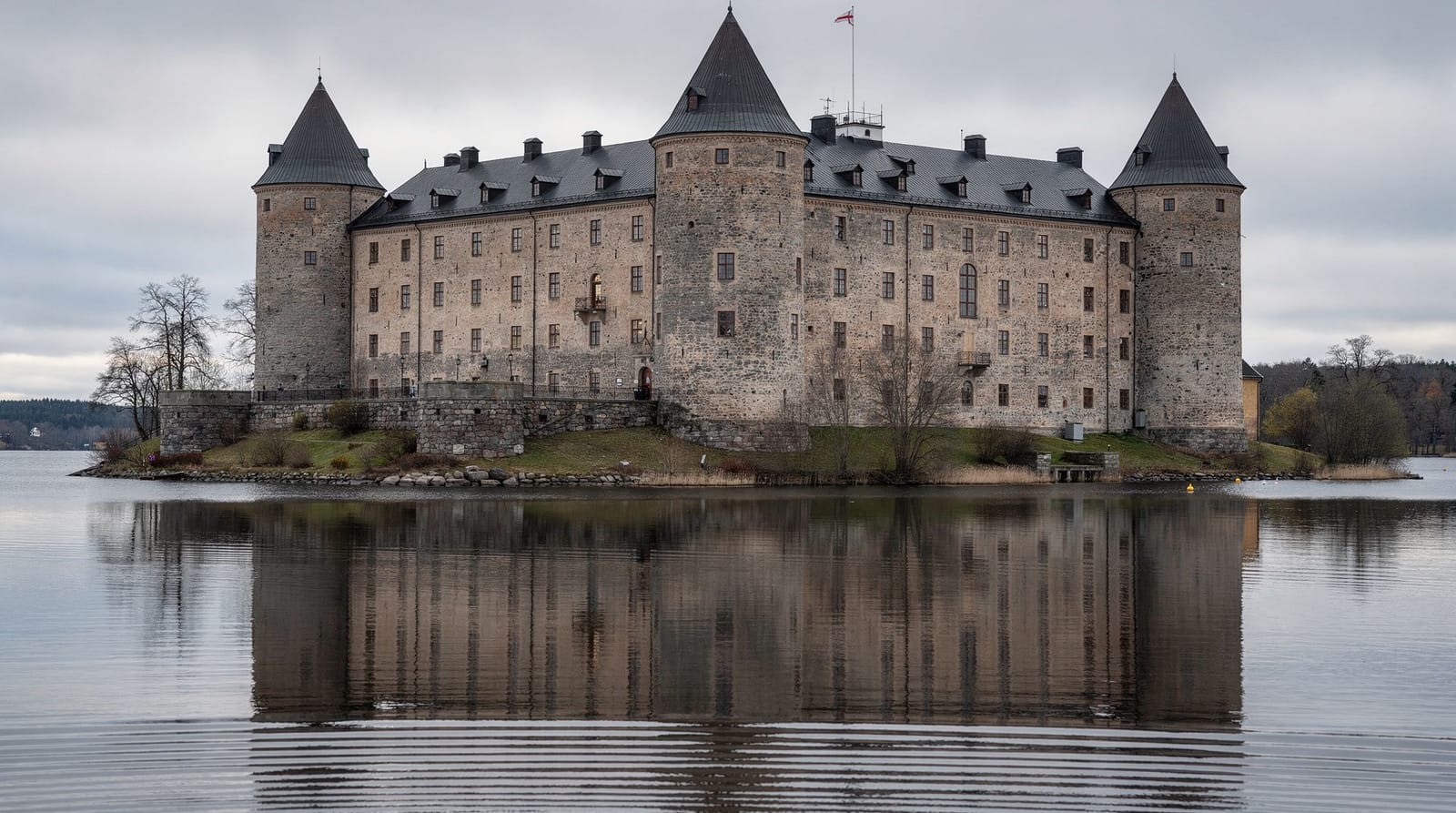
The castle stands directly on the Lake Mälaren shoreline, its four round towers reflected in the water when conditions are calm. The setting is among the most dramatic of any castle in Sweden: isolated on its promontory, with the small town of Mariefred visible to one side and open water on the others.
The architecture is Swedish Renaissance — the style associated with Gustav Vasa’s building programme, which imported Italian and German craftsmen to construct the first generation of Swedish castles in the new idiom. The characteristic round towers, high brick walls, and corner turrets are reproduced across several of Sweden’s major 16th-century castles, but Gripsholm’s lakeside setting makes it the most photogenic.
The interior has been modified by successive Swedish monarchs but retains significant Renaissance and Baroque elements. The Royal Chapel — in continuous use since the castle’s foundation — is one of the best-preserved Renaissance chapel interiors in Sweden. The White Hall (Vita Salen) is a Baroque reception room added in the 17th century. The Blue Hall (Blå salongen) contains significant portrait collections.
The National Portrait Gallery
The portrait collection is the intellectual core of the castle. Swedish monarchs have been adding portraits of significant figures to the Gripsholm collection since Gustav Vasa, creating an accidental record of Swedish history through faces. The result is remarkable: kings and queens from Gustav Vasa to Carl XVI Gustaf, prime ministers, scientists (including Carl Linnaeus), military commanders, writers and poets, diplomats — all hanging in rooms designed by the same monarchs who commissioned the portraits.
The portraits are not all Swedish. The collection includes foreign rulers, ambassadors, and notable Europeans who had connections to the Swedish court. Walking through the sequence of rooms is an involuntary history lesson in Swedish and European affairs from the 16th century to the present.
The collection is not presented as a conventional museum — objects are not all behind barriers, the hanging is dense and unmediated, and the rooms feel inhabited rather than curated. This is a feature rather than a flaw.
Take your time in the portrait rooms rather than hurrying toward the next landmark. The faces make the most sense when you read the labels as a sequence, noticing how fashion, symbols of power and the way sitters chose to present themselves change from one generation to the next. For a different take on royal interiors, the Gripsholm Castle guide goes deeper into the rooms themselves, and the Royal Palace guide shows how the same monarchy presents itself in the capital.
The town of Mariefred
Mariefred is a small town of approximately 3,000 people with a beautifully preserved 19th-century town centre, a church overlooking the water, and a lakeside atmosphere that has not been significantly disturbed by development. The name means “Peace of Mary” — the town grew around the Franciscan monastery that preceded Gustav Vasa’s castle.
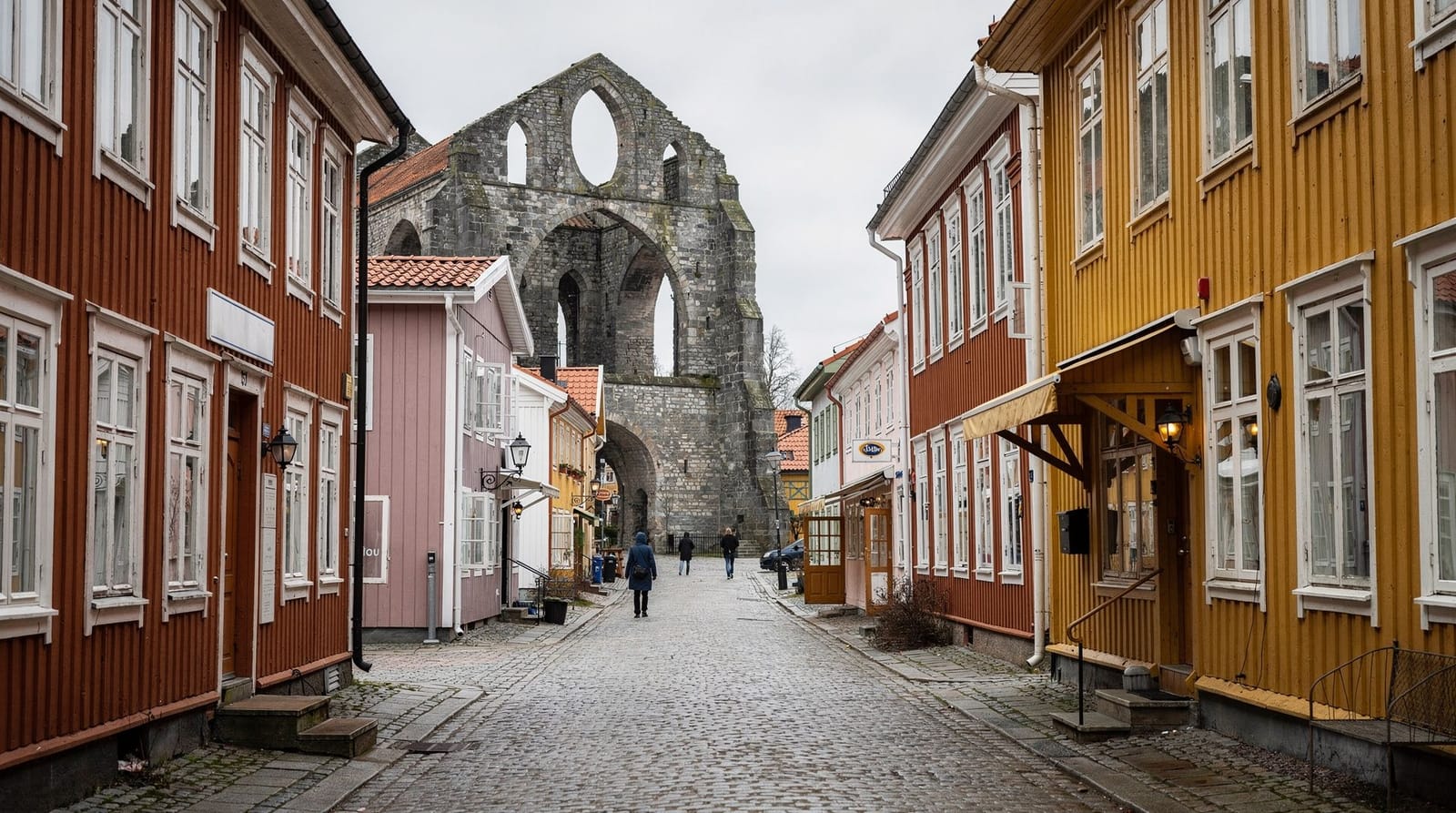
The main street, Kyrkogatan, has well-maintained wooden buildings and a handful of independent shops and cafés. The waterfront on the Mälaren shore has views back to the castle — the approach to Gripsholm from the town side, across a small bridge, is the classic view of the castle above the water.
Gripsholms Värdshus: the oldest inn in Sweden
Gripsholms Värdshus, established in 1623, holds the record for the oldest continuously operating inn in Sweden. The building near the castle has been feeding travellers since the era of horse-drawn carriages and stagecoaches, and the current restaurant maintains a level of quality that the historical claim alone would not guarantee.
The kitchen focuses on traditional Swedish food — husmanskost (home cooking), game in season, fish from Mälaren, and the kind of slow-cooked Swedish dishes (pytt i panna, gravlax, smörgåsbord components) that Sweden does better than anywhere else. The interior is appropriately historic: low ceilings, wooden panelling, the accumulated atmosphere of four centuries of hospitality.
Lunch at Gripsholms Värdshus followed by an afternoon in the castle is the optimal Mariefred structure. The restaurant is popular on summer weekends — booking ahead is sensible. The combination of historical claim, genuine quality, and the castle view from the terrace makes it one of the better meals available on a Stockholm day trip.
Gripsholm Castle in Swedish history
Gripsholm Castle’s history is inseparable from the history of the Swedish monarchy, and understanding the major episodes makes the portrait collection considerably more legible.
Gustav Vasa (reigned 1523–1560), the castle’s founder, is the figure who dominates Swedish historiography in a way comparable to Henry VIII in England — the monarch who broke with Rome, seized church properties, established a national Protestant church, and created the administrative apparatus of the modern Swedish state. His portrait in the castle collection is frequently reproduced and shows the power and suspicion that contemporaries described. The castle he built was also a prison: several of his political opponents were confined at Gripsholm, including his brother-in-law Erik Sture and other members of the aristocracy who challenged his authority.
Erik XIV (reigned 1560–1568), Gustav’s mentally unstable son, was himself imprisoned at Gripsholm after being deposed by his brother. Erik XIV eventually died at Örbyhus Castle, probably poisoned — his chamber at Gripsholm, where he spent years as a prisoner, is identified in the tour of the castle. The concentration of imprisoner and imprisoned at the same location gives Gripsholm a quality absent from purely ceremonial palaces.
Johan III (reigned 1568–1592) expanded and improved the castle, adding the round tower that bears his name and commissioning artistic work that reflects his Catholic sympathies (unusual in post-Reformation Sweden). The Renaissance decoration of the castle chapel dates largely from his period.
Gustav III (1746–1792), the Enlightenment king who was also responsible for the Court Theatre at Drottningholm, used Gripsholm extensively and added systematically to the portrait collection — establishing the National Portrait Gallery as a deliberate archive of Swedish history rather than just an accumulation of royal commissions.
The steamboat journey on S/S Mariefred
The S/S Mariefred was built in 1903 and is a genuine early 20th-century steam vessel, maintained and operated by the Mariefred Steamboat Society (SS Mariefred Ångbåtssällskap) as a heritage service. The boiler is oil-fired (an early-20th-century conversion from wood and coal) and the steam engine drives the paddle wheels that give the boat its characteristic sound and water-trail.
The ship carries approximately 250 passengers and has an on-board café serving coffee, sandwiches, and pastries. The main deck is open-air, with the views of the Mälaren channels providing most of the entertainment. The pace is slow by modern standards — 3.5 hours for the 65-kilometre journey — but the slowness is the point: it returns the journey to the scale at which Mälaren travel was conducted for most of Swedish history.
The S/S Mariefred sails on selected summer days (in 2026: Saturdays in June, then Wednesday, Thursday, Saturday and Sunday from 1 July to 2 August). Adult tickets cost 490 SEK return or 370 SEK one way (children 6–16: 245 / 185 SEK). The schedule is limited, so book in advance, and check the current schedule and tickets at mariefred.info before planning.
Mariefred Vingård (vineyard)
A few kilometres outside Mariefred, Mariefred Vingård produces wines from cold-climate Swedish grape varieties. Sweden’s wine production is very recent (serious commercial viticulture began in the 2000s) and the vineyard offers tastings and tours in season. It is a small-scale operation and an unexpected find in this latitude. Worth visiting if you have a car or bicycle, though public transport access is limited.
Combining Mariefred with other castles
For visitors with a specific interest in Swedish royal architecture, Mariefred fits naturally into a broader castles itinerary. The 1-day royal palace and castle tour from Stockholm covers Drottningholm, Wenngarn, and Skokloster in a single day. Gripsholm’s distance from Stockholm (65 km) and the heritage railway logistics make it harder to combine with other castles on the same day, but pairing it with a Drottningholm visit on consecutive days gives a strong royal architecture sequence.
The royal palaces comparison guide places Gripsholm within the Stockholm-region palace spectrum and explains the architectural and historical differences between Drottningholm (baroque residential), Gripsholm (Renaissance state castle), and the Royal Palace in Gamla Stan (ceremonial baroque). For the archaeological end of the same Mälaren-region day-trip spectrum, see the Birka guide.
Getting the most from a Mariefred day
Because both main transport options (steamboat and heritage railway) run on limited schedules, check the timetable before committing to either route — a mismatched schedule can turn a relaxed day trip into a rushed one. If travelling by S/S Mariefred, book at least a week ahead for July and August Saturdays. If travelling by train and the ÖSJ heritage railway, confirm it is running on your chosen day, since the narrow-gauge service does not operate daily outside peak summer.
Once in Mariefred, the castle, town, and Gripsholms Värdshus are all within a 15-minute walk of each other, so the logistics on the ground are simple regardless of how you arrive. A natural sequence is: castle in the morning (2–2.5 hours), lunch at Gripsholms Värdshus, then a slow walk through the town centre and waterfront before the return journey. Visitors building a longer Mälaren-region itinerary can combine this with Gamla Stan on a separate day, or see the day trips from Stockholm guide for the full range of options.
Pairing Mariefred with other days out
Mariefred works best as a day of its own, and it rewards travellers who treat it as a change of pace after a few days in the city. Visitors who like the idea of a sequence of excursions can read about Drottningholm by boat as the natural companion on another day, or look at the Uppsala destination page and the Sigtuna destination page for medieval and Viking-era contrasts to Gripsholm’s Renaissance character. If you are planning the whole stay, the Stockholm in 4 days with the archipelago itinerary shows where an excursion beyond the city can slot in without exhausting you.
Frequently asked questions about Mariefred and Gripsholm Castle
Is the vintage steamboat to Mariefred worth it?
Yes, substantially. The journey through Mälaren aboard the S/S Mariefred is one of the more distinctive transport experiences available near Stockholm — a working early 20th-century steam vessel with an on-board café, taking the same route that passengers and merchants used before roads changed Swedish travel habits. The 3.5-hour journey each way makes this an all-day affair, but the journey itself is half the attraction. For visitors who want efficient access, the train-and-heritage-railway route is perfectly good and takes half the time.
When is Gripsholm Castle open?
Gripsholm is open daily in the main summer season (10:00–16:00 in September 2026), with only some days in October and November (in 2026: weekends 12:00–15:00 in October, plus 1 November) and a few days in winter. Adult admission is 170 SEK. Check the Royal Palaces website (kungligaslotten.se) for current opening hours before planning your visit.
Is Gripsholm Castle worth visiting without a guide?
Yes — the castle has informative signage and the portrait collection speaks for itself. However, a guide adds considerable value by explaining the political context of specific portraits and the architectural evolution of the rooms. The private day trip with guide includes guided access.
How does Gripsholm compare to Drottningholm?
Drottningholm is a baroque residential palace with UNESCO gardens and a working court theatre — more spectacular in the garden and theatre elements. Gripsholm is a Renaissance castle with more accessible castle architecture and the National Portrait Gallery collection — more interesting as a castle museum and for history of portraiture. Drottningholm has more to offer as a landscape; Gripsholm has more to offer as a castle interior. Both are excellent for different reasons.
What is the best season to visit Mariefred?
June–August for the steamboat option and the full castle opening hours. Late May and September are excellent for quieter conditions with most facilities open. The small town of Mariefred is attractive in autumn foliage. Winter access is limited and the steamboat does not run.
Is there accommodation in Mariefred?
Limited but high-quality options exist, including rooms at Gripsholms Värdshus itself — staying in a 17th-century inn adjacent to a Renaissance castle is a particular experience. The town also has smaller B&B options. Booking well in advance for summer weekends is essential given the limited supply.
Top experiences
Bookable activities with verified prices and instant confirmation on GetYourGuide.