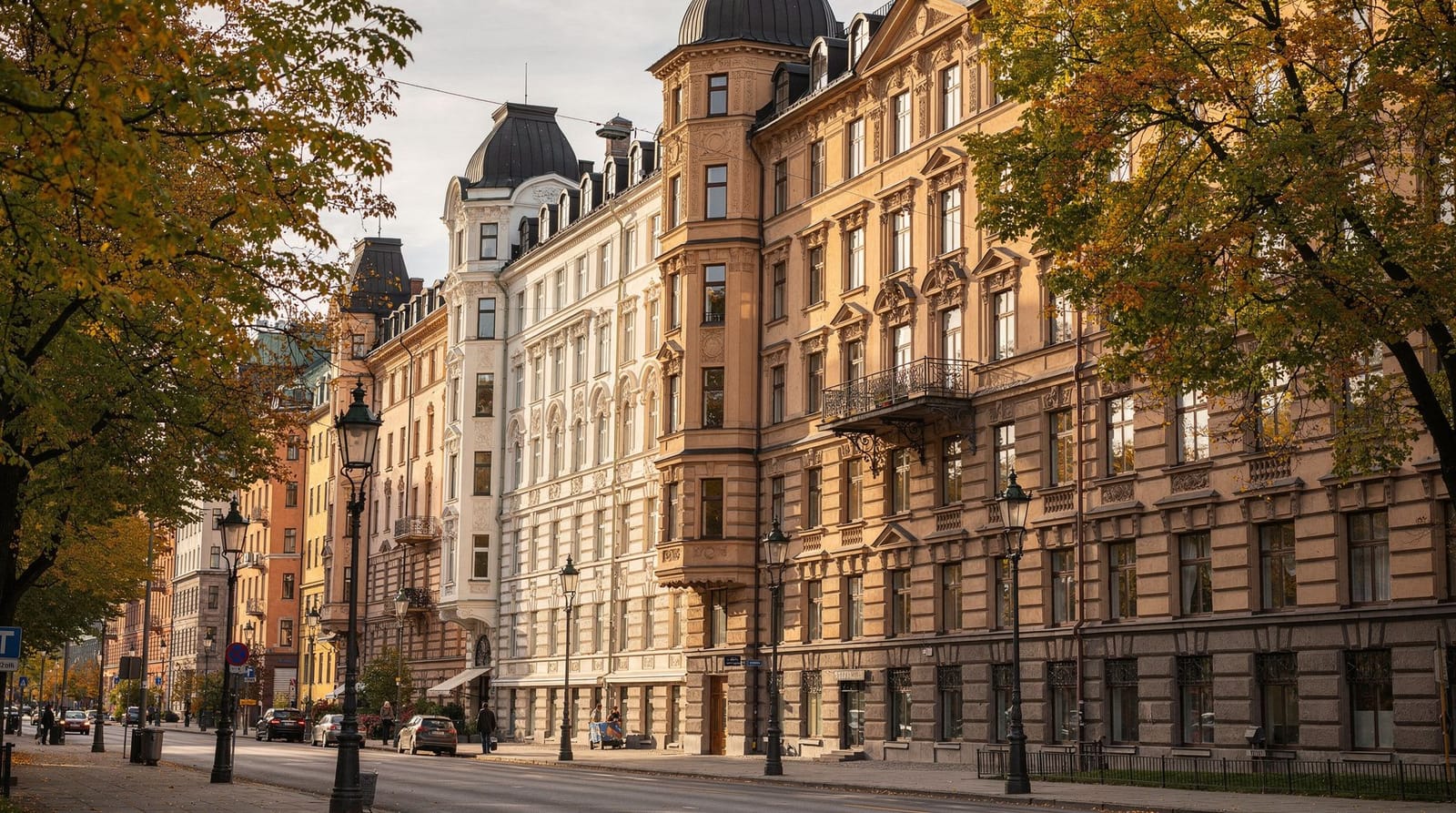
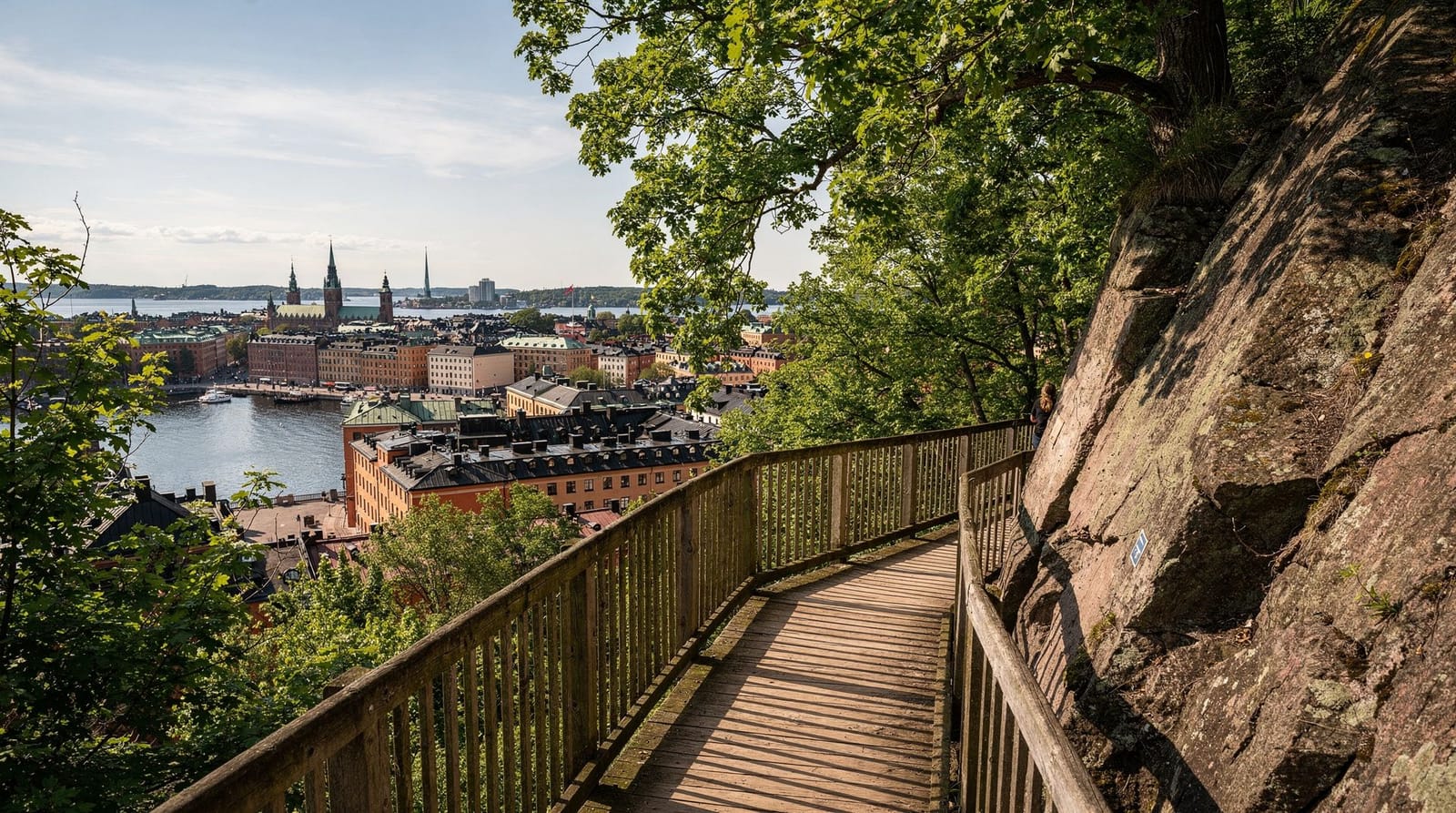
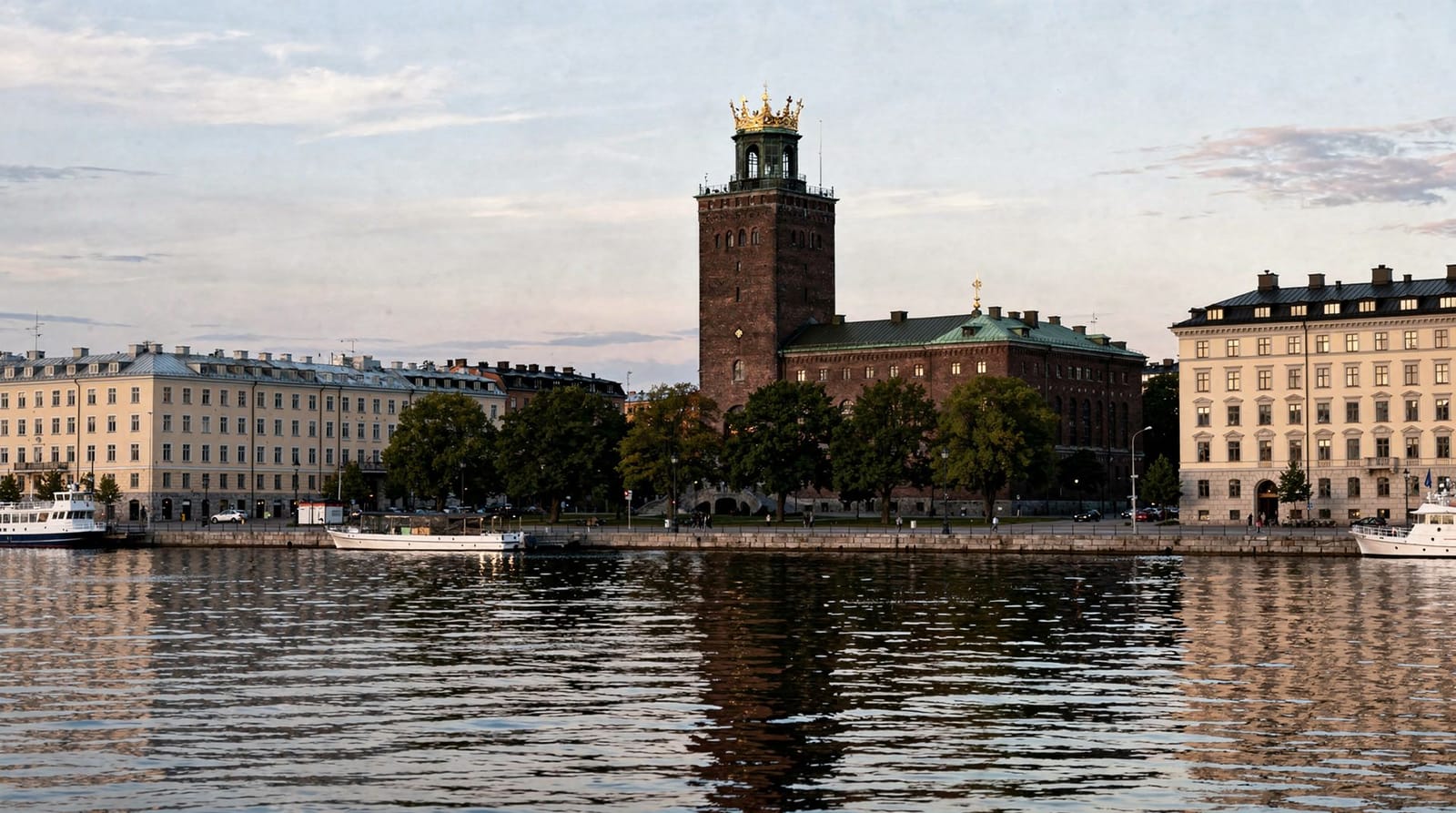
Norrmalm — Stockholm's commercial downtown district
Norrmalm is Stockholm's central downtown: Sergels Torg, Drottninggatan, Kulturhuset and the best mid-range hotels near T-Centralen.
Stockholm: must-see attractions walking tour with a guide
Quick facts
- Hub station
- T-Centralen (all metro lines)
- Character
- Modern commercial, transit hub
- Best for
- Staying, transit, shopping, Kulturhuset
- Distance to Gamla Stan
- 10 min on foot, 2 min by metro
Stockholm’s functional heart
Norrmalm occupies the mainland blocks directly north of Gamla Stan — the district that grew up around Stockholm Central station and became the city’s modern commercial center in the 20th century. It is not the Stockholm of postcard photographs. The medieval lanes, the waterfront palaces, the island parks — those are elsewhere. What Norrmalm offers is something different and genuinely useful: transit access to everything, a concentration of mid-range hotels within walking distance of the main attractions, the cultural resources of Kulturhuset, and the pedestrian shopping of Drottninggatan.
Most visitors to Stockholm pass through Norrmalm multiple times a day without necessarily spending dedicated time there. That is entirely reasonable. But understanding Norrmalm’s geography helps you navigate the city, and a few of its specific attractions deserve more attention than the transit-hub framing suggests.
| Where | Mainland Stockholm, directly north of Gamla Stan |
| Hub | T-Centralen — every metro line stops here |
| Time needed | 2–4 hours for Kulturhuset, Sergels Torg and Drottninggatan |
| Cost | Free to walk; Kulturhuset entry free, exhibitions/tickets vary |
| Best for | Transit, hotels, shopping, a rainy-day cultural stop |
Sergels Torg — Stockholm’s urban heart
The large square with the glass obelisk and the sunken fountain plaza is either the best or the worst public space in Stockholm depending on who you ask. Sergels Torg was built as part of the Norrmalm reconstruction that demolished much of the old working-class district between the 1950s and 1970s — a period of urban renewal that cleared most of the original 19th-century building stock and replaced it with the concrete commercial blocks that now define the area.
The square itself is a two-level design: a ground-level street plaza with the famous 37-metre glass obelisk (lit in blue and pink at night), and a sunken pedestrian level with fountains that connect to the Kulturhuset building and the underground passageways of T-Centralen. It functions as Stockholm’s primary public gathering space for demonstrations, concerts, and spontaneous events.
The square is not conventionally beautiful, but it is genuinely urban in a way that much of Stockholm is not — the scale is ambitious, the fountains work well in summer, and the sight lines across to the department stores and the glimpse of the old Klara Church tower through the commercial buildings give it more visual interest than a first glance suggests.
Kulturhuset — cultural life on the square
Kulturhuset (the House of Culture) is a large modern building designed by Peter Celsing and opened in 1974, occupying the entire eastern side of Sergels Torg. The building’s glass facade facing the square has become one of Stockholm’s most recognizable architectural statements, however divisive.
Inside, the programming is broad and genuinely accessible: the Kulturhuset houses Stadsteatern (Stockholm’s main city theatre), several exhibition galleries, a cinema, a reading room (open to all), a dedicated children’s culture floor called Lava, and the Tiogruppen design collective shop that introduced the Marimekko-adjacent Swedish graphic design of the 1970s. Entry to most of the building is free; performances and some exhibitions require tickets.
The rooftop café on the top floor has a view over Sergels Torg and out toward the water that justifies climbing six floors. In summer, the roof terrace is open and makes a good free alternative to paid viewpoints.
Drottninggatan
Drottninggatan (Queen Street) is the long pedestrian street running north from Sergels Torg up through Norrmalm and into Vasastan. The section in Norrmalm is the city’s primary high street — department stores, international chains, H&M (founded in Sweden, with its largest Stockholm store here), and the concentration of mid-range retail that makes this the most practical shopping address in the city.
Honest note: Drottninggatan is also Stockholm’s primary pickpocket location. The pedestrian street becomes genuinely crowded in summer, and the same conditions that make it convenient for shoppers make it convenient for thieves. Keep valuables in front pockets or a bag you can see, and be aware of groups that create distractions. This is standard urban travel precaution, not a reason to avoid the street — just something to know.
NK (Nordiska Kompaniet) on Hamngatan, just east of Sergels Torg, is Sweden’s equivalent of a Selfridges or Galeries Lafayette — a 1915 art nouveau department store with multiple floors of Swedish and international brands, a food hall in the basement, and an interior that justifies a walk-through even if you are not buying anything. The Christmas displays in the NK windows in December are a Stockholm institution.
Hötorget market
Hötorget (Hay Market) is the open-air square five minutes north of Sergels Torg where an outdoor market has operated since the 17th century. Today it runs daily (except Sunday) with stalls selling flowers, fruit, and vegetables — the kind of working market that is becoming rare in European city centers. The Hötorgshallen food market hall underneath the square has a basement full of speciality food stalls, fishmongers, delicatessens, and a handful of sit-down counters that offer some of the best-value lunches in the city.
The Konserthuset (Concert Hall) on Hötorget is where the Nobel Prize ceremony takes place each December — the blue neoclassical building with Carl Milles’ Orpheus fountain in front is one of the more significant buildings in the city even on a normal weekday. The fountain is particularly good in winter when it is briefly snow-covered.
Where to eat in Norrmalm
Norrmalm is not a neighborhood for exploratory dining — the tourist density around Sergels Torg and the station supports a large number of mid-quality international restaurants and fast-food chains. The good options require slightly more direction.
Vete-Katten on Kungsgatan is Stockholm’s most celebrated traditional konditori (bakery-café), operating in the same premises since 1928. The interior is intact Swedish art deco — wood paneling, ornate ceilings, waitstaff in uniforms — and the pastries are made on site to traditional recipes. The cinnamon buns (kanelbulle) and cardamom buns (kardemummabulle) are among the best in the city. It is genuinely busy with Stockholmers rather than purely tourists, which is the best endorsement any café can have. Go for a late morning fika.
Operakällaren at the Royal Opera House on Gustav Adolfs Torg offers both fine dining (one of Stockholm’s most historic restaurants, mains 400–800 SEK) and the more accessible Bakfickan (Back Pocket) bar and restaurant attached to the main kitchen. Bakfickan serves classic Swedish dishes including the genuine smörgåsbord at lunch — open counter seating, old-school charm, 200–350 SEK per dish. For a legitimate traditional Swedish lunch without tourist-trap pricing, this is one of the better options in the city center.
Hötorgshallen (below Hötorget) for quick, quality lunch: the fish counter serves fresh seafood at market prices, and the various counter restaurants offer everything from Vietnamese pho to Greek mezze.
Hotels in Norrmalm
Norrmalm has the highest concentration of mid-range hotels in Stockholm, which makes it the most practical choice for transit access and value.
Budget (under 1,200 SEK): Generator Stockholm on Torsgatan is the best hostel option — design-forward, private rooms available, rooftop bar, 5 minutes from T-Centralen. A serious upgrade from traditional hostel standards.
Mid-range (1,200–2,500 SEK): Freys Hotel on Bryggargatan is one of the city’s consistently reliable mid-range choices — good breakfast, central position, comfortable rooms. Clarion Hotel Sign on Östra Järnvägsgatan (above Stockholm Central) is efficient and business-oriented. Hotel Birger Jarl on Tulegatan is well-regarded for the price category.
Higher mid-range (2,000–3,500 SEK): Nobis Hotel on Norrmalmstorg is a converted 1880s bank building and one of Stockholm’s more stylish addresses at a price below full luxury. Berns Hotel near Berzelii Park has history (the famous Berns Salonger concert venue is attached) and a genuine sense of place.
Getting around from Norrmalm
T-Centralen is the transit hub for all of Stockholm — the metro lines T10 (Red), T11 (Red), T13 (Green), T14 (Green), T17 (Blue), T18 (Blue), T19 (Blue) all pass through here. From T-Centralen:
- Gamla Stan: 2 minutes (Red or Green line south)
- Slussen (Södermalm gateway): 3 minutes
- Östermalmstorg (Östermalm): 5 minutes
- Odenplan (Vasastan gateway): 5 minutes
- Fridhemsplan (Kungsholmen): 5 minutes
The Djurgårdslinjen ferry to Djurgården departs from Slussen (3 minutes by metro from T-Centralen). Walking from T-Centralen to Gamla Stan takes 10 minutes through Norrmalm and over the bridge.
The SkyView gondola at Ericsson Globe
Slightly south of central Norrmalm (closer to the Södermalm border), the Ericsson Globe is the world’s largest spherical building — a massive white sphere that hosts concerts, sports events, and the SkyView gondola, which travels up the outside of the sphere in a glass pod to a height of 130 metres.
The view from the top is less central than the Stockholm Pass photography might suggest — the Globe is several kilometers south of the Old Town — but the experience of riding on the exterior of a giant sphere is genuinely unusual and the city panorama looking north is striking. Book in advance; the gondola runs every 30 minutes on a timed schedule.
Book SkyView Stockholm gondola tickets — ride the exterior of the world’s largest spherical buildingBest time to visit Norrmalm
Norrmalm operates year-round and has no specific seasonal dimension. The Christmas season brings lights along Drottninggatan and the NK window displays, which are worth seeing in December. Summer brings outdoor café terraces at Hötorget and Berzelii Park.
For the Kulturhuset’s programming, check their calendar regardless of season — the theatre and exhibition schedule varies significantly.
Best time to visit Norrmalm
Norrmalm has no genuine off-season — it is a functional district that operates year-round, and its key attractions (Kulturhuset, Vete-Katten, NK, Hötorget) run on consistent schedules.
December is the most visually compelling time: NK’s Christmas window displays (established since the 1960s, a genuine Stockholm tradition) are lit and dressed from late November through December, Drottninggatan gets its street illuminations, and Hötorget occasionally hosts a small Christmas market. The Konserthuset on Hötorget hosts the Nobel Prize ceremony, which takes place on 10 December each year — the surrounding streets see unusual ceremony and black-tie arrivals in the early evening.
Summer brings outdoor café seating around Berzelii Park and the areas east of Sergels Torg, and the Kulturhuset rooftop terrace opens for the season. The pedestrian flow on Drottninggatan peaks in July, which makes it the best time to be reminded of the pickpocket caution.
Planning Stockholm from Norrmalm
The practical reality for most visitors is that Norrmalm functions as a planning base as much as a destination. T-Centralen is where you buy your SL card, connect to every transit line, store luggage at the Central Station lockers, and orient yourself for the day. A few practical notes for using Norrmalm as a base:
SL transit cards: Available at Pressbyrån kiosks throughout T-Centralen and at the SL Center information office in the station. Load passes (24h, 72h, 7-day) rather than single tickets if you are making more than three journeys per day.
Currency exchange: Avoid airport exchange desks. Forex Bank has branches in Norrmalm near T-Centralen and offers better rates. Your bank’s debit card at an ATM (Bankomat) will give the best rate of all — Stockholm has ATMs throughout Norrmalm.
Luggage storage: Stockholm Central Station has lockers in the lower level, priced by size and duration. There are also third-party luggage storage services (Bounce, Stasher) with locations in Norrmalm for same-day or multi-day storage.
Hop-on hop-off buses: The red double-decker buses depart from near Sergels Torg and cover most of the major attractions. For a first-day orientation, the hop-on hop-off is a reasonable way to calibrate Stockholm’s geography before deciding where to spend more focused time.
Book Stockholm hop-on hop-off bus tickets — 24h or 72h passes covering 25 stops across the cityUnderstanding the Norrmalm reconstruction
For visitors interested in urban history, Norrmalm has a significant story: between roughly 1950 and 1975, the city demolished most of its original 18th and 19th-century building stock in the district and replaced it with the concrete commercial blocks, underground pedestrian networks, and open plazas that now define it. This “Norrmalm regulation” was controversial at the time and is now regarded as one of the more regrettable urban decisions in modern Swedish history.
A few survivors of the original Norrmalm remain: the Klara Church (Klara kyrka) on Klarabergsgatan, its spire visible above the commercial blocks, was built in 1588 and largely rebuilt in the 1750s — the church and its small churchyard provide a pocket of genuine historical texture in the otherwise modern surroundings. The NK department store building (1915) and the Concert Hall (1926) on Hötorget survived as individual landmarks within the rebuilt street grid.
The comparison between what Norrmalm was (dense 19th-century city) and what it is now (modernist commercial district) is instructive for understanding why Gamla Stan is so heavily visited — it is now the primary place where Stockholm’s pre-20th-century urban texture survives intact.
Norrmalm vs staying elsewhere: a quick comparison
Deciding where to base yourself is one of the first practical questions in planning Stockholm, and Norrmalm is the default answer for a reason — but it is not the only reasonable one.
| Base | Transit access | Atmosphere | Best for |
|---|---|---|---|
| Norrmalm | Best in the city — T-Centralen | Functional, commercial | First-timers, transit convenience, budget-to-mid hotels |
| Gamla Stan | Good, but cobblestones and stairs | Atmospheric, touristy, noisy | Postcard views, willing to pay a premium |
| Södermalm | Good via Slussen/Medborgarplatsen | Hip, residential, hilly | Food and coffee focus, independent travelers |
| Östermalm | Good via Östermalmstorg | Upscale, quiet, residential | Luxury stays, Djurgården access |
For most first-time visitors prioritising ease of movement over atmosphere, Norrmalm remains the sensible default. Visitors prioritising neighborhood character over transit convenience should look first at Södermalm or Gamla Stan, accepting a slightly longer walk to the T-bana in exchange.
Connections to other neighborhoods
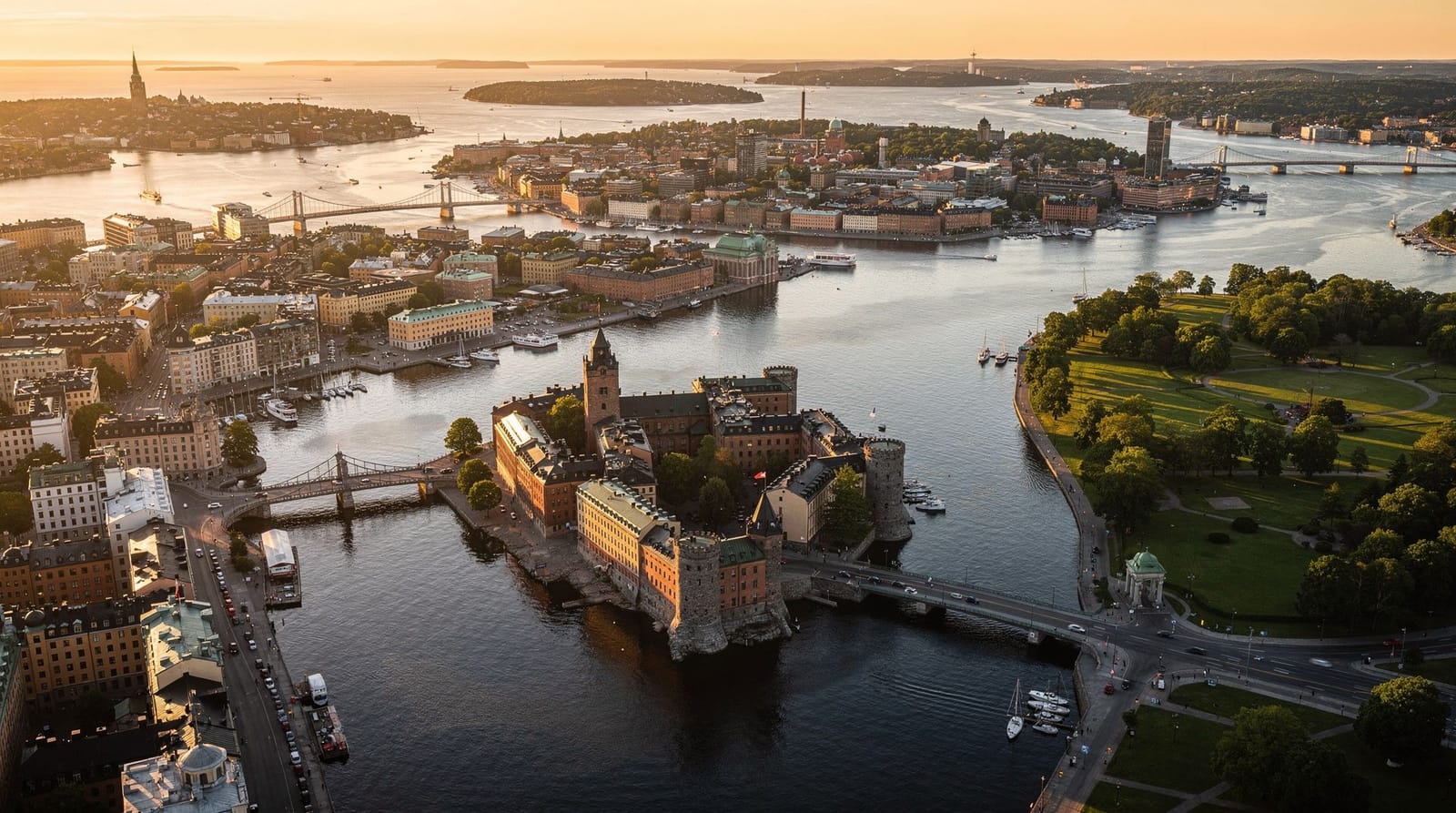
Norrmalm sits at the center of Stockholm’s geography. Gamla Stan is directly south, 10 minutes on foot. Östermalm is east along Hamngatan and Strandvägen, 15 minutes on foot or 5 minutes by T-bana. Kungsholmen is west across the Klarastrandsleden, 10 minutes by bus or 15 minutes on foot. Vasastan is north along Drottninggatan, 20 minutes on foot. Södermalm is south across Gamla Stan, most easily reached by T-bana.
For a city-wide overview and planning tools, see the Stockholm travel guide and the Stockholm in 3 days itinerary.
Avoiding Norrmalm’s tourist traps
Because Norrmalm absorbs the largest share of first-time visitors, it also concentrates a few of Stockholm’s more avoidable spending mistakes. The souvenir shops directly around Sergels Torg and along the upper stretch of Drottninggatan mark up everyday items (magnets, Dala horses, T-shirts) well above what the same items cost a few streets away or in Gamla Stan’s less trafficked lanes — see the overpriced souvenir shops guide for specifics. Restaurants directly facing Sergels Torg and inside the Central Station concourse also trade on footfall rather than quality; the Stockholm tourist traps guide covers this pattern citywide, and it applies to Norrmalm more than most districts precisely because it is the first area most visitors see.
For a genuinely cheap but satisfying lunch near T-Centralen, Hötorgshallen’s counters beat anything directly on Sergels Torg — the eating cheap in Stockholm guide has more addresses in the same spirit. And if you are relying on the free walking tours that depart near Sergels Torg, know the tipping expectation before you join — the free walking tour tipping guide explains what “free” actually means in practice.
Norrmalm for design and department-store shopping
Beyond Drottninggatan’s high-street chains, Norrmalm has a more specific shopping identity worth knowing about if Swedish design interests you. Svenskt Tenn on Strandvägen is technically over the Östermalm border but frequently visited as part of a Norrmalm/city-centre shopping loop — its Josef Frank textile patterns are a genuine piece of 20th-century Swedish design history, not a tourist gift-shop version of one. Closer to Norrmalm proper, DesignTorget and the concept stores along Kungsgatan carry contemporary Swedish homeware and accessories at a range of price points. The Stockholm design shopping guide maps the full circuit, including stops in Östermalm and Södermalm that pair naturally with a Norrmalm start.
For visitors deciding between a broad department-store browse and a boutique-by-boutique crawl, NK on Hamngatan remains the single most efficient stop: multiple floors, a curated Swedish design section, and the food hall in the basement if you need a break partway through.
Frequently asked questions about Norrmalm
Is Norrmalm worth visiting for its own sake?
As a dedicated destination, Norrmalm has specific highlights (Kulturhuset, Vete-Katten, NK department store, Hötorget market) rather than the area-wide walkable appeal of Gamla Stan or Södermalm. Most visitors to Stockholm will pass through it as a transit hub and do well to stop at two or three of these specific spots. It is not a neighborhood to spend a full day wandering; it is a neighborhood to navigate efficiently between more atmospheric destinations.
Where should I stay in Stockholm for transit access?
Norrmalm, specifically within 15 minutes’ walk of T-Centralen, gives you the most efficient access to the rest of the city. Virtually every Stockholm attraction is within 10 minutes by metro from T-Centralen. Hotels in this zone include Freys Hotel, Clarion Hotel Sign, Generator Stockholm (hostel), and a range of international chains.
What is the shopping situation in Norrmalm?
Drottninggatan and the streets around Sergels Torg are the main high-street shopping zone. NK department store at the eastern end of Hamngatan is the best quality department store. Åhléns City on Drottninggatan is the mid-market department store equivalent. For Swedish design and independent retail, you will find better options in Östermalm (for premium) or Södermalm (for independent and vintage).
How safe is Norrmalm?
Generally safe, with the exception of pickpocket activity along Drottninggatan and around Sergels Torg, which is the most commonly reported crime in Stockholm’s tourist areas. Standard urban precautions (front pockets, awareness in crowds) are appropriate. The area around T-Centralen at night has some antisocial behavior typical of major transit hubs — nothing dangerous but not the most pleasant evening walking route.
Can I get a good meal directly at T-Centralen or Sergels Torg?
You can, but it is rarely the best value. The counters inside Hötorgshallen (five minutes north) and Bakfickan at the Royal Opera House both beat the chains directly on the square for quality per krona. Save the immediate Sergels Torg restaurants for genuine convenience — a quick bite between trains — rather than a destination meal, and see the eating cheap in Stockholm guide for more reliable addresses nearby.
Top experiences
Bookable activities with verified prices and instant confirmation on GetYourGuide.