Stockholm's third-wave coffee scene: a guide for coffee drinkers
Stockholm: guided fika tour
Where is the best specialty coffee in Stockholm?
Drop Coffee (Södermalm) is Stockholm's leading specialty roaster — single-origin, filter-focused, serious sourcing. Johan & Nyström (Södermalm and others) is the other main independent roaster. Koppi has a Stockholm location. For traditional Swedish café culture alongside quality coffee, Vete-Katten (Norrmalm) and Café Saturnus (Östermalm) serve good coffee in classic settings.
Sweden and coffee: the context
Sweden is one of the world’s highest per-capita coffee-consuming countries — consistently ranking fourth or fifth globally, behind only Finland, Norway, and the Netherlands. This is not a recent development; coffee consumption in Sweden has been extraordinary since at least the 18th century, when Sweden was repeatedly (and unsuccessfully) attempting to ban the drink through royal decree due to concerns about its social effects.
The volume has always been there. The quality revolution — the third-wave movement treating coffee as a complex agricultural product with traceable origins and careful processing — arrived in Stockholm in the mid-2000s and has developed into a genuinely strong specialty scene.
| Where | Mostly Södermalm and Vasastan |
| Cost | around 35–75 SEK per drink |
| Time needed | 30–60 minutes per café, longer for a guided fika tour |
| Getting there | T-bana to Mariatorget or Zinkensdamm for Södermalm’s cluster |
| Best time | Morning, when batch brew and pour-over are freshest |
For the traditional side of Swedish coffee culture that this specialty scene sits alongside, see the fika culture guide and the cinnamon bun guide — the two traditions overlap more than they compete.
Drop Coffee — Södermalm
Wollmar Yxkullsgatan 10, Södermalm.
The reference point for Stockholm specialty coffee. Joanna Alm founded Drop Coffee in 2009 and built a roastery and café that has competed successfully at World Brewers Cup level. The sourcing is meticulous — direct trade relationships with producers in Ethiopia, Colombia, Kenya, and elsewhere, with transparent information about varieties, processing, and harvest seasons.
The café operates around the filter coffee program: V60 pour-overs, AeroPress, and filter batch brew are available alongside espresso. The single-origin espresso changes regularly. Pastries are sourced from quality bakeries rather than made in-house.
Drop Coffee is not the place to go for a comforting flat white in a casual atmosphere. It is the place to go when you care about what is in the cup. The staff are knowledgeable without being evangelical.
Best for: Single-origin filter, espresso tasting, understanding what Stockholm’s specialty scene does best.
Johan & Nyström — Södermalm and other locations
Swedenborgsgatan 7, Södermalm. Also in Östermalm and other locations.
The other major Stockholm roaster, Johan & Nyström has a slightly more approachable aesthetic than Drop Coffee. The sourcing is serious, the espresso program strong, and the café atmosphere invites lingering — comfortable seating, warm lighting, the sort of place where you can stay for two hours. Their bags of coffee are widely distributed in Swedish cafés and Scandinavian specialty shops.
The Södermalm flagship is the best location. The café also does proper Swedish pastries, creating a more complete fika experience than Drop Coffee’s minimal food offering.
Best for: Specialty coffee with a slightly warmer, more social atmosphere. Good for a longer stay.
Koppi — Stockholm location
Koppi is primarily a Helsingborg roastery but maintains a Stockholm presence. The roastery is one of the most respected in Sweden for green coffee sourcing, with a particular emphasis on relationship-driven procurement from East African producers. If you encounter Koppi coffee at a café in Stockholm, it is worth ordering.
Traditional cafés with good coffee
The specialty roaster scene and the traditional Swedish café culture coexist in Stockholm without significant tension — they serve different needs.
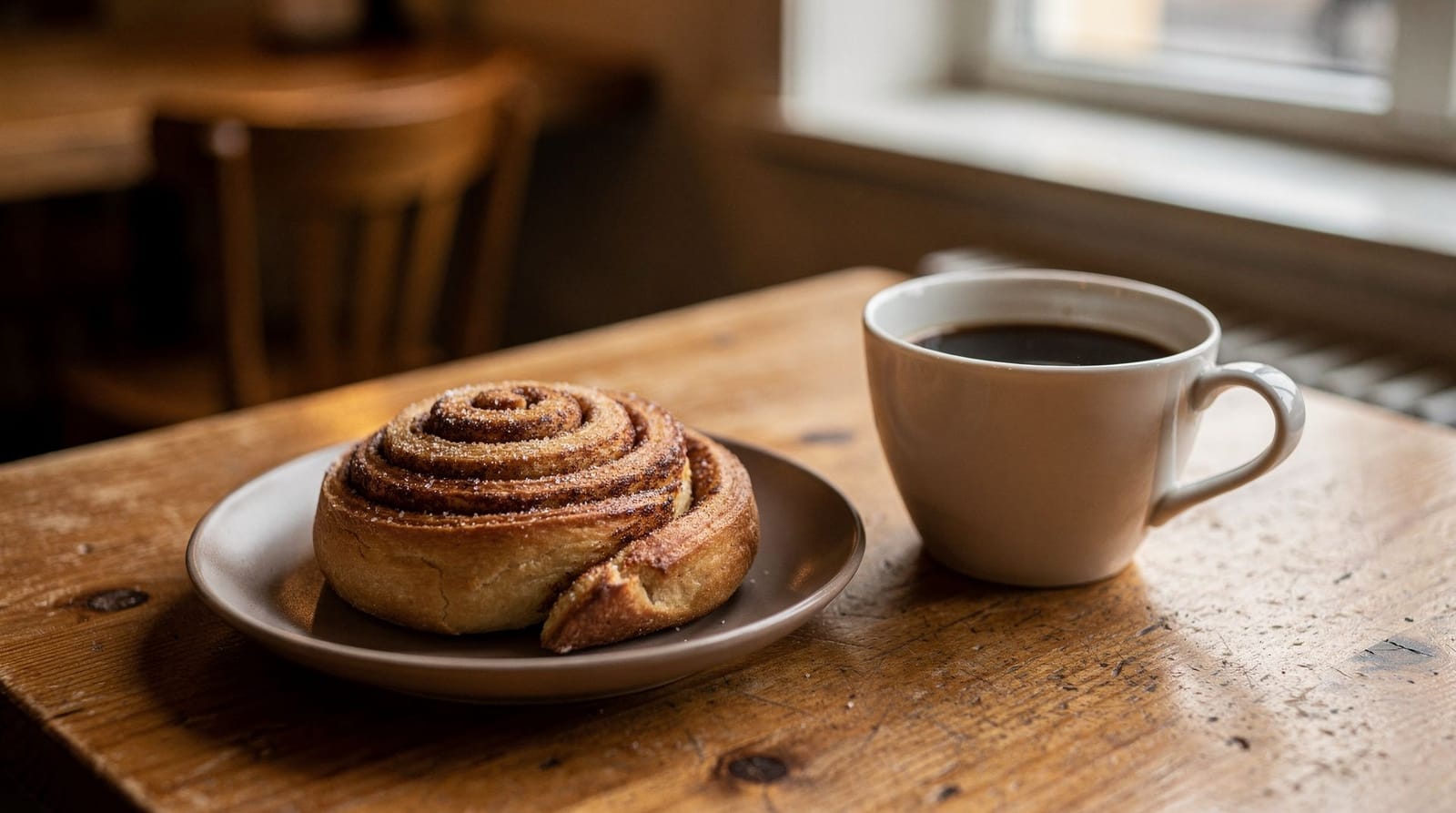
Vete-Katten (Norrmalm, since 1928): The coffee is not specialty — it is traditional Swedish filter (bryggkaffe) made from a commercial blend — but it is made correctly and served in the right context. The combination of traditional filter coffee and a cinnamon bun in a 1920s setting is a more authentically Swedish experience than a V60 pour-over.
Café Saturnus (Östermalm): Similar situation — good coffee in a proper café context, not specialty, but correct and well-made. The giant kanelbulle is the draw; the coffee is a worthy companion.
Pascal (Mariatorget, Södermalm): Occupies a middle position — better than traditional café coffee, not as rigorous as Drop Coffee. Good enough to satisfy someone who cares about coffee quality in a more relaxed setting. Mariatorget sits within Södermalm’s wider food scene, worth exploring beyond just coffee if you’re spending a morning in the area.
Comparing Stockholm’s specialty roasters
| Café | Vibe | Best for | Location |
|---|---|---|---|
| Drop Coffee | Serious, minimal | Filter purists, single-origin | Södermalm |
| Johan & Nyström | Warm, sociable | Longer stays, good pastries | Södermalm + others |
| Koppi | Focused, small presence | East African sourcing fans | Stockholm outpost |
| Vete-Katten | Traditional, historic | Classic fika, cinnamon buns | Norrmalm |
| Café Saturnus | Traditional, grand | Kanelbulle plus good coffee | Östermalm |
Building a coffee morning around Södermalm
The easiest way to experience the specialty scene is to treat Södermalm as a single walking loop rather than a list of addresses. Start at a filter-focused café while the batch brew is fresh, ask what is on filter that day, and resist the urge to order your usual milk drink straight away. Then let the neighbourhood do the rest: browse the shops and side streets, stop for a second, lighter coffee, and finish somewhere with comfortable seating where you can sit and compare notes.
If the loop appeals, the Södermalm neighbourhood deep dive and the Södermalm walking tour guide give you the streets and landmarks to string between café stops. In the evening the same area turns into one of the city’s better drinking districts, covered in the Södermalm bar scene guide, so a coffee-led morning can flow into a bar-led night without leaving the island.
Reading a specialty menu
Menus at serious cafés can look intimidating if you have only ever ordered by size. A few habits help. Look for the origin, the processing method and the variety listed beside each filter coffee; these tell you more about the flavour than any roast label. Lighter, fruitier coffees tend to come from East African origins, while rounder, sweeter ones often come from Latin America. If you are unsure, ask for a taste of the espresso on the grinder or the batch brew before committing to a pour-over.
It is also normal to order filter and espresso at the same café to see how one bean behaves in two formats. Baristas in Stockholm tend to welcome the curiosity, and it is the quickest way to learn which style you actually prefer.
Pairing coffee with sights
Specialty coffee works best as a pause between bigger activities rather than a destination in itself. After a morning at one of the big museums, a good cup is a useful reset: the Vasa Museum guide and the Moderna Museet guide both pair naturally with a coffee stop before or after your visit. If you are heading to the green side of the city, the Djurgården walking route is easier with a takeaway cup in hand.
Visit a photography museum on a cold day and you will want a warm drink afterwards; the same logic applies to a long day outdoors in the dark months, when a quality coffee is as much about warmth as flavour. The Stockholm winter guide explains how the city’s café culture carries people through the darker season.
The brewing method landscape
Stockholm’s specialty cafés have adopted the full range of third-wave brewing methods:
V60 (Hario): The standard manual pour-over. Produces clean, complex filter coffee. Drop Coffee and most serious Stockholm cafés offer this. Brewing time 3–4 minutes.
Chemex: A larger filter device producing a slightly different texture — very clean, slightly lighter body. Available at some Stockholm specialty cafés.
AeroPress: Faster, slightly more forgiving method producing espresso-adjacent pressure-extraction. Popular for experimentation and competitions.
Batch brew: Pre-brewed filter coffee kept at temperature, usually single-origin and changed regularly. The most accessible entry point for visitors — it is filter coffee but produced with specialty attention.
Espresso: All major Stockholm specialty cafés serve espresso. The quality is significantly higher than average because the sourcing and roast level are chosen to create genuine flavour in the shot rather than just bitterness and volume.
Cold brew and iced options: Increasingly common in summer, though Stockholm’s specialty scene treats cold brew as a seasonal addition rather than a year-round staple the way some warmer-climate cities do. Available at Drop Coffee and Johan & Nyström from roughly May through August.
Roasteries you can visit
Beyond the café-facing side, several Stockholm roasters allow visitors to see the roasting process or buy directly from the source. Drop Coffee roasts on-site at its Södermalm location, meaning the café itself doubles as a small production space — visible through the café’s open layout rather than hidden in a separate facility. This transparency around sourcing and roasting is part of what distinguishes third-wave from earlier coffee culture: the process is deliberately visible rather than treated as a trade secret.
Coffee and fika: how they interact
The fika ritual and third-wave coffee are in some tension: fika traditionally uses bryggkaffe (filter from a classic machine, relatively dark roast, the ubiquitous Swedish coffee of the 20th century) rather than specialty filter or espresso. Many Swedes who care about coffee drink specialty at home or at Drop Coffee but accept bryggkaffe at a fika with colleagues without complaint.
The traditional fika café culture — Vete-Katten, Café Saturnus — is not going away. It serves a different need: the atmosphere, the historical context, the specific Swedish café aesthetic that is not replicated in a minimalist specialty café with concrete walls and a whiteboard menu.
A visitor who wants both should do both: Drop Coffee on a Södermalm morning for the quality coffee experience, Vete-Katten on a Norrmalm afternoon for the cultural fika experience.
Join a guided fika tour including Stockholm’s best cafésPractical notes for coffee tourists
Best time to visit specialty cafés: Morning, when batch brew is freshest and pour-over availability is highest. Most specialty cafés in Stockholm open at 08:00 or 09:00.
Asking about the coffee: Stockholm baristas at specialty cafés are genuinely enthusiastic about explaining what is on offer. Asking “what do you recommend for filter today?” is a natural question and will get a useful answer.
Pricing: Specialty coffee in Stockholm costs more than regular café coffee — a V60 pour-over is 50–70 SEK, an espresso 35–50 SEK, a flat white 55–75 SEK. This is in line with Oslo and Copenhagen and slightly above London specialty pricing.
Take-home coffee: Drop Coffee and Johan & Nyström both sell retail bags of their current offerings. Buying a bag of Drop Coffee’s current single-origin as a gift is an excellent Stockholm souvenir.
Join a guided tour of Stockholm’s hideaway cafésWho this scene suits
Stockholm’s specialty cafés suit travellers who like to slow down and pay attention. If you enjoy comparing flavours, chatting with baristas and taking home a bag of beans, you will find plenty to occupy a morning or two. If you travel mostly for big sights and want coffee only as fuel, the traditional cafés are more convenient and just as pleasant, and nothing is lost by choosing them.
Travelling as a pair or a group with mixed tastes is easy. One person can order a filter at a serious roaster while another has a pastry and a milk drink, and nobody feels out of place. Families can also make a stop, though the minimalist specialty cafés are quieter and less set up for restless children than the larger traditional cafés; the Stockholm with kids family guide has broader ideas for keeping younger travellers happy between stops.
If rain is forecast, a long café session is one of the most pleasant ways to spend a grey morning, and it combines well with the options in the rainy day museum guide. Coffee here is less a tourist attraction than a daily habit you are invited to join for an hour, and that is exactly why it feels honest.
Coffee as part of a wider food day
Coffee rarely stands alone on a Stockholm itinerary — most visitors pair a specialty café stop with breakfast or a mid-morning break. See the Swedish breakfast guide for what to eat alongside your coffee, and the food tour guide if you’d rather have coffee folded into a broader guided culinary experience covering Södermalm and beyond.
Frequently asked questions about Stockholm’s coffee scene
Is Stockholm’s coffee scene actually good?
Yes — genuinely strong by European standards. Drop Coffee has competed internationally with distinction. Several Stockholm roasters source directly from producers and apply extraction methods matching Oslo, Copenhagen, or London’s best.
What is the difference between third-wave coffee and regular coffee?
Third-wave treats coffee as an artisanal product where origin, processing, roast, and extraction technique all matter. A third-wave café uses light roasts to preserve origin character and employs brewing methods chosen to highlight specific qualities.
Will I be able to get a flat white or latte in Stockholm’s specialty cafés?
Yes — most serve espresso-based milk drinks alongside their filter program. The milk drinks at Stockholm’s best cafés are considerably better than average because the base espresso is better.
How does fika culture interact with specialty coffee?
Fika traditionally uses filter coffee (bryggkaffe) rather than specialty. The specialty movement has influenced younger Stockholmers but the core fika ritual remains filter-coffee-adjacent. Traditional cafés and specialty cafés coexist in parallel.
Are there specialty coffee options near the main tourist areas?
The specialty scene is concentrated in Södermalm and Vasastan. Snickarbacken 7 (Vasastan) is the closest quality option to Gamla Stan at about 15 minutes on foot.
Top experiences
Bookable activities with verified prices and instant confirmation on GetYourGuide.