The Vasa Museum, visited twice — still worth it
The first time we visited the Vasa Museum was in 2016. We’d been warned it was good. We weren’t prepared for it to be that good.
The second visit happened four years later, partly because we wanted to see what we’d missed and partly because we’d been telling so many people about it that we wanted to check our own memory wasn’t inflating the experience. Museums have a way of shrinking between visits — the thing you remembered as staggering reveals itself as merely impressive, and you feel slightly foolish for the enthusiasm.
The Vasa did not shrink.
| Entry | 240 SEK adults in May–September (195 SEK October–April); book ahead in July-August |
| Time needed | 90 minutes minimum, 2-2.5 hours ideal |
| Location | Djurgården, easy tram/bus from central Stockholm |
| Best add-on | Vrak Museum of Wrecks, combo ticket available |
| Guided tour | English, multiple times daily, worth taking |
What you’re actually looking at
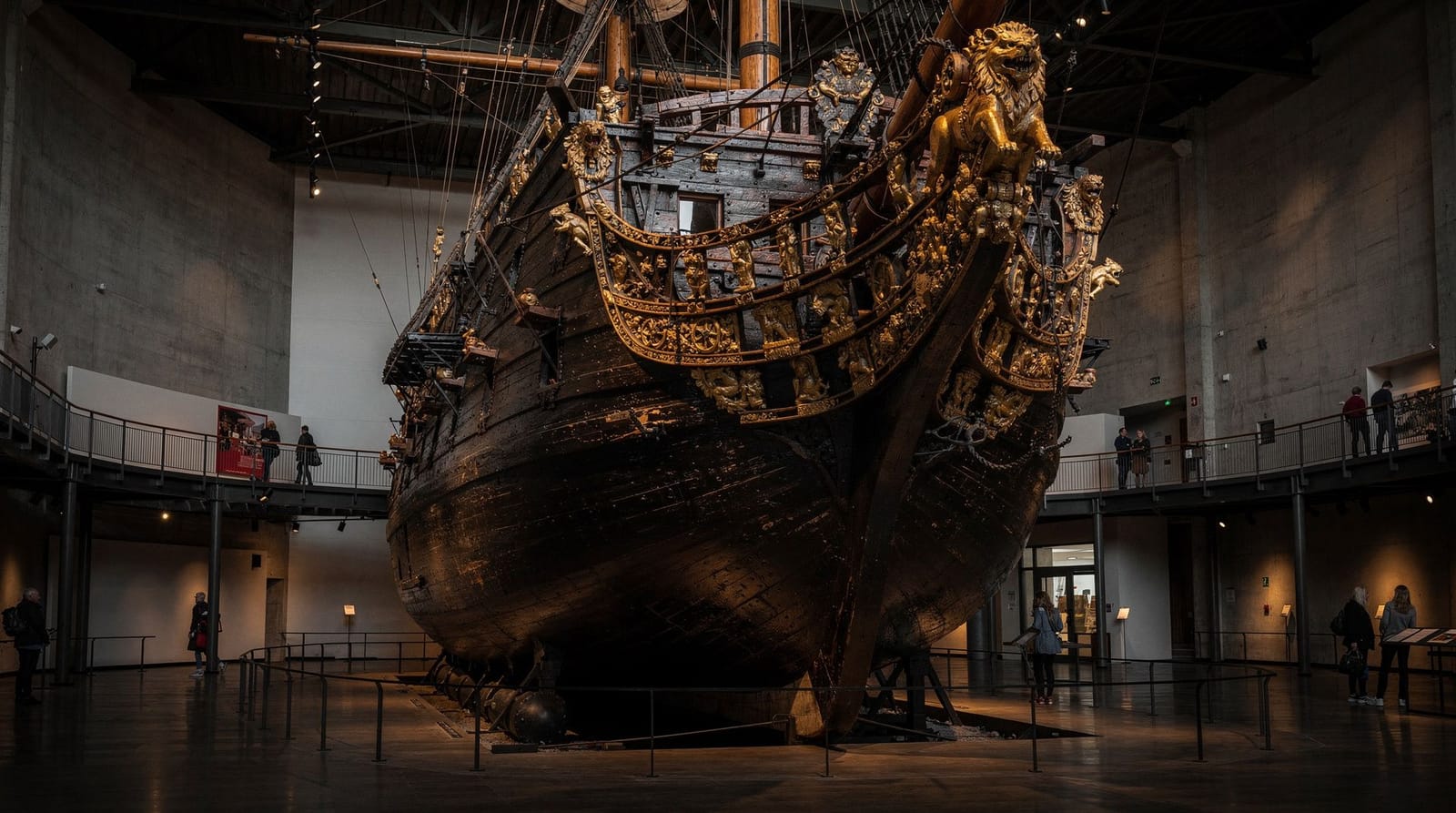
For those who haven’t been: the Vasa was a Swedish warship commissioned by King Gustav II Adolf, built between 1626 and 1628, the most powerful naval vessel of its day. On August 10, 1628, it sailed out of Stockholm harbour on its maiden voyage, caught a gust of wind, tipped, and sank. 333 metres from the dock. In full view of the city. In front of a crowd of onlookers including foreign dignitaries who had gathered to watch Sweden’s great symbol of naval power depart.
It lay on the bottom of Stockholm harbour for 333 years, preserved by the cold, low-salinity Baltic water. In 1961, it was raised. Intact. Cannons still in their ports, sculptures still attached to the hull, sailors’ personal belongings still in the ship.
No amount of description prepares you for standing inside the museum and looking up at the full 69-metre hull. The scale is wrong in a way your brain resists. Ships are things you see from outside; this one you’re inside, looking up, and the upper gun deck is four storeys above the lower one and the ceiling of the hall is higher still.
What changed between visits
The exhibition around the ship has been updated. On our second visit in 2020, several of the displays had been refreshed with better lighting and more explanatory context — particularly the reconstructed faces of crew members, rendered from skeletal remains found aboard, which are quietly devastating in a way that snaps the abstract history into something immediate.
The upper galleries that explain the conservation process — how the ship was raised, preserved, stabilized over decades — had expanded. These are worth more time than first-time visitors typically give them.
What didn’t change: The ship itself. Which is the point.
The practical reality
Entry: 240 SEK for adults in May–September (195 SEK October–April). Online booking strongly recommended — not because queues are always enormous, but because they can be, especially in July and August. An online time-slot ticket also gives you flexibility on the day.
Time needed: Minimum 90 minutes. Ideally two hours. If you want to see everything including the upper galleries, two and a half hours.
The guided tour: On our second visit we did the guided tour rather than going independently. The English-language guided tour runs multiple times daily and adds substantial value — the guide on our tour knew the names of specific crew members found aboard, what they had in their lockers, theories about why the ship sank (design flaws the builders may have known about but were afraid to tell the king). This context changed how we saw the ship.
Combination tickets: The Vasa + Vrak (Vrak Museum of Wrecks, a smaller but excellent nearby museum) combination ticket saves money and makes a full Djurgården museum day.
Is it worth a second visit?
For our purposes, yes. We saw things we’d missed — the lion figurehead on the stern, the complete inventory of objects found on board, the details of the conservation struggle. But I’d acknowledge this is a traveller’s answer rather than a universal one.
For most people, one thorough visit is enough. The museum is almost uniquely immune to the “museum fatigue” problem because the central object is so dominant and so consistently astonishing that it holds attention. But there isn’t a substantially different experience on a second visit if you did the first one well.
The recommendation: Go once, go thoroughly, take the guided tour.
Stockholm Vasa Museum guided tour with entry Stockholm Vasa Museum and Vrak Museum of Wrecks combo entryOur Vasa Museum guide covers opening hours, skip-the-line options, and what to prioritise inside. The Djurgården destination page explains how to combine the Vasa with the island’s other attractions. If you’re deciding what else to pair it with, our Vasa versus Skansen comparison and Vasa versus ABBA Museum guide both cover realistic same-day combinations.
How it compares to nearby options
Djurgården has enough museums to fill several days, and the Vasa is only the best-known of them. The Vrak Museum of Wrecks guide covers the smaller sister museum, which shares a building complex and works well as a 45-60 minute add-on rather than a full separate trip. If you’re weighing a broader Djurgården day against sticking to the Vasa alone, the 3-day first-timer itinerary shows how much time a typical visitor allocates to the island overall, and a museum pass can be worth it if you’re planning three or more Stockholm museums in a short trip.
What the museum does well
The conservation achievement is worth understanding separately from the ship itself. The Vasa was raised in 1961 and immediately began deteriorating in air, after 333 years of preservation in cold, low-oxygen water. The decision to spray the ship with a polyethylene glycol (PEG) solution — for 17 years — stabilised the waterlogged wood, but the long-term structural stability of this approach was unknown when it was applied. The ship is still being monitored continuously. The conservation challenge is not solved; it’s ongoing.
The galleries on the upper floors of the museum document this history in detail that most first-time visitors skip, because most first-time visitors are looking at the ship. This is the material that rewards a second visit or a long first one: what was found aboard the ship, what it tells us about the people on board, and the extraordinary ongoing effort to keep a 400-year-old wooden warship from slowly collapsing.
The most affecting objects are the personal ones. A backgammon set, complete. Shoes. A barrel that may have contained butter. Clothing. The ship carried between 130 and 150 crew members on its maiden voyage; most survived by swimming to shore (the harbour was crowded with spectators). A few didn’t. Their bones were found inside the ship. Their faces, reconstructed by forensic artists, look out from frames in the lower gallery.
What to actually prioritise
The ship itself: Spend at least 45 minutes just looking at it from different levels. The ground-floor view reveals the scale. The upper gallery view reveals the detail of the stern decorations — hundreds of carved figures, originally painted in bright colours, that covered every surface of the ship’s exterior. These weren’t decorative vanity; they were psychological warfare, intended to terrify the enemy.
The guided tour: In English, twice daily, free with entry. If your visit coincides with a tour start time, take it. The guide context changes what you’re looking at.
The skeleton exhibit: In the lower gallery, behind the ship. Often missed, not to be missed.
The conservation floors: Up on levels 3-4, often quiet. The best material for understanding what the museum’s actual achievement is.
Building the rest of the day around it
Because the Vasa is so dominant, the sensible move is to let it anchor the day and choose the rest around it. If you’d like to stay on the island, the Djurgården walking route strings the main sights together in an order that avoids doubling back, and the Skansen open-air museum guide explains what that very different outdoor experience offers after a dark, hushed hall. Our honest ABBA Museum review is useful if someone in your group would rather have pop music than naval history.
If the weather turns, the Vasa is a reliable shelter, and our rainy-day museum guide shows where else to go indoors without repeating yourself. Anyone who found the 17th-century story gripping may also enjoy the Viking Museum guide or the Swedish History Museum guide, which go further back in time. For getting to the island without fuss, the SL pass guide covers how public transport works.
Frequently asked questions about the Vasa Museum
Do I need to book tickets in advance?
In July and August: yes, emphatically. Online time slots sell out. In September-June: booking a few days ahead is sufficient and strongly recommended. Walk-ins are occasionally possible in off-peak months but you may wait.
Can children enjoy the Vasa Museum?
Yes. The ship is visually dramatic enough to engage children of all ages. Younger children (5-7) will want to see the big boat and may not engage with the upper galleries. Older children who have any interest in history or ships will find it genuinely absorbing. The hands-on cannons (replicas that can be “fired”) and ship models in the lower gallery are specifically child-friendly.
How does the Vasa Museum compare to the Viking Ship Museum in Oslo?
Different things. The Oslo Viking Ship Museum has three ships: the Oseberg ship, the Gokstad ship, and the Tune ship, all from the Viking Age (around 800-900 AD). The Vasa is from 1628 — 700 years later, much larger, more complex, and unique in being a complete warship rather than a burial vessel. If you have the opportunity to visit both, do. They don’t compete; they cover different eras.
Should I do the Vasa Museum and Skansen on the same day?
It’s possible since both are on Djurgården, but it’s a long day — the Vasa alone deserves 90 minutes to 2 hours, and Skansen easily fills half a day on its own. Our Vasa versus Skansen comparison breaks down whether to combine them or split across two days.