Swish, cards, and cash — the tourist payment reality in Stockholm
Sweden is, by most measures, the most cashless society in the world. The Riksbank (Sweden’s central bank) has reported that less than 10% of transactions involve physical cash. Some Stockholm restaurants, museums, and transit services explicitly do not accept cash. Accepting this as a tourist means understanding how the system works, what you can access, and what you can’t.
| Bring | Contactless Visa/Mastercard, no foreign-fee card ideal |
| Skip | Swish (tourists can’t register), large cash amounts |
| Cash to carry | Around 200-300 SEK, for edge cases only |
| ATMs to use | Bankomat (green), avoid Euronet (orange) |
| Currency | SEK; card and mobile pay are the default everywhere |
The card situation (good news)
Contactless Visa and Mastercard work essentially everywhere in Stockholm. Metro turnstiles, buses, trams, museums, restaurants, cafés, supermarkets, market stalls — the card reader is the default. Apple Pay and Google Pay are accepted at most modern terminals.
This is the primary message: if you have a contactless Visa or Mastercard, you will have no payment difficulties in Stockholm. Budget for €0 in currency exchange fees by using a travel card with no foreign transaction fees (Wise, Revolut, and similar) or your existing bank card if it doesn’t charge international fees.
American Express: Accepted at many places but not universally. Don’t rely on it as your only card.
Visa debit vs Visa credit: Both work.
Swish — what it is and why you can’t use it
Swish is a Swedish mobile payment app used for person-to-person and person-to-business payments. It’s linked directly to a Swedish bank account and requires a Swedish BankID to register. BankID requires a Swedish personnummer (national ID number).
None of these things are available to tourists.
Swish QR codes appear on many Stockholm restaurant tables, market stalls, and even some street performers’ signs. These are for Swedish residents only. Tourists cannot use Swish. This is not a technical limitation that can be worked around — it’s structural to the system.
When you see a Swish code, look for an alternative payment method (there almost always is one) or ask.
The tipping situation
Sweden’s tipping culture is lighter than the US, UK or France. The default expectation is none — Swedish service staff are paid properly, and a service charge is not added to bills. Rounding up, or adding 5-10% for genuinely excellent service, is appropriate and appreciated. More than 10% is unusual and not expected.
The practical implication: budgeting for tips is less important in Stockholm than in many cities. At a restaurant where you’ve been given excellent service, leaving 10% is generous. Leaving nothing is not impolite.
Exception: Free walking tours (we’ve written about this separately), where the guide’s income depends on tips and the cultural expectation is higher.
Cash: is it worth carrying any?
For most visitors: no. There are virtually no cash-only situations in central Stockholm. Even the archipelago ferries accept contactless payment.
The edge cases where cash helps:
- Some very small independent market stalls
- Some archipelago island cafés that may have unreliable card terminals
- Church donation boxes
- Tips in cash if you prefer to leave them that way
Carrying 200-300 SEK in case is not unreasonable. More than that is typically unnecessary.
Getting cash: Stockholm ATMs (Bankomat) are widely available and accept international cards. The Euronet ATMs at airports and tourist areas charge high fees; use the Bankomat network specifically (the green-branded terminals associated with Swedish banks).
Systembolaget and the alcohol rules
Systembolaget, the state alcohol monopoly, sells all wine, spirits and beer over 3.5% ABV. They accept cards but not cash at many locations. Opening hours: Monday-Friday 10 AM-7 PM (or 8 PM at larger stores), Saturday 10 AM-3 PM, closed Sunday. This is relevant planning information if you want wine for Sunday evening.
Convenience stores (Pressbyrån, ICA Kvantum) sell beer up to 3.5% ABV and cider. This is different from, say, Germany — you cannot buy wine at a Swedish supermarket.
The VAT reality for tourists
Sweden’s standard VAT is 25%. Accommodation and dine-in restaurants: 12%. As of April 2026, a temporary reduction to 6% applies to groceries, takeaway food, and non-alcoholic beverages (alcohol and tap water stay at 25%). This temporary reduction runs until December 2027.
The 6% grocery rate makes supermarket shopping and takeaway noticeably cheaper relative to 2025 prices. It’s worth factoring in if you’re self-catering or buying lunch from a supermarket counter.
Tax refund for tourists: Non-EU residents can claim VAT refunds on qualifying purchases over 200 SEK. The Global Blue system operates at major Stockholm stores. This is most relevant for higher-value purchases (clothing, electronics). The process requires keeping your receipts and completing paperwork at the airport before departure.
Summary for the arriving tourist
- Contactless Visa/Mastercard: works everywhere
- Swish: not accessible to tourists
- Cash: useful to carry a small amount, rarely necessary
- Tipping: optional, light, not mandatory
- Airport ATM: use Bankomat not Euronet
- Systembolaget: closed Sundays, plan ahead
For full budget planning, our Stockholm budget guide covers accommodation, food and activity costs with current 2026 figures. Transport payment details are in the Stockholm transport guide, and our tourist traps guide flags a few payment-adjacent scams worth knowing before you arrive.
Stockholm Arlanda Airport train transfer — book and pay in advanceThe card reader landscape
Stockholm’s card reader infrastructure is comprehensive and modern. The terminals you encounter are primarily contactless-capable and accept the major international networks (Visa, Mastercard, Amex where noted). A few specific contexts worth knowing:
Museum ticket desks: All major Stockholm museums (Vasa, ABBA, Skansen, Fotografiska, etc.) accept card payment and have done so reliably for years. The ticket desks are often replaced by online pre-booking with mobile confirmation, which is card-payment by default.
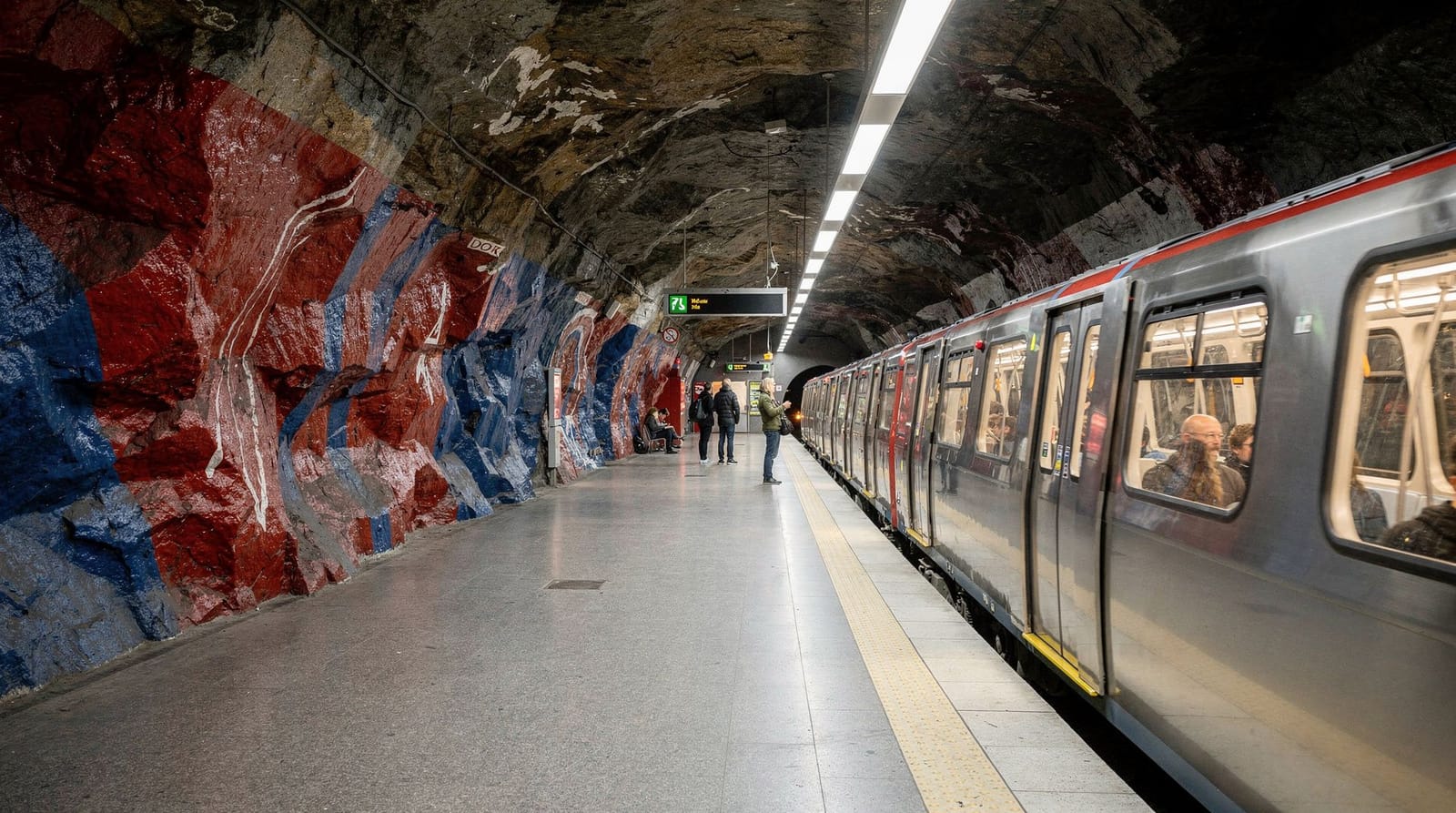
Metro and transit: SL turnstiles accept contactless cards directly (Visa, Mastercard, Amex). You can tap your card on the reader without an SL card or SL app. The per-journey cost is 43 SEK, debited from your card. The advantage of a multi-day SL pass is still the discounted rate for frequent travel.
Taxis: All regulated taxis (Taxi Stockholm, Cabonline) accept card. Use Taxi Stockholm (yellow cabs, metered) or order via app. The deregulation of taxis in 1990 created a market with unregulated operators; always use a metered, licensed cab or a ride-hailing app. Never accept an unmetered taxi at Arlanda or near tourist sites.
Markets and small vendors: Almost all market stalls at Hötorget, Östermalmshallen, and similar venues accept card. Occasionally a very small independent vendor at a street market uses cash-only — for these, your 200-300 SEK float covers it.
The tipping mechanics
On a card terminal, Stockholm restaurants typically do not add a tip prompt by default. The terminal completes the transaction for the menu price. If you want to tip, you can add it at the terminal when prompted (“Leave tip?” — yes/no), or you can leave cash on the table for the server.
Leaving cash tips is common and preferred by some servers who don’t want to share the terminal tip amount with the house. Both methods work. Neither is mandatory.
Mobile payments: Apple Pay, Google Pay, Samsung Pay
All three work in Stockholm as broadly as contactless Visa/Mastercard — which is to say, essentially everywhere. The same card network rules apply (Visa/Mastercard for universal acceptance, Amex at a subset of venues).
Specific useful application: Paying on the SL metro with Apple Pay or Google Pay avoids the need to load a separate SL card. Tap the card reader with your phone, pay 43 SEK, done.
Currency exchange: what to avoid
Airport currency exchange desks: High fees, poor rates. Avoid.
Euronet ATMs: A private ATM network that offers exchange-rate-inflated withdrawals with a fee. Easily identified by their orange branding at tourist locations (Arlanda arrivals, near Gamla Stan, etc.). Avoid.
Hotel exchange services: Higher rates than independent currency exchange, lower than airport desks. Acceptable in an emergency.
What to use instead: Bankomat ATMs (the green-branded Swedish bank network) have normal international fees. Your bank’s international ATM fee (check beforehand) plus the standard interbank rate. Or use a Wise or Revolut card pre-loaded with SEK for minimal fees.
Payments on the archipelago and day trips
Card and mobile pay work further from central Stockholm than most visitors expect. Waxholmsbolaget archipelago ferries, ticket kiosks at Vaxholm, and cafés on the more visited islands all take contactless cards. The genuine edge cases are small, seasonal kiosks on quieter islands, where a card terminal can occasionally be offline — your 200-300 SEK float exists mainly for this. If you’re heading to Sigtuna or Uppsala by train, payment works exactly as it does in central Stockholm; neither town is meaningfully more cash-dependent.
Paying for sights and getting around
Most of what you spend in Stockholm goes on entrance tickets, transport and meals, and all three work with a card. For the big sights, booking ahead online means the payment happens on your own phone, with your own card, before you arrive. The Vasa Museum guide and the ABBA Museum guide both explain how timed entry works, and if you are torn between the two, Vasa vs ABBA Museum helps you decide. If you already know you want the warship, you can buy a ticket for the Vasa Museum in advance and skip the desk entirely.
Other museums follow the same pattern. The Fotografiska guide, the Nobel Prize Museum guide and the Skansen open-air guide all assume card or mobile payment. If you plan to visit several attractions, the museum pass guide and the comparison in Stockholm Pass vs Go City vs SL show whether a bundled pass is worth paying for up front.
Transport is the other place where the card question comes up. Our SL pass guide covers the options, and the blog post on an SL pass versus individual tickets works through the choice. For the airport, the Arlanda airport to city options guide lists the ways in, and every one of them accepts a contactless card. Taxi payment and fares are covered in taxi vs Uber in Stockholm.
If you want a broader picture of costs beyond payment methods, eating cheap in Stockholm shows how everyday spending plays out, and Swish and payments for tourists is the shorter reference version of this article.
Frequently asked questions about payments in Stockholm
Can I use US dollars or euros in Stockholm?
Technically no — Sweden’s currency is SEK. In practice, some tourist-facing restaurants in Gamla Stan will accept euros informally, but this is not standard and the rate is always unfavourable. Pay in SEK.
What if my card is declined in Stockholm?
The most common cause: your bank’s fraud detection triggering on an international transaction. Contact your bank before you travel to notify them of your destination dates. This is standard practice and takes two minutes.
Is Swish available for tourists?
No. Swish requires a Swedish bank account and BankID (Swedish national ID system). It is not accessible to tourists. See our earlier explanation above for why QR codes you see in restaurants and on market stalls are not for your use.
Do I need cash for the archipelago ferries or islands?
Generally no — Waxholmsbolaget ferries and most island cafés take contactless card. Carry your small cash float for the rare offline terminal on a quieter island, but don’t plan a day trip around needing cash.
Should I notify my bank before travelling to Stockholm?
It’s worth doing, even though most modern fraud systems handle international travel automatically. A two-minute call or app notification removes the small risk of a declined card at an inconvenient moment, such as an SL turnstile or a restaurant table.