Changing of the guard Stockholm: times, route, and what to expect
Stockholm: Royal Palace museums & Gamla Stan skip-the-line tour
Duration: ~4 hours
What time is the changing of the guard at Stockholm's Royal Palace?
The Changing of the Guard at the Royal Palace takes place all year at 12:15 Monday–Saturday and 13:15 on Sundays and public holidays. A parade with a military band runs on selected days (mainly April–August); times and locations can change, so check the Swedish Armed Forces' calendar. It is free to watch from the Outer Courtyard (Yttre Borggården) and lasts approximately 40 minutes.
The Royal Guard ceremony at Stockholm’s palace
The Changing of the Guard (Vaktavlösning) at the Royal Palace in Stockholm is one of Scandinavia’s most visible royal ceremonies — a free daily event in summer that draws significant crowds to the Outer Courtyard of Kungliga Slottet. Unlike some royal guard ceremonies that are primarily military routine observed by a passive crowd, the Stockholm ceremony includes a military band, a formal parade through city streets, and a full ceremonial exchange in the palace courtyard.
It is not the most spectacular guard-changing ceremony in Europe — Buckingham Palace’s scale and circumstance exceeds it, and the Horse Guards in London have the glamour of cavalry. But Stockholm’s ceremony benefits enormously from its setting: the 18th-century baroque palace above Gamla Stan, the scale of the courtyard perfectly sized for a crowd of several hundred, and the reliability of the summer schedule (daily at 12:15) make it one of the most accessible free activities in the city.
| Where | Outer Courtyard (Yttre Borggården), Royal Palace, Gamla Stan |
| Cost | Free |
| Time needed | 40–45 minutes |
| Times (all year) | 12:15 Monday–Saturday, 13:15 Sundays/holidays |
| Parade with band | Selected days, mainly April–August (check the official calendar) |
For the palace interior itself, see the Royal Palace Stockholm guide; if you want to compare it against Sweden’s other royal residences, the royal palaces comparison guide is the place to start.
Summer schedule (April–October)
Monday–Saturday: 12:15 at the palace courtyard. Sundays and public holidays: 13:15 at the palace courtyard.
Arrive at least 20 minutes early to secure a position with a clear sightline. The courtyard fills quickly on fine summer days; latecomers may see only the backs of other spectators.
Winter schedule (November–March)
Monday–Saturday: 12:15 at the palace courtyard. Sundays and public holidays: 13:15 at the palace courtyard. The band parade starts from Mynttorget on selected days; check the Swedish Armed Forces’ calendar.
Winter ceremonies are smaller and less crowded — often an excellent time to see the ceremony at closer range. The courtyard is not heated; dress accordingly.
The ceremony itself
The ceremony involves two main elements:
The march through Stockholm
The incoming guard — the relief company — marches from its barracks through central Stockholm to the palace. The route varies seasonally (the most common summer route passes through Kungsträdgården and down to Gamla Stan), and observers positioned along the route can watch the march with its military band before the palace ceremony.
If you want to see the parade in the streets, position yourself in Kungsträdgården approximately 15–20 minutes before the ceremony start time.
The palace courtyard ceremony
The formal exchange of the guard takes place in Yttre Borggården (the Outer Courtyard) on the north side of the palace. The ceremony involves:
The band: The Life Guards band (Livgardets Dragmusikkår) performs Swedish military marches and ceremonial music throughout the exchange. The band is one of the most professional military bands in Scandinavia and is worth hearing regardless of interest in the ceremony itself.
The guard exchange: The outgoing guard presents itself; the commanding officer conducts the formal inspection; the exchange of responsibility is marked by a series of commands and movements. The Swedish guard uses a formal style that has remained essentially unchanged for generations.
The duration: Approximately 40–45 minutes for the full courtyard ceremony. The most dramatic moments are the arrival of the incoming guard and the formal command sequences.
Best viewing positions
In the courtyard: The ceremony fills the Yttre Borggården, and spectators line the perimeter. Central positions give the best frontal view; arriving early (20–30 minutes before) is essential for these spots.
From the outer wall: The elevated walls of the courtyard’s southern approach give a slightly raised view if the central area is crowded. This is a good option for photography as it provides angle above the crowd.
From Slottsbacken: The sloping street on the eastern side of the palace is not part of the ceremony location but gives an architectural view of the palace exterior in the same time window. This is a photography position rather than a ceremony-viewing position.
For the street parade: Along Skeppsbron or Mynttorget (the approach to the northern courtyard) gives a close encounter with the marching band before the ceremony.
Photography tips
The courtyard ceremony: A 70–200mm equivalent gives good coverage from the sides of the courtyard. The guards’ navy-blue uniforms with gold detail photograph well in the midday light that falls on the north-facing courtyard in summer (the high summer sun angles into the courtyard differently from spring and autumn).
The band: The military band is the most photogenic element — close-framed portrait shots of musicians in ceremonial dress, or wider shots of the full band formation. A 50–85mm equivalent handles both at the viewing distances available.
Crowded conditions: The ceremony is popular in July and August — expect hundreds of spectators. Lens choices that compress rather than show the foreground crowd (85–135mm equivalent) are more useful than wide angles in these conditions.
Avoid flash: Flash is not necessary in the midday summer light and would be intrusive.
Combining with the Royal Palace visit
The most efficient combination:
- 10:00: Royal Palace opens — enter immediately and begin with the Treasury (most crowds arrive after 11:00).
- 11:30–12:00: Exit the Treasury and position in the courtyard.
- 12:15: Changing of the Guard (weekday summer).
- 13:00: Continue into the State Apartments or Tre Kronor Museum.
The combination of the Treasury’s crown jewels and the live guard ceremony within the same morning makes for the most concentrated Royal Palace experience.
Stockholm: Royal Palace museums and Gamla Stan skip-the-line tourThe guards and their uniforms
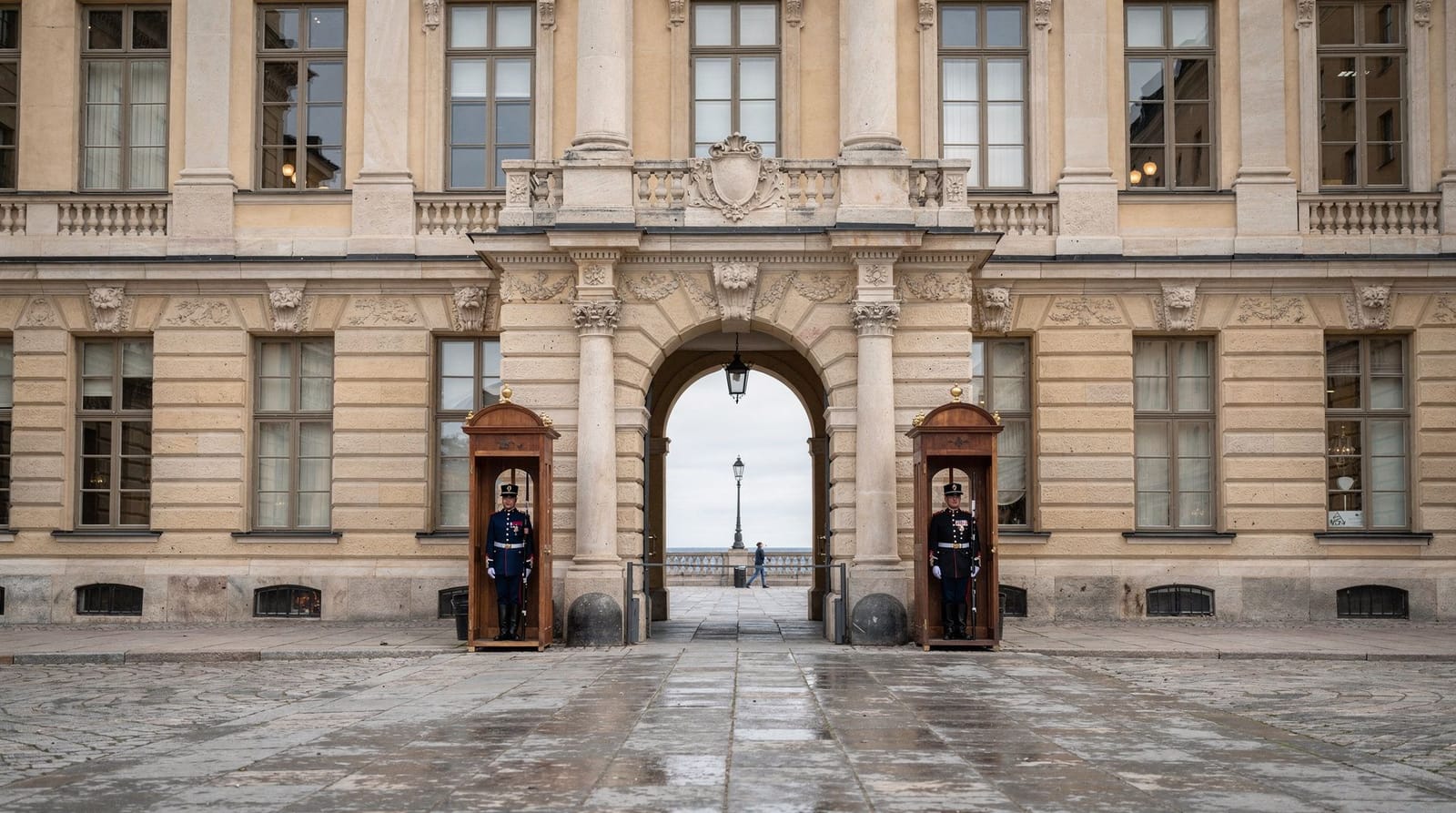
The Royal Guard (Livgardets Dragoner) wears a distinctive uniform:
Summer dress: Navy blue tunic, white trousers or navy breeches (depending on function), and the characteristic bearskin hat — similar to the British Royal Guards but smaller in proportion.
Winter dress: Heavier navy greatcoat, same bearskin.
Officers: Carry swords; their uniforms include additional gold braid and different rank insignia.
The Swedish Royal Guard is the oldest military unit in Sweden, with origins in the 16th century under Gustav Vasa. The ceremonial role at the palace has been continuous since the palace’s 18th-century construction.
The military band: the ceremony’s auditory centre
The musical component of the Changing of the Guard is underappreciated by visitors focused on the visual spectacle. The Life Guards band (Livgardets Dragmusikkår) is one of the best military bands in Sweden — a professional ensemble whose skill is not merely functional but genuinely musical.
The Swedish military march tradition draws on the same 18th-century European tradition as the British, German, and Austrian military bands, but with specific Swedish repertoire. The marches used for the Changing of the Guard include Swedish original compositions and adapted classical pieces. If you position yourself to hear the band without visual obstruction — at the edge of the courtyard rather than pressed into the viewing crowd — the acoustic quality of the open-space performance is striking.
Particularly in summer when the courtyard acts as a natural amphitheatre, the band’s sound bounces between the palace walls with clarity. This is most noticeable from the sides of the courtyard where the wall reflection is strongest.
The Life Guards: history and current role
The Livgardets Dragoner (Life Guards Dragoons) has a history stretching to the 16th century, when Swedish rulers first established a mounted guard for their personal protection. The unit has participated in virtually every Swedish military conflict from the Thirty Years’ War to the Napoleonic period, serving under kings including Gustav II Adolf, Karl XII, and Gustav III.
In contemporary Sweden, the Life Guards serve a dual function: as the ceremonial palace guard (performing the public-facing ceremony) and as an active military unit within the Swedish Armed Forces. This dual role — ceremonial and operational — is not unusual among European royal guards, but worth knowing: the soldiers performing the ceremony are not purely ceremonial figures.
The regiment’s motto — “Ständigt Beredt” (Always Prepared) — reflects the original 16th-century function. The bearskin hat, adopted in the 19th century following European fashion, was originally a practical winter garment before becoming purely ceremonial.
The ceremony schedule variation: why it changes by day
The distinction between Monday–Saturday (12:15) and Sunday/holiday (13:15) departure times is not arbitrary. On weekdays, the ceremony is conducted with fewer personnel — a smaller guard, smaller band — reflecting the working-week rhythm of the palace. On Sundays and public holidays, the full ceremonial complement is deployed, with more soldiers and a longer ceremony duration.
For photography, the Sunday ceremony is preferable: more subjects, longer ceremony, and the 13:15 timing in summer gives the light from a slightly higher sun angle than the noon weekday ceremony. For avoiding crowds: the weekday ceremony is noticeably less busy.
High-attendance days to be aware of: National Day (6 June) and the birthday of the King (30 April) draw the largest annual crowds. These dates see the ceremony augmented with additional ceremonial elements; arrive 40 minutes early rather than the standard 20.
What to see in the courtyard before the ceremony
If you arrive 25–30 minutes before the ceremony, the outer courtyard (Yttre Borggården) is already accessible. The current guard is at their posts; the palace facade provides context.
The main palace gate (porten): The ornamental ironwork gate is Swedish baroque — less extravagant than French equivalents but well-crafted. The Swedish royal coat of arms (Tre Kronor) above the gate has been the primary symbol of Swedish sovereignty since the 14th century; the three crowns appear on the City Hall tower, on the guards’ belt buckles, and throughout the palace’s decorative scheme.
The courtyard dimensions: Note the scale of the courtyard relative to the number of ceremony spectators. The ceremony is intimate by London or Madrid standards — the palace forecourt at Buckingham Palace holds thousands; Yttre Borggården at the Stockholm palace holds hundreds comfortably. This is Stockholm’s style: functional and appropriately scaled rather than maximally impressive.
Context: the ceremony in Swedish royal culture
The Swedish monarchy is one of the most restrained in Europe in terms of public ceremony. Sweden’s constitution significantly reduced royal power across the 20th century; King Carl XVI Gustaf’s role is now entirely ceremonial, making the ceremony not a display of political power but of cultural continuity.
The Changing of the Guard is the most public face of a monarchy that otherwise conducts itself with considerable privacy. Swedes have a generally neutral-to-positive relationship with the monarchy as an institution — neither the passionate royalism of Britain nor the active republican opposition of some European states. The ceremony takes place; Swedes pass by without particularly noticing; tourists gather to photograph. This Swedish-ness — understated, functional, unremarkable in the best sense — is itself an accurate introduction to how the country operates.
Ceremony etiquette
The ceremony is a working military exercise, not a theatrical performance, and Swedish norms around it are correspondingly understated. Applause is not customary during the ceremony itself, though a brief round at the very end is common and welcome. Stepping into the marching path to get a photograph is both disruptive and, on occasion, physically risky — the guards continue their formal movements regardless of spectators, and stewards will move people back if needed. Drones are not permitted over the palace courtyard. Loud conversation during the formal command sequences draws disapproving looks from Swedish onlookers, who tend to watch quietly even when the crowd is largely tourists. None of this is strictly enforced with signage, but following the lead of the quieter locals near you is the easiest way to blend in and get a better view in the process.
Gamla Stan after the ceremony
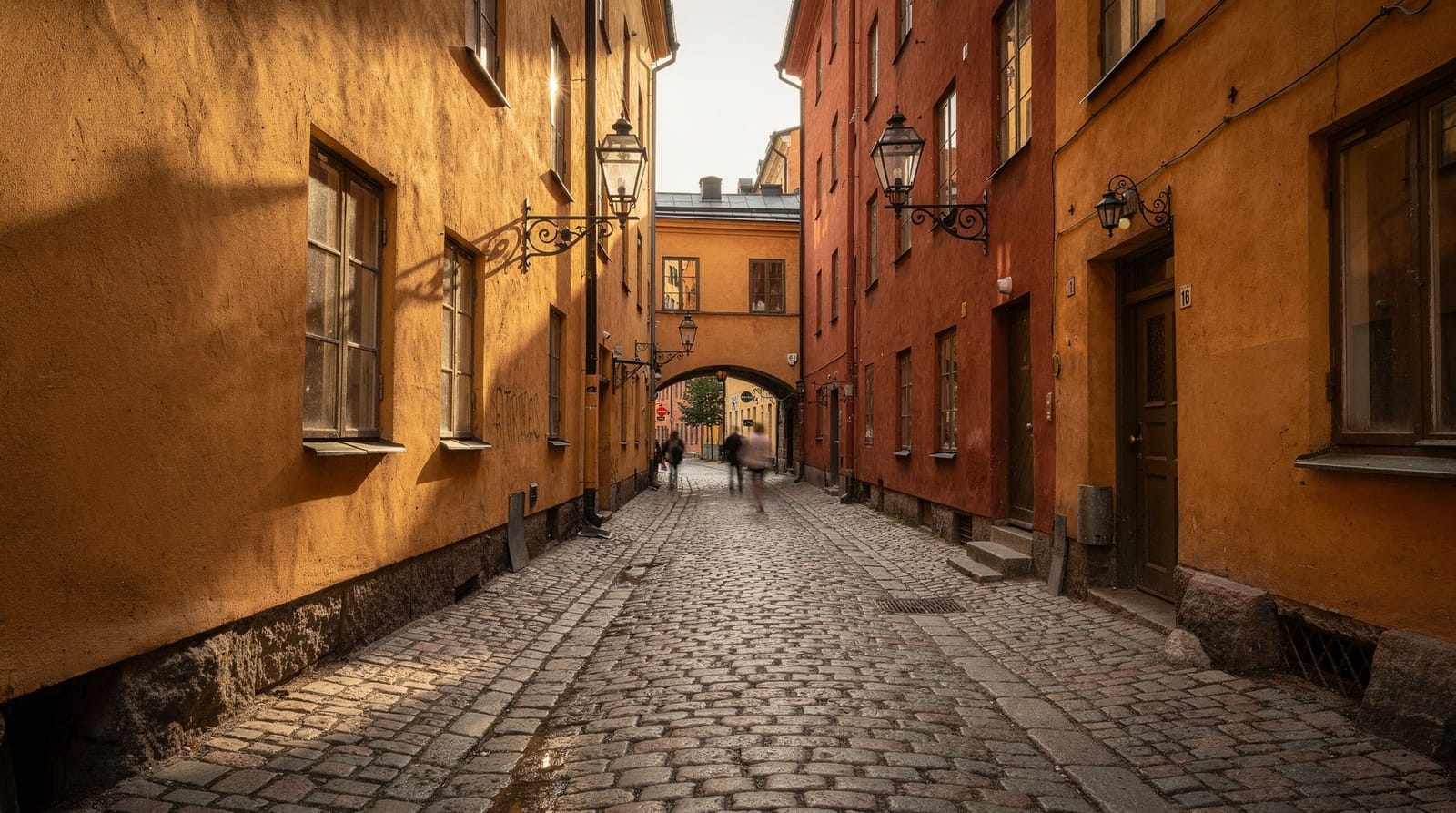
After the ceremony, the morning crowds in Gamla Stan (which peak around 11:00–13:00) begin to disperse for lunch. A walk through Gamla Stan at 13:30–14:00 gives the streets slightly more space than the pre-ceremony peak. The route from the palace courtyard through Stortorget, down Köpmangatan, and west to Riddarholmen takes 45–60 minutes at a relaxed pace. The Gamla Stan walking tour guide covers the full neighbourhood route, and the self-guided Stockholm walking guide has further routes if you want to keep exploring on foot afterwards.
If the ceremony leaves you wanting more royal residences, Drottningholm Palace — the King’s actual private residence, also UNESCO-listed — makes a natural half-day extension by boat or bus.
The ceremony compared to other European royal guards
Stockholm’s Changing of the Guard is frequently compared to its British equivalent at Buckingham Palace. The comparison is natural but slightly misleading — the two ceremonies reflect different national characters as much as different scale.
Buckingham Palace: A maximum spectacle designed for maximum crowds. The forecourt holds thousands. The ceremony involves cavalry, foot guards in bearskins, multiple regiments, mounted police, and a military band of considerable size. The duration is approximately 45 minutes. The scale is designed to be impressive from a distance.
Stockholm Royal Palace: A human-scale ceremony in a courtyard sized for hundreds rather than thousands. The guard is smaller, the band is smaller, and the setting — the baroque palace above Gamla Stan’s rooflines rather than a city park — is more architecturally specific. The ceremony is professional but not maximised for spectacle.
What Stockholm’s ceremony delivers that London’s cannot: the intimacy of being 20 metres from the band rather than 100 metres, the ability to see the individual soldiers clearly, and the specific sensation of standing in a working royal palace (not a museum) on a normal weekday morning. The ceremony is understated in the specifically Swedish way that Stockholm does understatement — it does not try to impress; it simply does what it does, well.
Madrid (El Cambio de Guardia at the Royal Palace): Spain’s royal guard ceremony is monthly rather than daily; the scale is similar to Stockholm’s but the baroque setting of the Spanish Royal Palace of Madrid is more imposing. Stockholm’s daily ceremony (in summer) is more convenient for visitors planning around it.
Vienna (Hofburg): No equivalent public ceremony in the current format.
The summary: Stockholm’s ceremony is not the most spectacular royal guard ceremony in Europe but it is among the most accessible, the most intimate, and the most consistently scheduled. For families, photographers, and visitors who want to see a genuine ceremony (not a theatrical recreation) in a architecturally significant setting without fighting massive crowds: it is the right choice.
Free Stockholm: the case for the ceremony
Stockholm is expensive. Hotels average 198 USD per night in summer; food at decent restaurants costs 150–250 SEK per main course; museums charge 150–230 SEK entry. The Changing of the Guard is a significant Stockholm experience that costs nothing.
This is worth emphasising for budget visitors. The ceremony, Stortorget (the central Gamla Stan square), the waterfront views from Skeppsbron, and the walking streets of Gamla Stan cost nothing. Combining the Royal Palace visit with the Changing of the Guard maximises the value of the single paid entry (~200 SEK for the combined ticket) by adding a free 40-minute ceremony to the same morning.
For visitors managing their Stockholm budget carefully: the morning sequence of Royal Palace admission incl. Treasury (220–240 SEK) + Changing of the Guard (free) + Gamla Stan walk (free) + Royal Bridges canal boat (280 SEK) covers four of Stockholm’s signature experiences for approximately 480 SEK — about the price of a mid-range Stockholm dinner.
If the boat appeals, a canal cruise under the royal bridges is a calm way to see the palace from the water after you have watched the ceremony from the courtyard. The wider picture of what a trip costs is in the Stockholm budget per day guide, and the royal canal boat tour guide compares the options in more detail.
Planning the rest of your day
The ceremony sits in the middle of the day, so it works best as an anchor around which you arrange everything else. A few ways to build the hours before and after it:
- Culture-heavy day: pair the palace with a museum on Djurgården; the Vasa Museum guide explains what to expect from the famous warship.
- Food-led day: the courtyard crowd thins out as people head for lunch, and the fika culture guide is useful if you want a coffee and a pastry before or after the exchange.
- Short stay: if you only have a day in the capital, the Stockholm in 24 hours itinerary shows where the ceremony fits among the other essentials.
- First visit: the 3-day first-timer itinerary slots the palace and the guard into a relaxed morning.
Getting to the palace is straightforward on foot from most central areas, and the public transport guide covers the other options. Because Gamla Stan is so compact, you can also treat the whole neighbourhood as one outing; the Gamla Stan neighbourhood deep dive and the Gamla Stan destination page give the wider context. If you would rather hear the stories behind the old streets from a guide, a guided Gamla Stan walk with a fika stop pairs naturally with the ceremony, and the medieval secrets of Gamla Stan is a good read beforehand.
Frequently asked questions about Stockholm’s changing of the guard
What happens if it rains?
The ceremony runs in light rain — the guards perform in all weather conditions. Heavy sustained rain may affect the street parade but not the courtyard ceremony itself. Crowds are noticeably smaller in rain, giving better sightlines.
Is the ceremony suitable for children?
Yes. Children respond well to the military band (the music is loud and rhythmically engaging) and the visual drama of the formal ceremony. The free admission and 40-minute duration are both appropriate for families. Position near the front of the courtyard for children’s sightlines.
Can you visit the palace on the same day as the ceremony?
Yes — the palace is open independently of the ceremony schedule. The ceremony itself is free and in the courtyard; palace admission is separate for the interior museums. The combination on the same morning is the most efficient use of time.
Is the ceremony different in winter than summer?
Not in the times: the ceremony is held all year at 12:15 Monday–Saturday and 13:15 on Sundays and public holidays. What changes is the band parade, which runs on selected days (mainly April–August) and starts from Mynttorget in winter. The guard numbers are smaller; the crowd is much smaller. The winter ceremony has a specific atmosphere: the baroque courtyard in cold air, the guards in heavy navy greatcoats, and perhaps frost on the stone — this is Stockholm at its most northern-European formal. Photographically, the low winter light is excellent for portraits of the guards. Both the summer and winter ceremonies are worth attending if your schedule permits either.
Top experiences
Bookable activities with verified prices and instant confirmation on GetYourGuide.