Tyresta National Park: old-growth forest near Stockholm
Tyresta National Park half-day: ancient boreal forest near Stockholm, regenerating after the 1999 fire. Hiking trails 2–9 hours. SL bus from Gullmarsplan.
Stockholm: sunset hike in Tyresta National Park with meal
Duration: 4.5 hours
Quick facts
- Bus from Stockholm
- Bus 807 or 835 from Gullmarsplan, ~40 min (SL pass valid)
- Days needed
- 0.5 day
- Best season
- April–October; snowshoe tours in winter possible
- Trails
- 2–9 hours, multiple difficulty levels
Old-growth boreal forest at the edge of the city
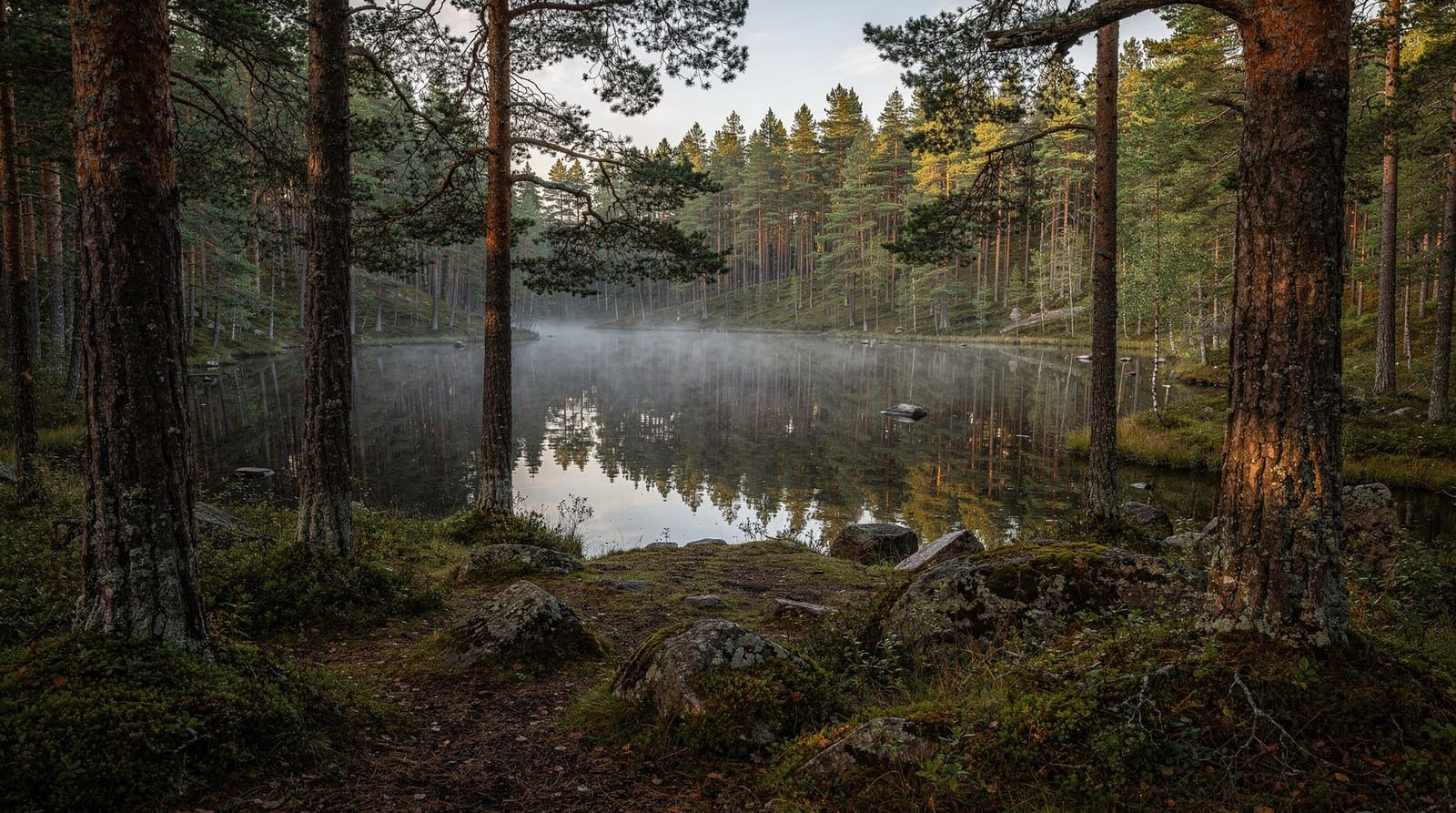
Tyresta National Park begins approximately 20 kilometres south of Stockholm’s centre and represents something rare in European urban geography: a functioning old-growth boreal forest accessible by public transit from a capital city. The park covers about 1,900 hectares and protects a landscape of ancient pines — some well over 300 years old — rocky ridges, lakes, boggy depressions, and the full ecology of a Swedish temperate forest that has never been commercially logged.
The remarkable part of the Tyresta story is the fire. In September 1999, a wildfire swept through the park and burned approximately 450 hectares of forest — a quarter of the total area — in an event that was the largest forest fire in Sweden in modern times. The Swedish authorities made a decision that would be unusual in most countries: rather than clearing the burned area and replanting, they left it entirely to natural regeneration. Twenty-five years later, the burned zone is the most ecologically interesting part of the park — standing dead trees (snags) full of woodpecker holes, fallen trunks thick with mosses and fungi, young birch and pine regenerating in the gaps, and a different quality of light coming through the less dense canopy.
This makes Tyresta more interesting than a simply well-preserved forest. Walking through both the original old-growth areas and the regenerating fire zone gives a direct experience of forest ecology in process.
| Where | ~20 km south of central Stockholm |
| Getting there | Bus 807/835 from Gullmarsplan, ~40 min, SL pass valid |
| Cost | Free entry; Naturum free; guided tours priced separately |
| Time needed | 0.5 day for the short trail; full day for the fire-zone route |
| Best for | Old-growth forest, wildlife, foraging in season |
Getting to Tyresta from Stockholm
Bus 807 from Gullmarsplan metro station runs to Tyresta village (the park’s main entry point) in approximately 40 minutes. The bus is within the SL network and covered by SL transit passes. Frequency is limited on weekdays — check the current schedule in the SL app and note the return times before you go. Missing the last bus means a taxi or a very long walk.
Bus 835 from Haninge Centrum (reached by commuter train from Stockholm) is an alternative route that reaches different parts of the park, useful if you want to approach from the southern side.
There is a car park at Tyresta village for visitors arriving by car, but the bus is the standard approach from the city.
If the SL network is new to you, the SL pass guide explains which ticket suits a day like this, and public transport explained covers how metro, bus and commuter train fit together. Tyresta is also one of the easier entries in the day trips from Stockholm overview, since it needs no booking and no ferry timetable.
What to bring for a Tyresta visit
Footwear: Proper walking shoes or boots, not city trainers — the trails are rocky and uneven, and wet ground is common near the boggy depressions and lake margins.
Layers: Boreal forest temperature swings more than open city streets; bring a layer even on a warm Stockholm day, since the tree cover changes the conditions noticeably.
Water and food: There are no shops inside the park beyond Tyresta village — bring what you need for the day, particularly on the longer routes.
Insect repellent: Relevant from late May through August, especially near the lake and boggy areas, where mosquito activity picks up in the evening.
Binoculars: Genuinely useful given the elk, osprey and woodpecker population — a pair transforms a walk into productive birding without any special skill required.
For a broader checklist that adapts to the season, the what to pack for Stockholm guide is a useful companion; the forest simply asks for sturdier footwear and an extra layer than the city does.
Tyresta village and Naturum
Tyresta village (Tyresta by) is a cluster of well-preserved 19th-century farm buildings at the northern edge of the park — one of the best-preserved examples of a traditional Swedish farm village in the Stockholm region. The buildings are inhabited and maintained rather than being open-air museum pieces, which gives the village a lived quality that the formal museums in the city do not have.
The Naturum visitor centre is the starting point for most visits: a modern building with exhibitions on the park’s ecology, geology, and the 1999 fire, plus maps and trail information. Staff at Naturum can advise on current trail conditions, recent wildlife sightings, and the best routes for different fitness levels. This is genuinely useful — trail conditions in a forest with wet areas and fallen trees vary more than in a groomed park setting.
Hiking trails
Tyresta has a trail network ranging from the easy Tyresta Nature Trail (approximately 2.5 kilometres, 45 minutes, suitable for families with young children) to the full Nackareservat circuit and longer routes that require 6–9 hours. The main trails are:
Tyresta Nature Trail (approximately 2.5 km): A short loop from Naturum through the old-growth pine forest with interpretive signs. Good for a first visit or for visitors with limited time. The old pines on this trail are among the most accessible ancient trees in the Stockholm area.
Nedre Storskogsleden (approximately 5 km, 2–2.5 hours): A moderate trail through mixed forest passing a lake (Stensjön) with swimming access and good picnic rocks. This is the most popular day-hike route and gives a representative experience of both old-growth and regenerating forest.
Övre Storskogsleden and fire zone route (approximately 8 km, 3–4 hours): The longer route includes the fire zone — the most dramatically altered landscape in the park. The standing dead trees (silver-grey snags, 25 years after the fire), the regenerating understorey, and the different light quality make this section visually unlike the rest of the park. Recommended for visitors interested in the ecological story.
Nackareservat connection (full-day routes, 6–9 hours): The park connects with the Nackareservat nature reserve to the north, allowing longer wilderness routes for experienced hikers. These routes require navigation skills and the terrain is more demanding.
Trail comparison at a glance
| Trail | Distance | Time | Best for |
|---|---|---|---|
| Tyresta Nature Trail | ~2.5 km | 45 min | Families, first visit, limited time |
| Nedre Storskogsleden | ~5 km | 2–2.5 hrs | Representative day hike, lake swimming |
| Övre Storskogsleden + fire zone | ~8 km | 3–4 hrs | The 1999 fire’s ecological story |
| Nackareservat connection | Full day | 6–9 hrs | Experienced hikers, wilderness routes |
Most visitors with a single half-day should choose Nedre Storskogsleden — it captures both the old-growth character and a representative slice of the regenerating forest without requiring a full day. The Tyresta day hike guide breaks each route down further with turn-by-turn notes.
Comparing Tyresta to Stockholm’s other nature options
Tyresta is not the only nature escape within reach of the city, and it is worth understanding what distinguishes it before committing a half-day. The hiking near Stockholm guide covers the full range, but the short version: Tyresta offers genuine old-growth forest and the unique fire-ecology story, which no other Stockholm-area hiking destination matches. The archipelago islands (Grinda in particular) offer hiking too, but combined with water access and a completely different landscape character — granite coastline rather than continuous forest. For visitors who have already done an archipelago day and want the forest half of Stockholm’s natural range, Tyresta is the clear next stop.
Wildlife
Tyresta supports a full boreal forest fauna at this scale: elk (moose) are frequently spotted, particularly in early morning and evening. Roe deer are common. The woodpecker population is notable — the old and dead trees provide habitat for black woodpecker (Sweden’s largest), great spotted woodpecker, and the three-toed woodpecker that specifically depends on fire-killed and dead timber. Osprey nests on several of the forest lakes. Badger, fox, and hare are present but secretive.
Birding is productive throughout the warmer months. The combination of old-growth pines (good for nuthatches, treecreepers, and crossbills) with the fire-zone snags (woodpeckers) and open lake margins (osprey, ducks) gives Tyresta an unusual range of habitat types for its relatively small area.
Allemansrätten in Tyresta
Tyresta is the ideal location in the Stockholm region to experience Swedish freedom of movement. Under allemansrätten, you can walk anywhere in the park beyond marked restricted areas, camp for up to two nights on any suitable ground, swim from any lake shore, and pick wild berries and mushrooms freely. The regulations that apply to private land apply here equally — this is allemansrätten in its most straightforward natural setting.
In September the park fills with Stockholmers gathering wild blueberries (blåbär), lingonberries (lingon), and chanterelle mushrooms (kantareller). This is not a tourist activity — it is how Swedish families traditionally use the forest, and Tyresta is close enough to the city to make it a regular weekend habit for many Stockholm residents.
The principles are the same in the archipelago and in the forest, so the allemansrätten guide is worth reading before you go: it explains the “do not disturb, do not destroy” spirit behind the freedom to roam, and what it means for where you walk, swim and rest. A picnic from the forest floor ends naturally with a fika break back in the city, and lingonberries picked in season are exactly what you will meet again alongside Swedish meatballs.
Guided experiences in Tyresta
For visitors who want context with their forest visit, the sunset hike in Tyresta National Park with meal covers the main ecological highlights and includes dinner in the forest — a distinctive experience that uses the long summer evenings productively. The hike takes approximately 4.5 hours.
The Tyresta wildlife tour with dinner and a short hike focuses on the fauna of the park — elk-spotting, bird identification, and the ecology of the old-growth forest — combined with a cooked dinner in the forest setting. This is good for visitors who want wildlife emphasis rather than just trail walking.
Flora and mushroom season
Tyresta’s plant life reflects its status as protected old-growth forest. The upper rocky ridges are dominated by Scots pine growing in shallow soil over granite — old trees, many 150–300 years old, with the twisted forms and orange-bark quality of trees that have grown slowly in difficult conditions. The lower, moister ground has birch, rowan, and aspen; boggy depressions support bog-moss (sphagnum), cotton grass, and specialized wetland plants.
Wild blueberries (blåbär) cover the forest floor extensively and ripen from late July through August. They are smaller than cultivated blueberries and significantly more flavourful — the combination of short growing season and intense Nordic summer light concentrates the sugars. Picking them is entirely legal under allemansrätten and is essentially universal practice in Swedish families. Bring a container; no permit required.
Lingonberries (lingon) ripen from late August through September — the essential Swedish berry, used in the lingonberry jam served with Swedish meatballs and most traditional meat dishes. The flavour is tart and acidic; raw eating is possible but the berries are most useful as picked for jam-making.
Chanterelle mushrooms (kantareller) are the primary foraging target in Tyresta for most Stockholm families. The golden-orange funnel-shaped mushrooms prefer the pine forest floor and appear from June through September after rainfall, peaking in August–September. Chanterelles are difficult to mistake for anything toxic once you know them — their forked gills, orange colour, and fruity smell are distinctive. The forest areas around the fire zone have particularly good chanterelle habitat in the regenerating understorey.
Other edible species include cep (porcini, Karl Johan), trumpet chanterelle (trattkantarell), and several others — but these require more confident identification. The Naturum visitor centre can advise on current conditions and provide identification guidance.
The 1999 fire: what happened and what it changed
The Tyresta fire of September 1999 is worth understanding in more detail than a passing mention, because the ecology of the burned zone in 2026 is directly shaped by decisions made in the immediate aftermath.
The fire began on 16 September 1999 in dry conditions following a warm summer. It burned intensely for approximately 12 hours, covering around 450 hectares — roughly 25% of the national park area — before wind changes and firefighting efforts stopped it. The fire was primarily a crown fire (burning through the tree canopy) rather than a ground fire, which meant it killed the trees but did not destroy the seed bank in the soil.
Swedish authorities, in consultation with ecologists, made the decision not to conduct salvage logging in the burned area. This was unusual — standard European forestry practice after a major fire typically involved removing dead timber for commercial value and replanting. At Tyresta, the decision was to observe what happened in an entirely natural succession.
Twenty-five years later, the results are visible and ecologically significant. The standing dead trees have created what ecologists call a “snag habitat” — silver-grey columns providing nesting holes for black woodpeckers (which need mature dead timber), food sources for bark beetles and their predators, and structural complexity in the forest that old-growth pines alone do not provide. The fallen snags create additional habitat in the deep moss and fungi layer. The regenerating trees — mostly birch in the early decades, now replaced in many areas by returning pine — have created a multi-layered structure absent from the mature adjacent forest.
Walking from the unburned old-growth into the fire zone, the change in character is immediate: more light, more visual complexity, more sound (woodpecker excavation is audible from 50 metres), and a different kind of beauty from the cathedral pine forest nearby.
Combining Tyresta with other Stockholm nature
Tyresta is the best single natural area accessible from Stockholm by public transit, but it works differently from the archipelago — forest rather than water, one continuous landscape rather than multiple islands. Visitors who want the full range of Stockholm’s natural environments should combine a Tyresta forest walk with an archipelago ferry trip on separate days.
For the water half of the picture, the complete archipelago guide and the archipelago in one day plan make a natural counterpart to a forest day, and a September Tyresta walk fits well with the autumn colours guide. If you are building a longer stay around these ideas, the four days with the archipelago itinerary shows how to space them out. The outdoor activities guide covers Tyresta alongside other hiking options within the Stockholm region. The Stockholm summer guide explains how to use the white nights and extended daylight for longer Tyresta hikes that start in the evening.
Frequently asked questions about Tyresta National Park
Is Tyresta National Park free to enter?
Yes — there is no entry fee for the park itself. The Naturum visitor centre is free. Guided tours have their own pricing. A picnic and swimming access cost nothing. The main cost of a Tyresta visit is the bus fare (covered by SL pass) and food.
Can I swim at Tyresta?
Yes — Stensjön lake within the park has good swimming access from the rocky shore, with clear forest lake water that is noticeably different from the Baltic coast. The lake is cold in spring and reaches comfortable swimming temperature in July–August.
Is Tyresta suitable for children?
The Tyresta Nature Trail (2.5 km, flat, interpreted) is well suited to families with young children. Longer trails involve uneven rocky ground that requires reasonable fitness. The wildlife — elk, woodpeckers, deer — provides genuine excitement for children with a nature interest.
What is the 1999 fire zone like today?
Visually striking and ecologically rich. The standing dead trees (snags) have been colonised by woodpeckers, fungi, and invertebrates over 25 years. The regenerating forest around them — birch and pine of various heights — creates a complex, textured landscape. The light through the lower canopy is different from the mature forest. Walking through it is a direct encounter with forest succession that most people rarely see.
When is Tyresta best for mushroom picking?
September is the prime month for chanterelles and other edible fungi after summer rainfall. Blueberries and lingonberries peak in August. Bring your own container; no permit required under allemansrätten.
Can I reach Tyresta without a car?
Yes — bus 807 from Gullmarsplan metro station is the standard route, taking approximately 40 minutes. The bus is covered by the SL pass. Check the return schedule carefully; the service is infrequent on weekdays. A return taxi from Tyresta village to Gullmarsplan costs approximately 300–400 SEK if you miss the bus.
Which trail should I choose if I only have a few hours?
The Tyresta Nature Trail (2.5 km, 45 minutes) if your time is genuinely limited or you have young children. If you have three to four hours and want the fire-zone story as well as the old-growth pines, Nedre Storskogsleden or the longer Övre Storskogsleden route give a fuller picture. Check the current Naturum trail conditions before committing to the longer routes, since wet ground and fallen timber vary more here than in a groomed park.
Top experiences
Bookable activities with verified prices and instant confirmation on GetYourGuide.