Grinda: hiking, swimming, and the middle archipelago
Grinda in 1 day from Stockholm: just over 1 h by ferry, hiking trails through the forest, north and south swim coves, and Grinda Wärdshus for lunch.
Stockholm: full-day archipelago sailing tour
Duration: 8 hours
Quick facts
- Ferry from Strömkajen
- Just over 1 h (Waxholmsbolaget; SL card valid outside summer)
- Days needed
- 1 day
- Season
- May–September (guesthouse opens mid-May)
- Best for
- Hiking, swimming, overnight stays in the middle archipelago
Into the middle archipelago
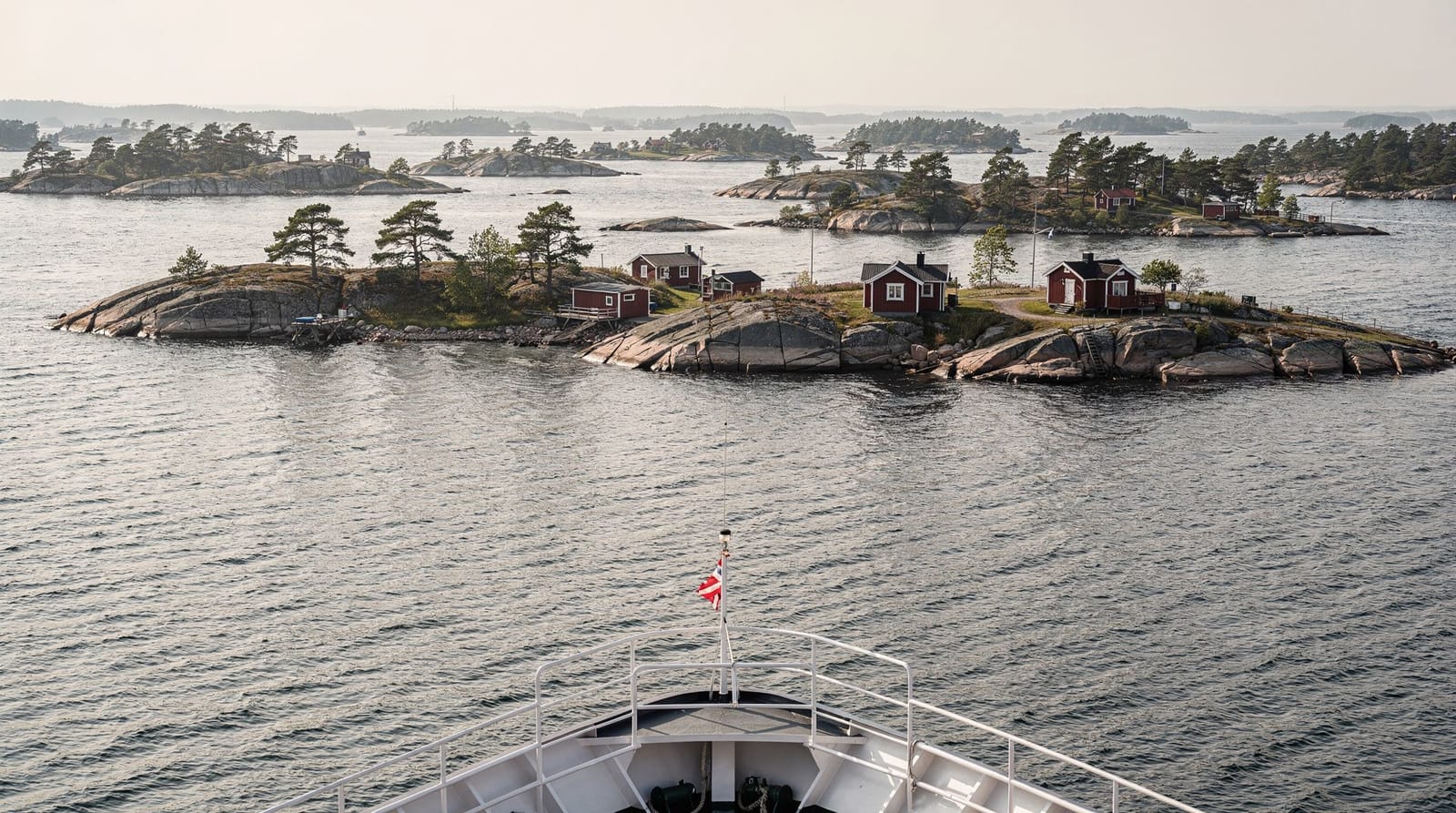
Grinda sits in the middle archipelago — far enough from Stockholm that the city skyline has disappeared, close enough that a full day return trip is realistic without feeling rushed. The ferry from Strömkajen takes around 1 to 1.5 hours with Waxholmsbolaget, and the journey itself is part of the appeal: watching the inner archipelago’s wooded channels give way to progressively flatter, more exposed landscape as the boat winds outward.
The island is medium-sized by archipelago standards — large enough for a proper hiking trail network (roughly 8–10 kilometres of marked paths), small enough that you understand its full geography within a few hours. It has a northern shore and a southern shore with distinct characters, a forested interior of pine and birch, a guesthouse that functions as the social centre of the island in summer, and a kind of concentrated quietness that is very different from both the city and the outer islands.
Grinda is not a tourist experience in the managed sense — there are no attractions beyond the landscape itself. What it offers is the thing the archipelago does better than anywhere else accessible from a major European capital: space, granite, water, forest, and the freedom to move through them under alemansrätten.
Getting to Grinda
Take the Waxholmsbolaget ferry from Strömkajen. An SL period card is valid on Waxholmsbolaget boats to Grinda in autumn, winter and spring (per grinda.se); in summer, check the fare with Waxholmsbolaget. No advance reservation needed: board at the pier and find a seat.
The journey to Grinda takes just over an hour from Stockholm (per grinda.se), with stops at intermediate islands including Vaxholm. Some ferry routes may be slightly faster or slower depending on which vessels serve the route on a given day. Check the current Waxholmsbolaget schedule at sl.se or the SL app before travelling.
If the way these boats work is new to you, the Waxholmsbolaget ferries explained guide covers boarding and routes, and Strömma vs Waxholmsbolaget helps you decide between the public boats and the commercial operators. For how the pass fits into the rest of your trip, see the SL pass guide.
The ferry lands at Södra Grinda (South Grinda) pier, which is the main arrival point for most visitors. Norra Grinda (North Grinda) has a separate pier served by some but not all ferry routes — useful to know if you plan to start hiking from the north end of the island.
Return timing: The last ferry from Grinda to Stockholm in summer typically departs in the late afternoon or evening. Check the exact return times before leaving Stockholm and allow yourself time to walk to the pier before departure. Missing the last ferry means staying the night — which is not necessarily a disaster, but requires a reservation at Grinda Wärdshus.
The hiking trails
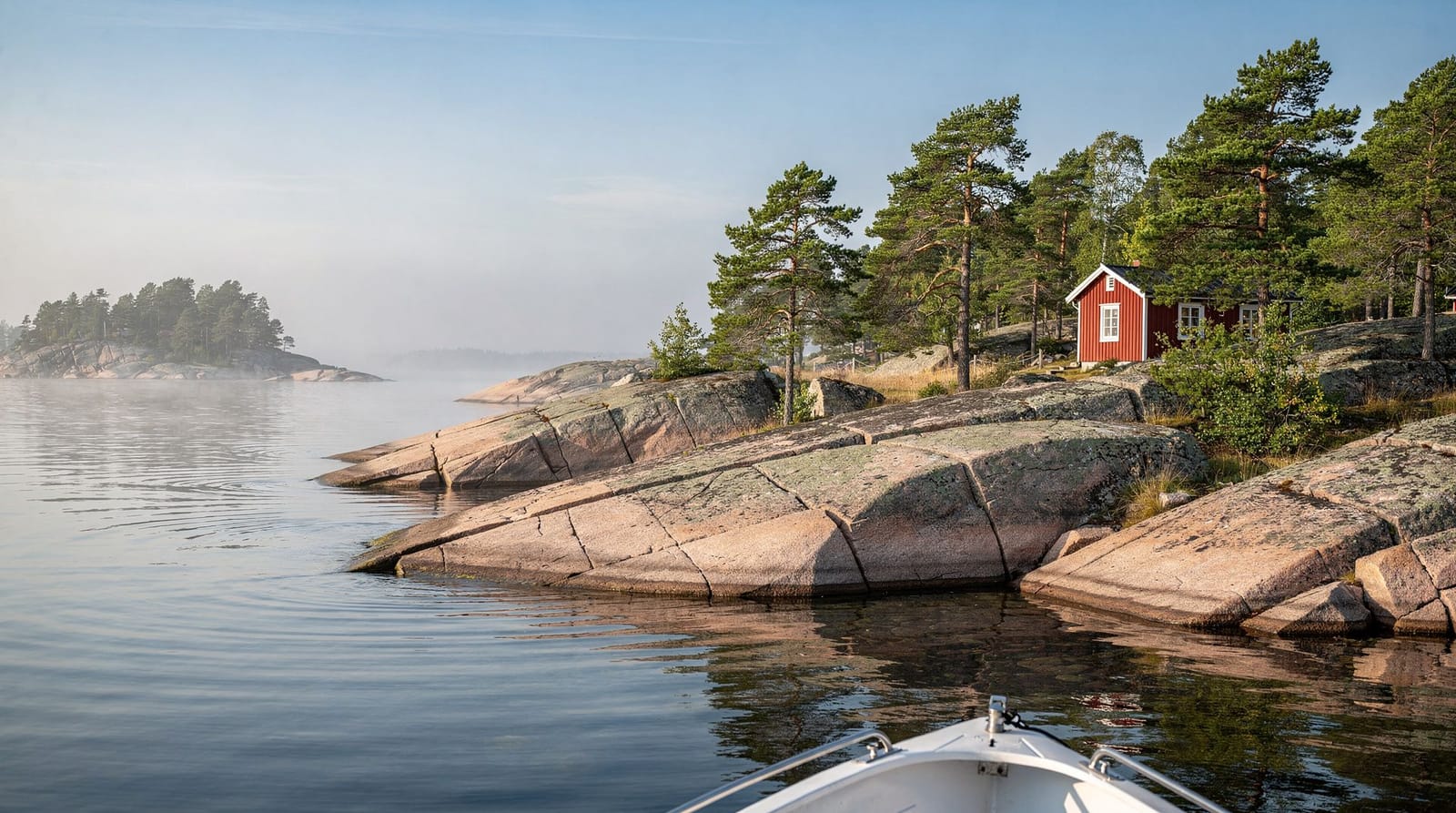
Grinda has a marked trail network that covers the main terrain of the island. The most useful loop is a roughly 6–8 kilometre circuit connecting the south pier, the guesthouse, the forested interior, the northern shore, and back. The path passes through classic inner-to-middle archipelago forest — Scots pine on the higher granite outcrops, birch and aspen in the lower, damper ground, open rocky viewpoints where the Baltic appears in different directions depending on which ridge you are standing on.
The terrain is undemanding — no serious climbing, no scrambling — but the paths are natural rather than paved, and good walking shoes rather than sandals will make the experience more comfortable. The forest floor between the paths is genuine Swedish woodland, not a managed park, and it has the smell and texture and bird noise of the real thing.
North shore: The north side of Grinda has a series of rocky coves and inlets that differ from the south in being more exposed — smaller islands visible offshore, more wind, a more open horizon. These coves are excellent for swimming and for watching the ferry traffic on the Sandhamn route passing in the distance.
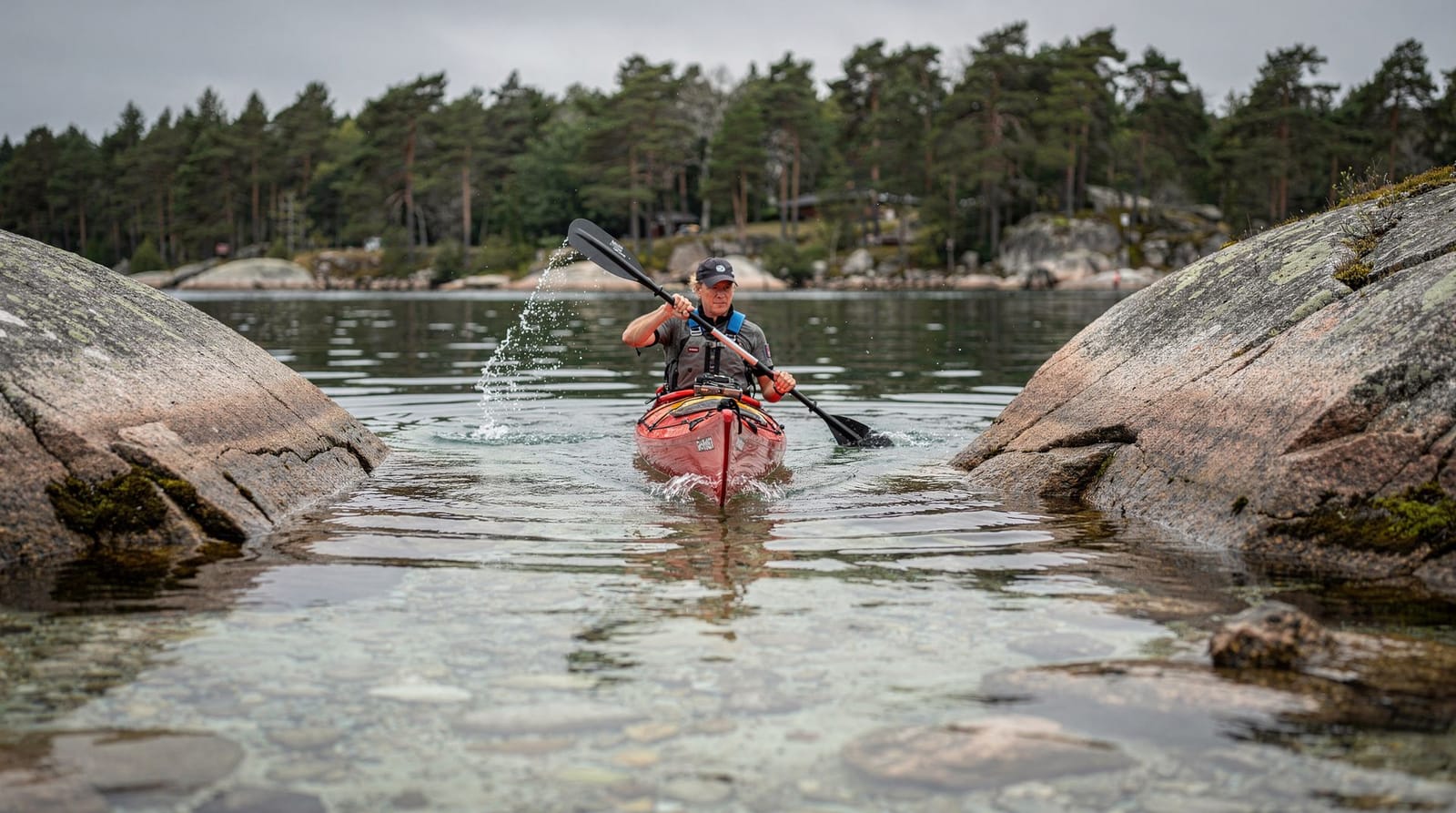
South shore: The south side near the guesthouse is more sheltered, with calm water ideal for kayaking or paddleboarding in addition to swimming. Grinda Wärdshus has rental equipment for guests.
Swimming coves
Swimming at Grinda is more rewarding than at Fjäderholmarna or in the inner archipelago simply because you are further from the city — the water feels cleaner and the surrounding landscape is more dramatic. The granite coves on both shores provide natural platforms at various heights above the water, and the rocks warm in the sun to the point where they function as natural hot beds between swims.
Water temperature at Grinda in July–August typically reaches 18–21°C — warmer in sheltered southern coves, closer to 17–18°C on the exposed northern shore. Under allemansrätten you can swim from any point on the shoreline not immediately adjacent to the guesthouse or private dwellings.
Grinda Wärdshus
The Grinda Wärdshus is the island’s guesthouse and restaurant, open from approximately mid-May through September. It occupies a traditional Swedish wooden building near the south pier and serves as both the social centre of the island in summer and the logistical hub for visitors.
The restaurant serves lunch and dinner to day visitors as well as guesthouse guests. The menu focuses on Swedish seafood — grilled fish, shrimp, herring in season — cooked in the straightforward Swedish style that suits the outdoor setting better than any attempt at elaboration. Lunch on the guesthouse terrace looking over the water is one of the more pleasant meals available within two ferry hours of Stockholm.
Overnight accommodation at Grinda Wärdshus ranges from hotel rooms and traditional Swedish cottages (stugor) to a small glamping area in summer, where furnished tents with proper beds are pitched near the southern shore. Booking overnight accommodation well in advance is essential for weekends in July — demand consistently exceeds supply.
For independent campers, Grinda has designated camping areas where visitors can pitch tents under the standard alemansrätten rules. These are not formal campsite facilities (no electricity or running water) but they are recognised spots where camping is established practice.
If you are weighing a night on Grinda against other islands, the archipelago overnight guide compares the options, and the archipelago summer cottage rental guide is worth a look if you would rather have a place of your own for a longer stay.
Alemansrätten in practice at Grinda
Grinda is an excellent place to understand what Sweden’s freedom-to-roam law actually means in practice. The island has private owners — the Grinda Wärdshus and some associated land — but the vast majority of the island’s granite shores, forest paths, and rocky outcrops are covered by the right to roam. You can walk anywhere outside the immediate vicinity of buildings, swim from any shore, pick berries and mushrooms in season, and camp for up to two nights in designated areas, all without permission.
This is not theoretical. On a summer day at Grinda you will see Swedish families walking paths that cross private farmland, kayakers landing on isolated rocks nowhere near any infrastructure, children picking wild blueberries in the forest — all entirely legal and culturally normal. The concept of not having the right to be somewhere outdoors is, in the Swedish context, somewhat alien.
Sailing and kayak access
Grinda is a natural stop on the archipelago sailing circuit, and the guesthouse has berths for visiting yachts in summer. Private yachts arriving from Stockholm or continuing outward toward Sandhamn regularly stop here for the night.
For visitors without their own boats, a full-day archipelago sailing tour passes through the Grinda area and gives the perspective of the middle archipelago from the water — a genuinely different experience from the ferry view. The 2-day kayaking and camping trip in the archipelago uses the Grinda corridor as part of a multi-island kayak route, combining paddling with overnight stays under the stars on uninhabited skerries.
Anyone curious about the paddling side in more depth can read the kayaking in the Stockholm archipelago guide, and the sailing in the Stockholm archipelago guide explains what a day under sail involves. Both give useful context for how Grinda fits into the wider water routes.
Island ecology and what makes Grinda distinct
Grinda’s specific character within the archipelago is determined by its position in the middle zone — far enough out that the vegetation has already changed from the dense inner-archipelago forest, close enough that the forested interior remains substantial. The island occupies an ecological transition point.
The higher ridge ground on the island carries Scots pine in the thin, slow-growing form typical of granite archipelago soils — these are not the impressive old-growth trees of Tyresta National Park, but they have the characteristic twisted forms of archipelago pines that grow sideways before they grow upward, anchoring themselves in rock crevices. The lower ground between the ridges has birch, rowan, and the wetter vegetation of depressions sheltered from the wind.
The most characterful terrain for hiking is the sequence of granite ridges running north-to-south across the island. From any of these ridges, the view includes open water in at least one direction — the inner archipelago landscape visible to the west, more open Baltic water to the east. On the highest points, the view extends to adjacent islands and, on clear days, to the Stockholm skyline in the west.
Bird life: The middle archipelago has a rich bird population particularly during the migration periods of spring and autumn. Common eider ducks (ejder), the classic island-dwelling sea duck, are reliably present. Oystercatchers (strandskata) nest on the rocks. Osprey (fiskgjuse) is occasionally visible above the lakes and bays. In the forest, the tree pipit (trädpiplärka) and various warblers are present in summer.
Grinda in the Swedish summer tradition
Grinda is not a tourist destination in the way that Sandhamn’s sailing heritage has made it internationally known. It is a Swedish summer destination — one of the hundreds of islands that Stockholm families visit on weekends from May through September as an unremarkable exercise in Swedish summer life.
This means that on a July Saturday the ferry brings a mixture of tourists and Stockholmers in roughly equal proportion, and the experience at Grinda is that of a Swedish outdoor day rather than an international tourism experience. The conversations on the ferry are in Swedish. The families at Grinda Wärdshus are largely regulars. The hikers on the trails know the paths without needing maps.
This character is worth understanding because it explains both what Grinda offers and what it does not. It offers an authentic Swedish outdoor summer day — smörgas, granite, swimming, the evening light. It does not offer international tourist amenities, sophisticated dining choices, or attractions designed for visitors who have never been to the archipelago before. The assumption is that you know what archipelago means; the island simply provides it.
For visitors making their first archipelago visit, Fjäderholmarna (25 minutes, purpose-built for introduction) or Vaxholm (with its town infrastructure) may be more legible starting points. Grinda is at its best for visitors who have an idea of what they want and simply want the island version of it delivered without mediation.
Combining Grinda with Vaxholm
The Waxholmsbolaget ferry from Stockholm to Grinda passes through Vaxholm, making a combined day possible — though tight. One approach is to stop at Vaxholm for 1–2 hours (fortress, town walk, lunch), then take the onward ferry to Grinda for the afternoon before returning to Stockholm on the evening service. This requires checking that the timing works with the specific day’s ferry schedule and accepting that Grinda time will be compressed.
The better approach for most visitors is to treat Grinda and Vaxholm as separate day trips — Vaxholm for the town and fortress, Grinda for the hiking and swimming. See the Vaxholm guide for the separate destination coverage, and the inner vs outer archipelago guide for how Grinda’s middle-zone position compares to islands further out like Sandhamn.
Grinda versus Fjäderholmarna and Sandhamn
| Island | Ferry time | Character | Best for |
|---|---|---|---|
| Fjäderholmarna | ~25 min | Managed, food-focused | Quick introduction, families |
| Grinda | ~1–1.5 h | Hiking trails, guesthouse | Proper walking, swimming, overnight |
| Sandhamn | ~2h30–3h | Sailing village, outer archipelago | Sailing culture, more remote feel |
Grinda sits deliberately in the middle: substantial enough for a real hiking day, close enough that the round trip fits comfortably in a single day. Visitors who find Fjäderholmarna too managed and Sandhamn too far should find Grinda the right balance.
For a wider comparison, the archipelago day trip comparison and Vaxholm vs Sandhamn set the islands side by side, while the complete Stockholm archipelago guide and the Stockholm archipelago destination page give the big picture. If you would like a more detailed walkthrough of the island itself, the Grinda day guide goes further.
What to pack for a Grinda day
Good walking shoes matter more here than on most Stockholm day trips — the trail network is natural terrain, not paved paths. Bring swimwear and a towel regardless of forecast; the granite coves are usable even on cooler days for the committed. A packed lunch is a sensible backup even if you plan to eat at Grinda Wärdshus, since the restaurant can be busy on July weekends. Cash or card for the guesthouse and any camping fees; midges and mosquitoes are present in the forest in June and early July, so repellent is worth packing. A basic printed or downloaded trail map is useful, as mobile signal is inconsistent in parts of the forested interior. The allemansrätten and archipelago guide explains the right-to-roam rules referenced throughout this page in more detail.
Frequently asked questions about Grinda
Is Grinda worth visiting for just one day?
Yes, emphatically. A day at Grinda — ferry out in the morning, hiking trail circuit, lunch at Grinda Wärdshus, afternoon swimming from the rocks, ferry back in the evening — is one of the best day trips available from Stockholm. The 1–1.5 h ferry each way means you have roughly 5–6 hours on the island if you take a mid-morning departure and an early-evening return.
Does the SL pass cover the ferry to Grinda?
Outside summer, yes: an SL period card is valid on Waxholmsbolaget boats to Grinda in autumn, winter and spring. In summer, check the fare with Waxholmsbolaget before travelling.
Can I camp on Grinda independently?
Yes, in designated camping areas under alemansrätten rules. These are not formal campsites — no electricity, no showers — but camping here for up to two nights is legal and established practice. Grinda Wärdshus also has glamping options (furnished tents with beds) for those who want more comfort; these require advance booking.
How far is the hiking trail circuit at Grinda?
A full circuit of the island, including both the northern and southern shores, covers approximately 8–10 kilometres on marked paths. The terrain is varied but not demanding — moderate fitness assumed, good walking shoes required. The circuit takes 3–4 hours at a comfortable pace with swimming stops.
Is Grinda suitable for families with young children?
Yes, but the 1–1.5 h ferry is the main consideration — young children who struggle on boats may find the journey long. The island itself is excellent for families: car-free, safe rocks for supervised swimming, forest paths, and the guesthouse for lunch. Families with toddlers may prefer Fjäderholmarna (25 minutes from Slussen) as a simpler alternative.
What is Grinda like in the shoulder season (May/September)?
May and September are when Grinda is at its most atmospheric and least crowded. The guesthouse is open but lightly visited; the paths are yours alone; the light is extraordinary in both months. The main limitation is water temperature — the Baltic needs June–July to warm up, so May swimming is for the committed, and September water (still warm from summer) is often better than expected.
Top experiences
Bookable activities with verified prices and instant confirmation on GetYourGuide.