Taxi scams in Stockholm: how to get the fare you actually expect
Stockholm: Arlanda Airport private transfer
How do I avoid taxi overcharging in Stockholm?
Use Bolt or Uber (app-based, price shown before booking), or book with a regulated operator — Taxi Stockholm (yellow signs), Cabonline (Sverigetaxi), or Kurir. At Arlanda, take the commuter train (183 SEK) or pre-book a private transfer. If you must take a metered taxi, check the price sticker on the rear passenger window before entering — it shows the estimated fare for a standard 10-km city trip. Never accept a lift from an unmarked vehicle.
Sweden deregulated taxis in 1990
Sweden’s taxi market was deregulated in 1990, abolishing the government-controlled price zones that had applied since the 1920s. The intention was to increase competition and reduce prices through market forces.
| Where the risk is highest | Arlanda Airport arrivals hall |
| Safe cost, Arlanda→city | 500–700 SEK (regulated taxi/Uber/Bolt) |
| Cheapest option | Commuter train, 183 SEK (SL + Arlanda ticket) |
| How to check | Rear-window price sticker before boarding |
| Never do | Accept an unmarked vehicle or a verbal offer inside arrivals |
The outcome in tourist and airport contexts was more complex. While the bulk of Stockholm taxi travel (local residents hailing cabs or using apps) became more efficient and competitive, the Arlanda Airport arrival market and central tourist areas developed a two-tier structure: regulated operators with transparent pricing and professional fleets, and opportunistic operators who maximise revenue from passengers who do not know the expected fare.
The worst overcharging incidents — passengers paying 2,000–3,000 SEK for an Arlanda-to-city trip that should cost 500–700 SEK — are well-documented in Swedish press coverage. The deregulated market has not self-corrected at airports because the information asymmetry is most acute there: exhausted passengers arriving at an unfamiliar airport, no local knowledge, vehicles queuing immediately at arrivals.
The Arlanda arrival strategy
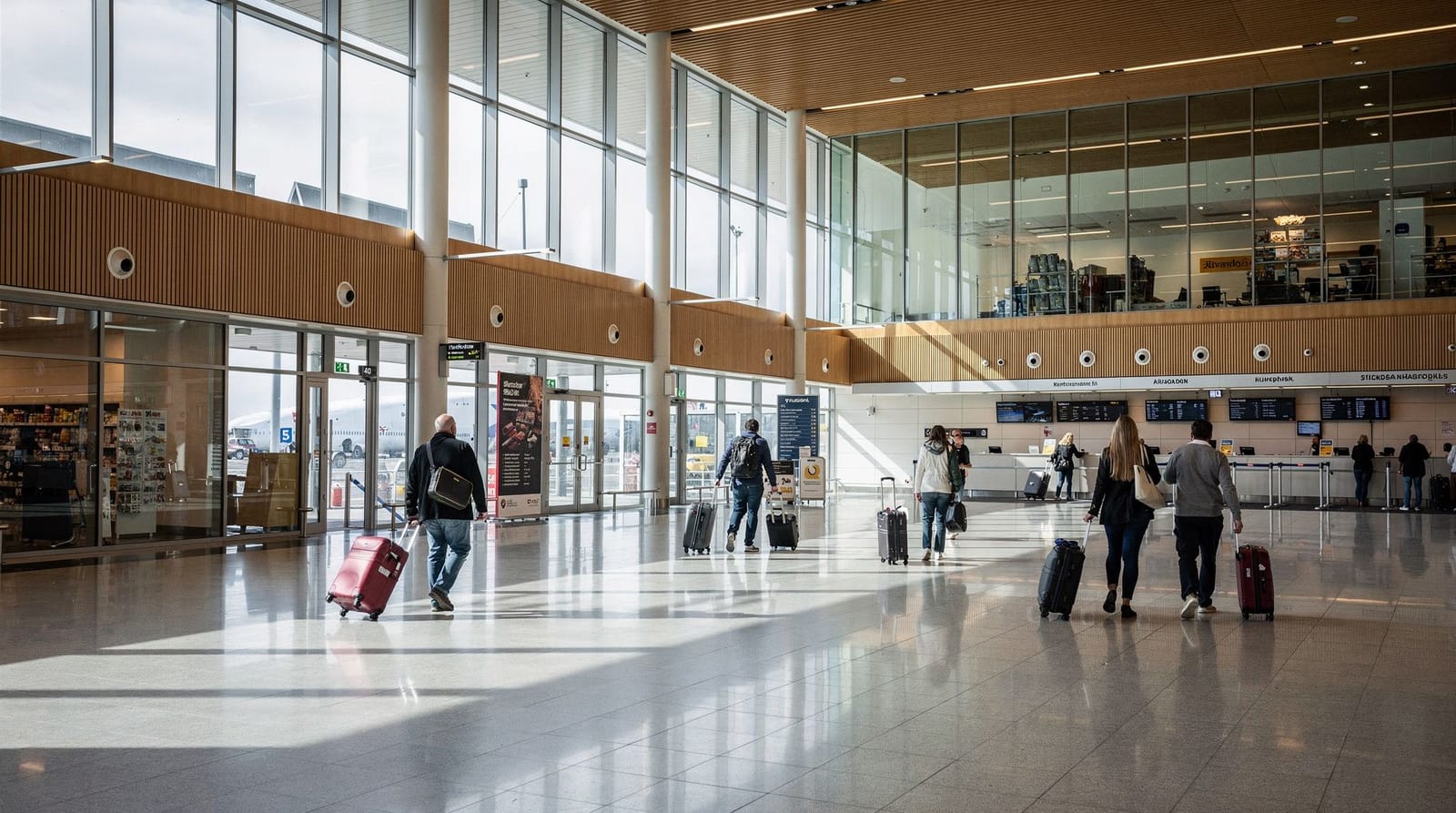
Arlanda Airport is 45 km north of central Stockholm. Your options, in order of cost:
Commuter train (Pendeltåg) — 183 SEK for the single SL + Arlanda ticket: Takes 38–45 minutes to Stockholm Central station (T-Centralen). Requires a transfer at Märsta station. The cheapest rail option. Buy an SL card and load it with credit at the airport — it also covers all Stockholm public transit for the rest of your trip.
Arlanda Express — 340 SEK one-way: The premium train runs in 18 minutes non-stop to Stockholm Central. Fast and comfortable; the price premium over the commuter train is 157 SEK for 20 minutes. Worth it if you are connecting to another train immediately, or if late-night service timing works better than the commuter train schedule.
Pre-booked private transfer — approximately 500–700 SEK: A licensed private transfer booked before arrival (through GetYourGuide, Welcome Pickups, or the regulated operators’ websites) offers door-to-door service at a known price. Recommended if you have heavy luggage or are arriving late at night.
Book a licensed private transfer from Arlanda AirportRegulated metered taxi — approximately 500–700 SEK: Taxi Stockholm (yellow roof signs), Cabonline (Sverigetaxi), and Kurir all operate regulated metered services from Arlanda. They are required to display their tariff. Expect 500–700 SEK to central Stockholm with these operators.
Never take: an unmarked vehicle or any driver who approaches you inside the arrivals hall. These vehicles are not regulated, prices are not set, and this is the precise context where the worst overcharging occurs.
Book an Arlanda Airport train transferUsing taxis within Stockholm city
Within the city, the regulated taxi market functions reasonably well. The key operators are:
Taxi Stockholm (phone 150150, yellow roof signs): The largest regulated operator in Stockholm. Metered pricing; all vehicles display the required price sticker. Available via their own app as well as hailing.
Bolt: App-based, shows price before booking. Often the cheapest option for short to medium city trips. Drivers are licensed.
Uber: App-based, shows price before booking. Operates legally in Stockholm. Uber Black and Uber Comfort are both licensed services.
Cabonline (Sverigetaxi): The second-largest regulated operator. App-based and phone-bookable. Professional fleet.
For evening and weekend travel from Södermalm, Östermalm, or Djurgården back to central areas, Bolt and Uber are generally more convenient than hailing a metered cab. The price difference within the city on short trips (10–20 km) between operators is moderate — typically 80–200 SEK — but the gap between any app-based or regulated service and an unlicensed one can be 400–1,500 SEK.
The price sticker rule: your pre-boarding check
Swedish law requires every metered taxi to display a price sticker on the rear passenger window (the right rear window when facing the vehicle). The sticker shows the estimated cost of a standardised test journey of approximately 10 km in Stockholm.
Use it: before opening the door, look at this sticker. A regulated, competitively priced taxi will show approximately 280–450 SEK for the 10-km test. An expensive but technically legal operator might show 450–600 SEK. A sticker showing 700+ SEK is a signal that this is a high-tariff operator — still regulated, but at the expensive end. No sticker means no regulatory compliance, and you should not get in.
This 10-second check at the taxi rank saves you the need for a lengthy price negotiation or post-trip complaint.
How this fits your wider arrival planning
The taxi question is really one part of a bigger decision about how you get from Arlanda into the city. See the Arlanda airport to city options guide for the full comparison across train, bus, and taxi, and the Stockholm airport arrival guide for what to expect at the terminal itself, including where the official taxi ranks and ride-share pickup points are located relative to arrivals.
Overcharging is not the only tourist-pricing trap in Stockholm — it belongs to a wider pattern covered in the Stockholm tourist traps guide, which is worth reading alongside this one if you want the fuller picture of where visitors typically overpay.
A fixed-fare ride from Arlanda to town
Most overcharging stories start at the airport, where you step off a flight tired and take the first car that waves you over. If a taxi is your choice for the run from Arlanda into the city, the simplest protection is to settle the fare before you land rather than negotiate at the kerb.
Decide who is meeting you and where, and keep the confirmation with your hotel address on your phone. Check that the total is stated in advance, that luggage and waiting time are included, and that the driver’s details are shared before pick-up. That way there is no meter to question at arrivals. If you prefer a pre-agreed price to a rank, you can arrange an airport transfer with Kiwitaxi ahead of your trip.
A calm routine for your first ten minutes at the airport
Most overcharging stories start with tiredness, not stupidity. After a long flight, the easiest thing in the world is to say yes to the first friendly person who offers help with your bag. The fix is to decide before you land, so there is nothing left to decide in the arrivals hall.
Before you leave home, pick your route into town and write it in your notes. If it is the train, you already know where to go and what to buy. If it is a private transfer, the booking confirmation is in your phone. If it is a taxi or ride-share, the app is installed, logged in and linked to a card. Our Stockholm airport arrival guide walks through the terminal layout so the signs make sense when you reach them.
Once you have your luggage, walk to the signed taxi rank or the ride-share pickup point, not toward whoever is calling out. A real operator does not need to approach you. Keep your phone ready, confirm the plate and the driver’s name in the app, and only then load the bags. If you are travelling with a partner or friends, one person can watch the luggage while the other checks the vehicle.
If a driver does approach you, a polite “no, thank you” and a steady walk is enough. You owe no explanation and no negotiation. The people working this angle count on a short, awkward conversation to pull you in, so the shorter you make it, the better. For a full comparison of every way into the city, see the Arlanda airport to city options guide, and for the two trains side by side, the Arlanda Express versus commuter train comparison.
Late arrivals and heavy luggage
The one situation where a taxi genuinely earns its place is a late landing with a lot of bags, or with children who are already asleep on their feet. That is exactly when a pre-arranged transfer is worth its price: the driver is waiting, the fare is agreed, and nobody has to improvise. The same logic applies to the return trip. Book your ride to the airport the evening before rather than relying on finding a cab at an early hour.
If you do choose a metered taxi in the city, make sure the meter is running from the start and that it is visible to you. Ask for a receipt at the end; a legitimate driver will print one without fuss. Take a photo of the licence information displayed inside the car if anything feels off, since that makes any later complaint far easier to process.
For travellers with limited mobility, the accessibility guide for Stockholm covers which options work best, and if you only need somewhere to leave your bags for a few hours before a late flight, the luggage storage guide can spare you a taxi altogether.
Taxi or Uber: choosing between them
Neither is automatically better. An app shows the price up front, which removes the haggling and the doubt, while a regulated metered cab gives you the safety net of the displayed tariff and a visible meter. We compare the two in more depth in taxi versus Uber in Stockholm, including when each one makes sense. Apps can raise their fares in busy periods, so look at the quoted price before you confirm rather than after.
Payment is the other half of the story. Sweden is almost entirely cashless, so expect to pay by card or through the app, and do not count on handing over notes. Our guide to Swish and card payments for tourists explains what visitors can and cannot use, and the blog take on payment reality shows how it plays out on an ordinary day.
What to do if you think you were overcharged
Stay calm and keep the evidence. Ask for the receipt, note the vehicle’s plate and the operator’s name, and take a photo of the meter and the displayed tariff if you can do so discreetly. Do not pay under pressure in a dark street if you feel unsafe; your safety matters more than the fare. Once you are settled, write down the time, pickup point and destination while the details are fresh.
Then contact the taxi company directly with those details, and if you paid by card, raise the matter with your card provider too. Regulated operators have a reputation to protect and a complaints process, which is another reason the sticker and the receipt matter. The shorter the delay before you complain, the better your chances of a useful answer.
Smarter ways to move around once you are in town
Taxis are rarely the best answer for sightseeing. The areas visitors care about are close together and well served by public transport, and some of the nicest stretches are best done on foot. A self-guided walking route through Stockholm or a stroll around Gamla Stan costs nothing, and the Djurgården walking route links several major sights without a single car ride.
If you are weighing up your passes for the whole trip, the SL pass versus Stockholm Pass comparison helps you decide whether a transport pass or an attractions pass suits your plans. For a broader look at spending, the Stockholm budget per day guide shows where money tends to go and where taxis fit, and our honest account of the Arlanda Express is worth a read if you are still undecided about that route.
Prices to expect for common trips
These are approximate figures for regulated operators with Bolt/Uber as reference:
| Trip | Estimated cost |
|---|---|
| Arlanda Airport → T-Centralen | 500–700 SEK (taxi); 183 SEK (commuter train) |
| Stockholm Central → Gamla Stan | 100–150 SEK |
| T-Centralen → Djurgården (Vasa Museum) | 120–180 SEK |
| T-Centralen → Södermalm (Mariatorget) | 100–150 SEK |
| T-Centralen → Skansen | 150–200 SEK |
| Gamla Stan → Arlanda Airport | 500–700 SEK |
These are reference points, not guarantees. Peak hour, rain, and weekend surcharges affect prices. The comparison is: all of the above city trips cost approximately one single T-bana trip (40 SEK) on the SL metro. If you have an SL 24h or 72h pass, the public transit option is almost always cheaper.
Stockholm public transit as the default
The honest recommendation for most tourists in Stockholm is: use the T-bana (metro), SL buses, and the SL archipelago ferries for 90 per cent of your travel, and take taxis only for the specific situations — late night when T-bana has stopped, heavy luggage, or point-to-point trips that do not align with transit routes.
Stockholm’s transit network is excellent. The T-bana covers all major tourist areas. A 24-hour SL pass (approximately 180 SEK) covers all buses, metro, and inner-zone archipelago ferries for a full day — the equivalent of two or three taxi short trips.
See the Stockholm public transport guide for full details on the SL network and pass options, and the SL pass guide for which pass length makes sense for your trip.
Frequently asked questions about taxis in Stockholm
What should a taxi from Arlanda to central Stockholm cost?
With a regulated operator, approximately 500–700 SEK. The commuter train (Pendeltåg) covers the same journey for 183 SEK with the single SL + Arlanda ticket.
What is the Arlanda Express and is it worth it?
The Arlanda Express runs in 18 minutes for 340 SEK. The commuter train takes 38–45 minutes for 183 SEK. The 157 SEK price difference buys 20 minutes — worth it for some, not most.
How do I recognise a regulated taxi in Stockholm?
Yellow roof sign, visible taxi meter, and a price sticker on the rear passenger window showing the estimated cost of a 10-km test trip.
Is Uber legal in Stockholm?
Yes. Uber operates under Swedish taxi licence regulations. Bolt and Sverigetaxi are the main alternatives.
What is the price sticker rule?
Swedish law requires all metered taxis to display a rear window sticker showing the cost of a standardised 10-km test route. Check it before getting in. Approximately 280–450 SEK is the normal range; 700+ SEK is expensive; no sticker means unlicensed.
Top experiences
Bookable activities with verified prices and instant confirmation on GetYourGuide.