Stockholm archipelago guided boat tour review: 2-hour island cruise
Stockholm: archipelago guided boat tour
Duration: 2 hours
The Stockholm archipelago is the reason many visitors extend their trip, and this 2-hour guided boat is the lowest-commitment way to see it without booking a full day out. This review covers what the inner-to-middle archipelago route actually shows you, how the slower guided pace compares to the RIB speedboat, and when it’s worth upgrading to a full-day island trip instead.
| Where | Inner-to-middle Stockholm archipelago |
| Cost | See the booking page; Strömma’s own archipelago tour with a guide starts from 375 SEK (autumn 2026) |
| Time needed | 2 hours, return cruise, no landings |
| Getting there | Departs central waterfront (Strömkajen/Strandvägen/Nybrokajen) |
| Best time | Late May–June for wildlife, evening slots in July for light |
Quick verdict
Top 3 reasons to book the guided archipelago boat tour:
- The 2-hour format gives you a genuine sense of the archipelago’s scale and character without requiring a full day or a commitment to a specific island.
- Slow-boat cruising means you can actually observe the landscape — birds, seals, the transition from urban waterfront to open island chains — rather than experiencing it as a blur.
- The guide’s commentary transforms the visual experience: understanding why the islands are shaped as they are (glacial geology), what the red-painted cottages mean (Falun paint tradition) and how the Allemansrätten access right works.
One reason to skip it:
- If speed and excitement are what you’re after, the RIB speedboat covers more territory more dramatically in the same 2 hours. The guided boat is a deliberate, contemplative experience — not an adrenaline one.
What’s included
- 2-hour guided boat tour departing central Stockholm
- Live guide commentary in English
- Narrated passage through inner and middle archipelago island chains
- Wildlife spotting (birds, seals depending on season)
- Return to central Stockholm departure point
What’s excluded
- Island landings (this is a return cruise without disembarkation)
- Food and beverages (varies by vessel — check operator listing)
- Ferry tickets to outer archipelago destinations
- Entry to any island sites
Pricing and duration
| Option | Price (approx.) | Duration |
|---|---|---|
| Guided boat tour (2h) | Price on the booking page | 2 hours |
| RIB speedboat (2h) | Price on the booking page | 2 hours |
| Historic ship + fika (2h) | Price on the booking page | 2 hours |
| Archipelago sightseeing cruise | Strömma archipelago tour with guide from 375 SEK; others on their booking pages | 1.5–3 hours |
The guided boat tour and the historic ship fika tour occupy the same price range — the choice between them comes down to whether you want a fika experience or a wildlife-oriented commentary.
Where and when it runs
Departure point: Central Stockholm waterfront — typically Strömkajen, Strandvägen or Nybrokajen. Confirm the specific departure point in your booking.
Season: Year-round with most frequent departures May–September. May and September offer the best combination of value, lower crowds and reasonable conditions.
Frequency: Multiple daily departures during peak season. Shoulder season (April, October) may have 1–2 departures per day.
Languages: English is standard for most departures. Swedish tours also available.
What you’ll actually see
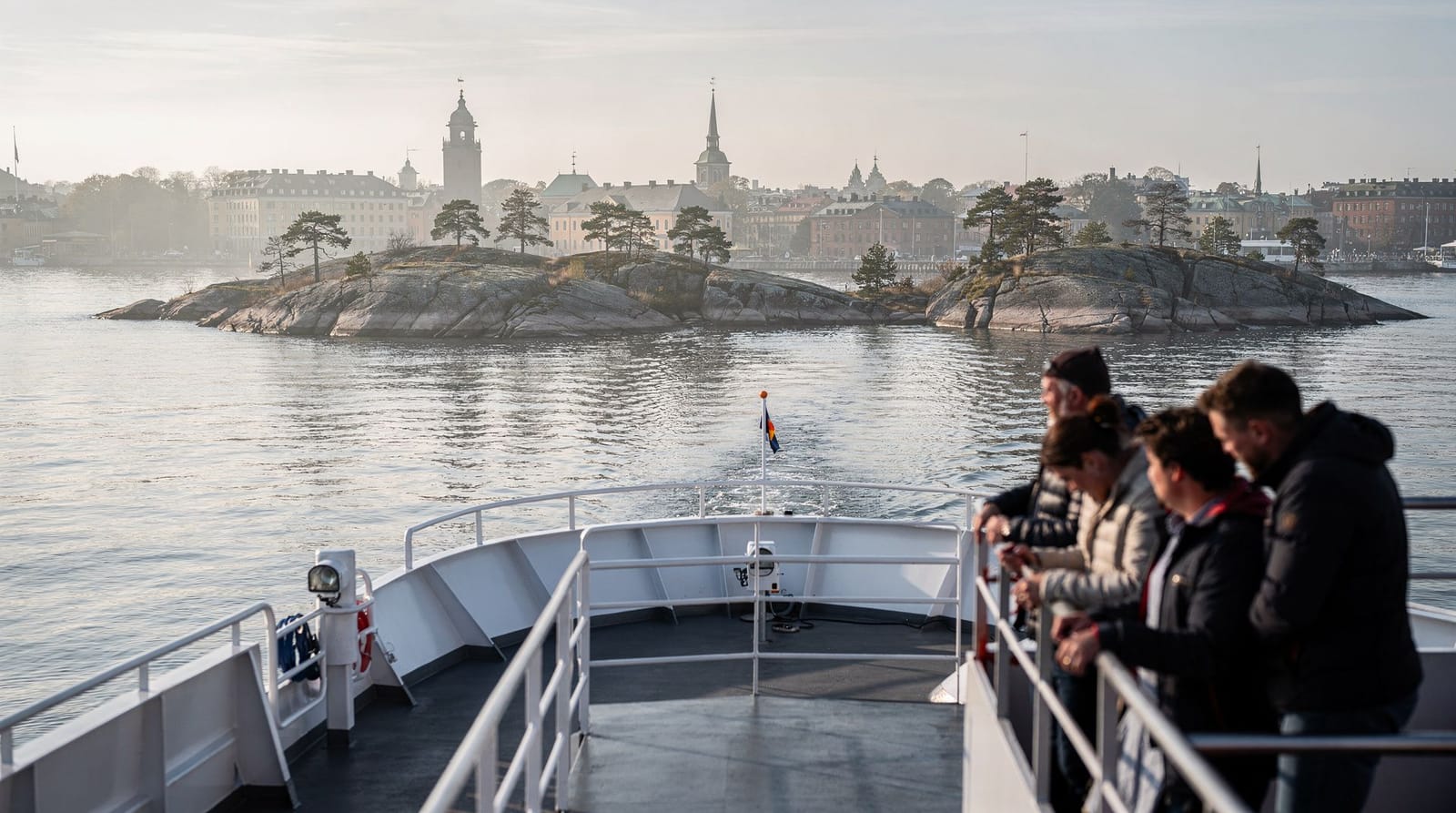
Departure (0–20 minutes): The first section passes Stockholm’s inner waterfront — Djurgården to the south, Östermalm to the north — familiar city views from a new angle. The guide uses this section to explain Stockholm’s island geography before the city gives way to the archipelago.
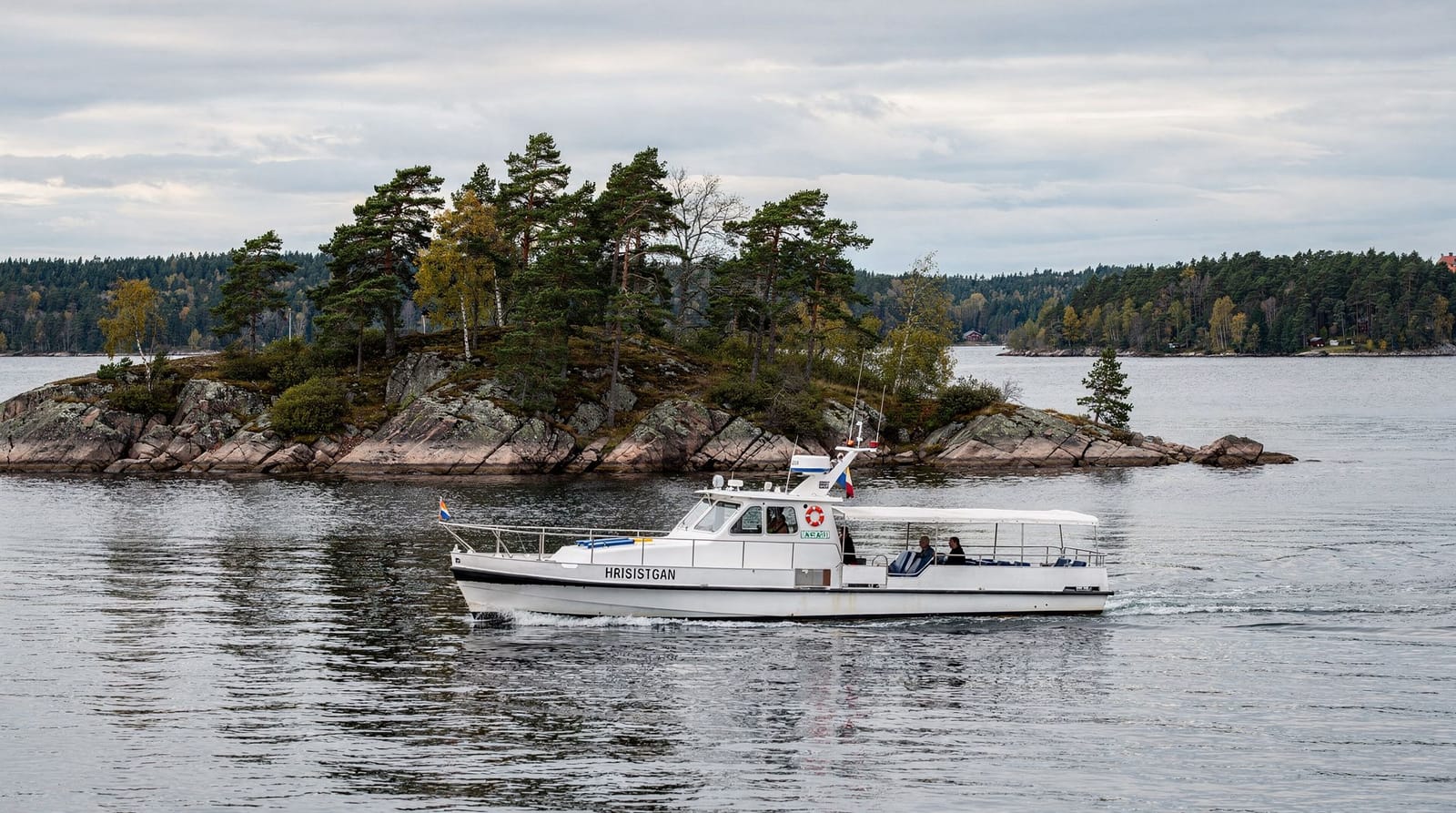
Inner islands (20–50 minutes): The transition from built-up inner islands (marinas, summer cottages, wooded hillsides) to more natural terrain. The guide explains the colour of traditional cottages (Falun red), the ecology of the rocky islands and the public access laws that allow anyone to land and camp on uninhabited islands.
Middle archipelago (50–90 minutes): The section where the city becomes invisible — granite rock sheets with minimal tree cover, isolated cottages, possible seal sightings. The guide covers the human history of the outer islands: fishing families, lighthouse keepers and summer visitors.
Return (90–120 minutes): The return passage, often taking a different channel, gives a second view of the inner island chain and the Stockholm skyline appearing again on the horizon.
Sample itinerary
14:00 Arrive at departure point 10 minutes before scheduled departure.
14:10 Depart. Guide begins with Stockholm’s island geography — how 14 islands create the city’s characteristic waterfront.
14:25 Clear of the inner harbour into the first archipelago zone. Guide describes the geological formation of the islands (post-glacial land rise, granitic composition, scrubby pine vegetation).
14:45 Slower passage through a narrow channel — guide identifies bird species visible on the rocks (seasonally dependent).
15:00 Middle archipelago — open water, islands more sparse. Guide mentions the Allemansrätten (public right of access) and explains how island cottage owners’ rights interact with it.
15:20 Possible seal haul-out site — guide checks and describes. Sometimes seals are visible; sometimes not. Honest guides say so.
15:40 Begin return passage. Different channel — new views of the inner island zone.
16:00 Stockholm skyline reappears. Guide covers the return journey with additional observations about the waterfront.
16:10 Arrive back at departure point.
Pros
- Comfortable, relaxed experience — no physical demands, covered seating available.
- Good for wildlife observation — the slow speed allows you to actually see what the guide is pointing at.
- Suitable for a wide range of visitors including those with mobility limitations.
- The guide’s ecological and historical commentary adds genuine depth to what would otherwise be a pleasant but passive boat ride.
- Good for afternoon use — the 14:00 departure slot is well-suited to a morning spent on Djurgården or in Gamla Stan.
Cons
- You don’t land anywhere. The archipelago is best understood from inside it — on foot, on a granite rock, at a cottage jetty. This tour gives you the visual overview but not the immersive experience.
- 2 hours covers the inner-to-middle zone; the iconic outer archipelago (Sandhamn, Grinda, the outer island culture) requires a full-day commitment.
- Wildlife sightings are weather and season-dependent — seals are not guaranteed.
- The slower pace and conventional boat format means the experience is easy to do but not particularly memorable compared to a RIB speedboat or a full day on an island.
Tips from us
Book a late-afternoon slot in June or July for the best light. The Stockholm archipelago in the 17:00–19:00 window, with the low evening sun across the water, is the visual payoff. The July 19:00 departure is one of the most rewarding options available.
Ask the guide about seal haul-out sites on departure. The guide will know whether seals have been visible in the past few days at the usual locations — it sets expectations accurately.
Bring binoculars if you have them. The guide will identify bird species but binoculars transform the wildlife observation sections from “I think I can see something” to actually seeing it.
Combine with a longer archipelago commitment. This tour is an excellent introduction; if you want more, a full-day trip to Vaxholm or Fjäderholmarna gives you what the 2-hour circuit can’t — the experience of being on an island rather than looking at one.
Seasonality at a glance
Wildlife sightings, light quality and crowd levels shift enough across the season that timing genuinely changes the experience:
| Season | Conditions | Wildlife | Crowds |
|---|---|---|---|
| Late May–June | Long daylight, mild, fair weather typical | Migrating birds, oystercatchers, terns | Moderate |
| July (peak) | Warm, reliable weather | Occasional seal sightings | High, boats often full |
| September | Cooler, dramatic evening light | Raptors, autumn bird activity | Low |
| Oct–April | Exposed, Baltic conditions | Long-tailed and sea ducks (limited departures) | Very low |
For visitors chasing wildlife specifically over comfort, late May and June is the strongest window; for lower prices and fewer boats, September is the honest trade-off. July remains the safest bet for guaranteed departures and predictable weather, even if it means sharing the boat with a fuller passenger list.
When to upgrade to a full-day archipelago trip
The 2-hour circuit is explicitly an overview — it doesn’t land anywhere, and it doesn’t reach the outer archipelago where islands like Sandhamn and Grinda sit. If the 2-hour tour leaves you wanting more, the Stockholm archipelago complete guide and the archipelago in one day guide both cover how to structure a full-day trip that actually gets you onto an island rather than just past one. For a slower, multi-day version, the archipelago overnight guide is worth reading before you commit a full day of your trip to it.
Kayakers with more time and better fitness should also look at the kayaking Stockholm archipelago guide, which reaches parts of the inner archipelago that no boat tour, guided or RIB, actually accesses. None of this makes the 2-hour tour a lesser product — it’s simply a different one, aimed at visitors who want the archipelago’s visual character without committing a full day, rather than at those chasing an island landing or an active kayaking route.
Best for / Skip if
Best for: Visitors who want a relaxed overview of the archipelago, nature observers, those with mobility limitations who can’t do the RIB speedboat, visitors with 2 hours available rather than a full day.
Skip if: You want speed and physicality (choose the RIB), or you want to actually land on an island and experience the archipelago at ground level (choose a Vaxholm or Fjäderholmarna day trip instead).
Cancellation policy
Free cancellation up to 24 hours before departure. Operator-cancelled tours (weather) are fully refunded.
Book the guided archipelago boat tour — free cancellationHow the options compare
| Guided boat (2h) | RIB speedboat (2h) | Historic ship + fika (2h) | Sightseeing cruise | |
|---|---|---|---|---|
| Price | See booking page | See booking page | See booking page | From 375 SEK (Strömma) |
| Duration | 2 hours | 2 hours | 2 hours | 1.5–3 hours |
| Pace | Slow | Fast | Slow | Slow–medium |
| Wildlife focus | Yes | Limited | Limited | Limited |
| Physical demand | Low | High | Low | Low |
| Best for | Relaxed sightseeing | Active visitors | Fika experience | Overview |
For the full archipelago picture and how to plan a day trip to outer islands, see the Stockholm archipelago complete guide and the archipelago in one day guide.
Frequently asked questions about the Stockholm archipelago guided boat tour
What does the tour cover?
Inner and middle archipelago — island chains east of Stockholm city, covering the transition from built-up inner islands to sparser middle archipelago terrain. Return cruise, no island landings.
How does it differ from the RIB speedboat?
Slower, larger, more comfortable. Better for relaxed sightseeing and wildlife observation. The RIB is faster and more physically demanding — different products for different visitor preferences.
What wildlife can I expect?
Depends on season. May–June: migrating seabirds, possibly nesting terns. July–August: occasional seal sightings. September: raptors and autumn bird activity. Not guaranteed — wildlife varies by day.
Is it accessible for mobility limitations?
Considerably more accessible than the RIB speedboat. Contact the operator in advance to confirm boarding arrangements.
What time of year is best?
Late May and June for long days and wildlife activity. September for fewer tourists and dramatic light. Winter tours exist but are challenging conditions.
Does the tour reach the outer archipelago?
No — the 2-hour format reaches the middle archipelago zone. Sandhamn and Grinda require half-day to full-day ferry trips.
Is food available on board?
Varies by vessel. Check the operator listing before booking.
What is the cancellation policy?
Free cancellation up to 24 hours before departure. Operator-cancelled tours (weather) are fully refunded.
Book now — free cancellation up to 24 hours